
Mistake Recovery
How to rescue overcooked vegetables
Turn sound soft carrots into a coarse soup, choose other uses for cooked vegetables, and know when texture rescue is not a safety rescue.
Before you begin
- Boil and steam vegetables without guessingComplete its 200 g prepared-carrot practice; do not deliberately overcook it.
- How to use hob heat without guessingSet gentle heat and prepare a supported landing place.
- Measuring accurately without stressUse scales and marked 15 ml tablespoons and 5 ml teaspoons.
Choose a new use for a softer texture
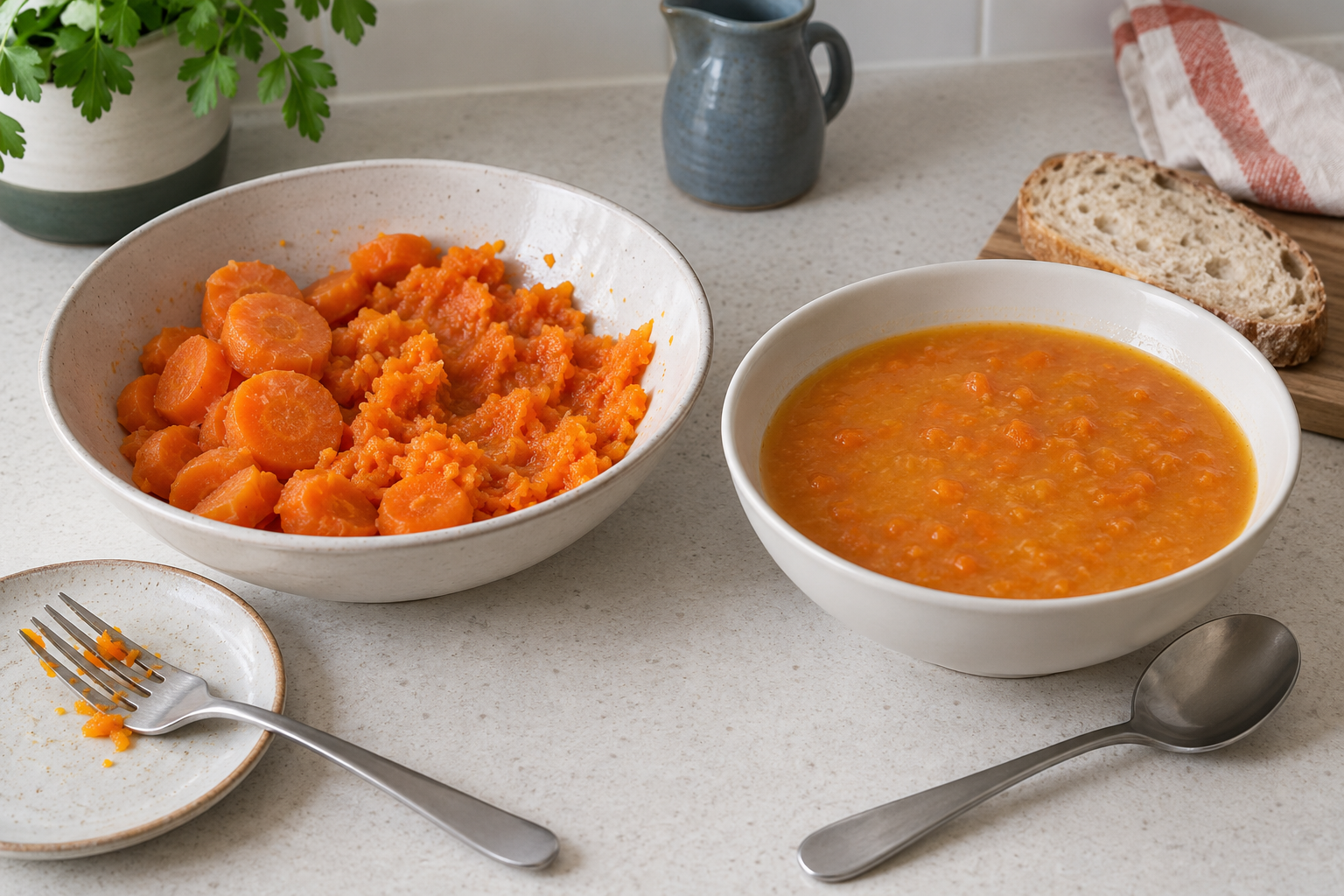
Once cooked vegetables are much softer than wanted, extra cooking cannot make them crisp again. Change their job instead: a coarse mash, soup, vegetable sauce or small filling can suit that softness. There is no need to create a mistake; practise with the normal tender carrots from the linked boiling lesson.
First separate softness from an unsafe history. Use vegetables whose original preparation, cooking and storage you know. Mould, an unsuitable use-by date, badly missed cooling, unknown time out of the fridge or uncertain storage are not repaired by soup, extra boiling or seasoning. Do not taste suspect food to prove it is safe.
The first method below uses freshly cooked carrots in the same cooking session. For chilled leftovers, weigh the portion while cold and use the separate storage checks below. A burnt flavour has its own stop decision, not a reason to blend dark residue into dinner.
Match the rescue to the vegetable
- Cook cauliflower spinach cabbage and kaleLearn the full cauliflower preparation and boil before a mash use.
- Boil roast and mash prepared butternut squashCook fresh peeled cubes fully before choosing a soft-texture use.
- Roast peppers courgettes and tomatoesPrepare and cook peppers or tomatoes by their own complete method, not the carrot timer.
- Cook cauliflower spinach cabbage and kalePrepare and cook the actual leaf type before its small freshly cooked filling.
- Drain food and save cooking water safelyChoose the supported draining or slotted-spoon method.
- Knife confidence: the safe claw gripPrepare a stable clean board and make controlled cuts.
- Omelettes: set, fill and fold without panicLearn its plain egg method before the later two-tablespoon cooked filling.
- Already cooked soft carrots, cauliflower or squash can become a coarse mash or a soup. Complete that ingredient's own preparation and cooking route first; softness by itself does not establish cooking or storage history. The squash route starts with fresh peeled cubes and does not ask you to tackle a hard whole squash. Frozen packets retain their full cooking instructions.
- Freshly roasted peppers or tomatoes can be mashed into a coarse topping with ready-to-eat bread, using their own complete preparation, temperature and centre checks in the soft-vegetable lesson. Its supported tomato bowl method explains pressing and serving; for a pepper version follow the same bowl and clean-sample handling with fully tender panels, accepting that skin pieces remain. Leave scorched tray residue and bitter burned pieces separate. The carrot roasting timer is not a pepper or tomato recipe.
- Freshly cooked spinach, rib-free cabbage or kale can be drained and chopped for a later small omelette filling during one continuous preparation. Complete the greens lesson's actual leaf preparation, boiling, draining and chopping route, then use no more than 2 measured tablespoons in place of cheese in the full omelette's later filling. Learn its plain set-egg method first and check the folded centre. This is not a raw-leaf filling or a chilled leftover portion warmed briefly in eggs; cooled leftovers need their full single reheating route.
- Drain watery vegetables before deciding how much liquid to add. If a cooled sample still has tough skin or stringy stems, set those parts aside with a fork rather than pressing harder or touching hot food. A mash or blender will not reliably make hard fibres pleasant.
Make a small vegetable soup rescue
- Boil and steam vegetables without guessingCook the prepared carrots fully and lift them safely.
- Drain food and save cooking water safelyUse tools and vessels that support the food.
- Stir, whisk, fold and turn: four different movementsMove through the centre and across the base.
- Storage and reheating basicsKeep the original cooking time and earliest ingredient deadline.
- Before cooking the carrots, set out a wide heatproof bowl holding at least 750 ml on a non-slip support, fork or hand masher, heat-safe spoon, clean saucepan holding at least 1 litre, 15 ml tablespoon, measuring jug, small ladle, serving bowl, clean tasting spoons, two small sample bowls and a clean ladle rest. Have dry gloves and separate trivets ready. Measure 150 ml drinking water for the soup and a separate 60 ml water reserve; leave stock and seasoning out for this first attempt. Have ready-to-eat bread beside the serving place.
- Complete the linked boiling method with 200 g prepared carrot half-rounds. Drain or lift with the slotted spoon as that lesson teaches, then put the whole drained batch into the standing heatproof bowl. Its cooked weight need not be exactly 200 g. Keep hands clear of the hot pieces and steam; leave the cooking water to cool safely.
- With the bowl supported and no heat underneath, hold its outside by a safe cool area or use a dry glove if hot. Press down slowly with the fork or masher, working in small areas. Keep the tool low and pause if the bowl rocks or slides. The soft carrots should break into a coarse mash; small soft particles are fine. Do not add liquid yet or pound forcefully to imitate a blender.
- Use the spoon to transfer the mash low into the separate cold saucepan, leaving both vessels supported. Add the measured 150 ml water and stir. Put the pan on a matching ring, handle turned safely in, and start medium-low. Stir across the whole base about every minute while it heats, lowering to low if it spits or catches. Stay beside it.
- If too thick to flow from the spoon, switch off, let bubbling settle and stir in 15 ml from the separate reserve. Return to gentle heat and reassess; repeat only as needed, up to the prepared 60 ml. It need not be smooth. If the base catches before the middle is hot, lower the heat and stir through; do not increase the heat to rush it.
- Finish when the whole stirred soup, not just the edge, is steaming hot and the remaining carrot particles are soft. Switch off and support the pan on its trivet. Transfer a little into the sample bowl, let it cool to comfortable eating warmth and taste with a separate clean spoon. Do not put a used tasting spoon back into the pan. Leave plain if you like it; later small flavour adjustments are below.
- Stand the serving bowl beside the pan and ladle low in small amounts rather than holding a bowl while tipping a hot saucepan. Put the ladle down on a clean rest, let your first mouthful cool and eat with the bread. Cool any untouched portion promptly from the original vegetable cooking time, not from whenever the soup becomes ready.
Add contrast or change the texture later
- Fresh herbs: storing them and using them upWash, dry and chop the small parsley portion.
- Dry frying, toasting and blooming spicesComplete its safe whole-seed preparation and cooked use.
- Stock cubes, stock pots and strengthDilute a concentrate according to its actual pack.
- Blend food without splashes or unsafe shortcutsFollow appliance identification, cold filling, operation, emptying and cleaning.
- Storage and reheating basicsKeep the original cooking time and earliest ingredient deadline.
Bread is the first contrast. For a later herb version, prepare 1 measured teaspoon washed chopped parsley by the herb lesson before cooking begins, keep it clean and cool, and scatter it over the served soup. Check labels and suitability for everyone eating. A topping changes flavour and bite, not the firmness of the original vegetable.
For toasted cumin, first learn the spice lesson's separate full dry-toasting, cooling, crushing and cooked-sauce practice. Toasting alone is not an instruction to eat an arbitrary spice uncooked. For a later fresh carrot soup, measure 1/4 teaspoon of those cooled whole or crushed seeds into the cold mash-and-water pan. Once gentle bubbling is established, cook and stir for a full 10 to 15 minutes, or longer if the spice pack requires, adjusting water as above. Taste only after that cooking, and expect whole seeds to remain noticeable. Leave this extra task out of the first soup.
For stock instead of the first 150 ml water, complete the stock-strength lesson, check salt and allergens, and measure 150 ml ready-strength stock while cold. A stock cube is not automatically unsalted, and a concentrate is not ready-strength liquid. Finish any longer preparation required by its label. The separate 60 ml thinning reserve can remain plain water.
For a smoother later soup, use the complete cold-first blending lesson and the cooling routine before taking out the appliance. Do not leave a hot pan waiting for hours, blend hot soup in a sealed cup, or assume a silent motor or absent steam proves safe temperature. Chilling and blending do not reset the food's history; after cold blending, heat the portion thoroughly once and serve now. If the vegetables have already been reheated, choose the non-blending finish now rather than another cooling and reheating cycle.
When flavour or storage is also a problem
- Seasoning food without guessingCompare a small finished sample before changing the whole pan.
- Butter, oil and finishing fatPractise a measured fat finish without a hot-oil shortcut.
- Burnt flavour rescue: when to save it and when to stopKeep scorched residue separate and know when to stop.
- Storage and reheating basicsThaw fully in the fridge before using a frozen cooked portion.
Before a later flavour trial, set out a small dish of fine salt OR a suitable ready-to-use bottle of food lemon juice with a clean teaspoon for dropping a little from the bottle into the sample; check its label. For a small flavour trial, transfer 1 tablespoon of fully finished soup to a clean sample bowl and cool it. If dull, try two or three fine grains of salt OR a few drops of food lemon juice from a suitable ready-to-use bottle, not both at once. Mix with a clean spoon and taste with a different clean spoon; compare a plain sample. If useful, make the same type of small addition to the pan, stir and take a new cooled sample. Stop if no longer improving. Do not return a tasted sample to the shared pan.
Butter or oil is another separate preference, not a remedy that has to be added. Use the linked fat-finishing lesson's measured vegetable or sauce practice before adapting it. A strong scorched bitterness is unlikely to disappear; use the burnt-flavour lesson's small trial and discard decision instead of piling in salt, spice and fat.
For chilled vegetables, use about 200 g cooked drained carrot weighed while cold, still within its original 48-hour limit or a shorter label limit, and not already reheated. Follow the same mash and soup steps, then heat the entire stirred portion to steaming hot throughout. This is their one reheating. Serve it now and do not save it for another hot meal. For frozen leftovers, complete the fridge-defrosting lesson first and respect the 24-hour fully-thawed limit. Unsafe or unknown history means discard, not a longer simmer.
Use the lesson for the next cook
- Boil and steam vegetables without guessingCheck actual thickness and tenderness rather than memorising one time.
Cut pieces to a similar thickness and begin checking at the original lesson's reminder. Lift a thick piece onto the testing plate with a spoon and test its centre with a fork; let any tasting sample cool first. Colour alone does not tell you how much resistance remains.
Once the batch has the tenderness you want, switch off and use the prepared draining or serving route promptly. Retained heat keeps softening food while you do another job. Make a note of the piece size and point you liked; do not deliberately overcook the next batch to practise rescue.