
Knife And Prep / Start here
Knife confidence: the safe claw grip
A calm beginner guide to holding food safely, controlling a knife, and cutting slowly without fear or rushing.
How to use this guide as a complete beginner
Before cutting, make the board stable, dry your hands, clear wrappers and bowls away from the knife area, and create a flat side on round food where possible. A calm setup is part of the technique, not a separate chore.
Look for food that stays still, fingers tucked back, and pieces that are close enough in size to cook evenly. You should feel in control of the knife. If you feel rushed, the pieces are too small or the food is moving too much.
Practise slowly on one ingredient. Stop between cuts if you need to reset your hand position. Speed is not the beginner goal; repeatable, safe movement is.
Go slowly enough to notice
Speed hides information. The first few attempts are for seeing the change, hearing the sound, naming the texture and learning what happens when you adjust.
Use the image as a checkpoint
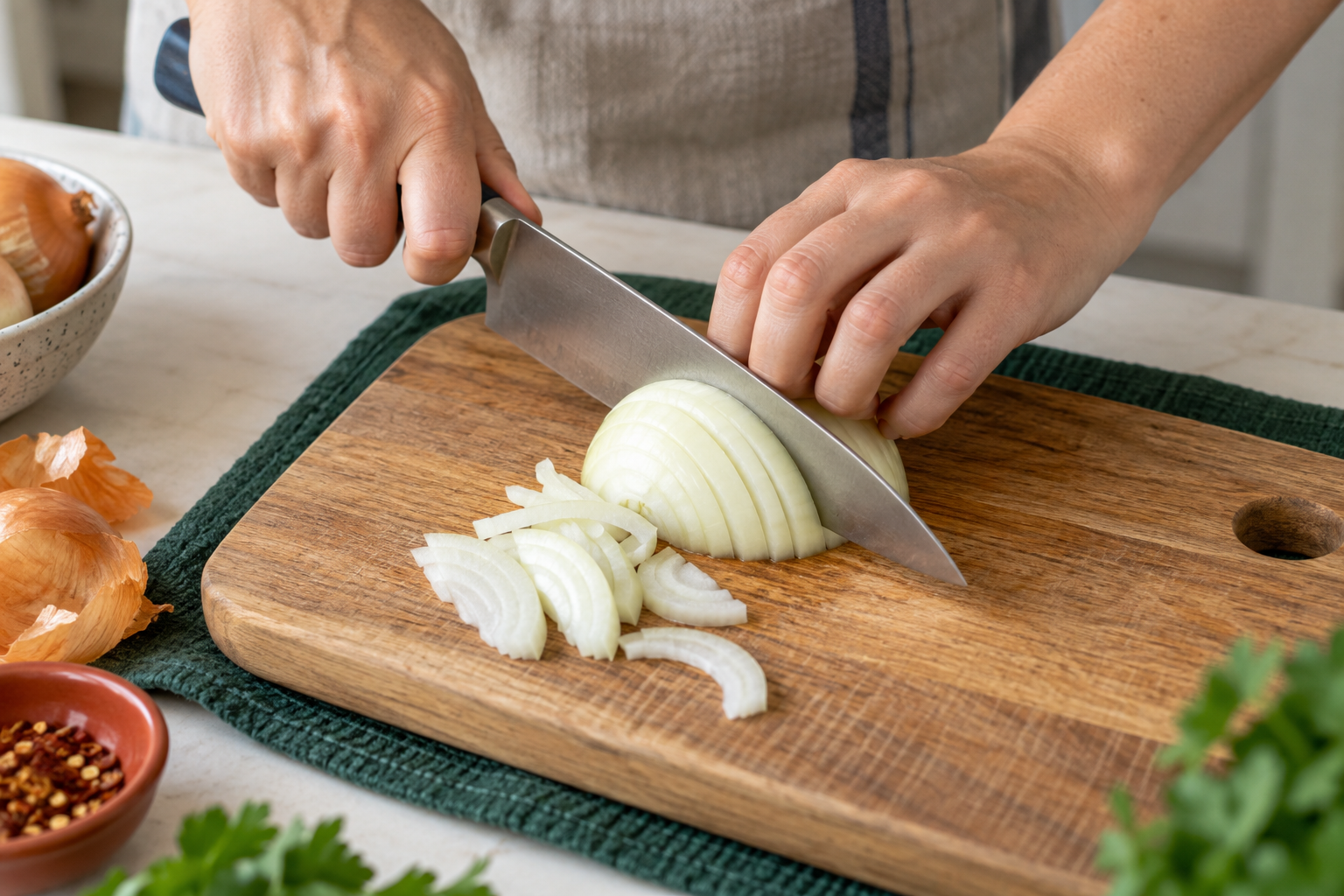
The linked KINALO image is not decoration. Compare it with your pan, board, bowl or tool so you know what stage you are looking for.
Good enough counts
Beginner cooking improves through repeatable attempts. If the food is usable and you learned the cue, the guide has done its job.
First-attempt checklist
Read the whole guide once before starting, then choose the smallest useful version of the task. Put the tools and ingredients where you can reach them. Decide what you will watch for first, such as colour, sound, texture, thickness, smell or how easily food moves.
During the attempt, change only one thing at a time. If the heat feels wrong, fix the heat before adding more ingredients. If the texture feels wrong, name the texture before trying to correct the flavour. This keeps the lesson clear.
Afterwards, write down one sentence: what worked, what changed too quickly, or what you would do earlier next time. That note matters more than a perfect result because it turns one cooking attempt into the next useful attempt.
If you only remember one thing, remember the cue rather than the instruction. Recipes tell you what to do; cooking confidence comes from recognising what is happening. Once you can name the cue, you can slow down, adjust and recover with less guesswork next time.
The point of the claw grip
The claw grip keeps fingertips away from the knife edge. It also gives the knife a guide, so cutting feels less random. You are not trying to look fast. You are trying to make the food stable and your hands predictable.
Most beginner knife stress comes from food sliding, fingers reaching forward, or the knife being treated like a chopping machine. Slow, controlled cutting is real cooking.
Set up before you cut
- Put a damp cloth or folded kitchen towel under the chopping board if it moves.
- Create a flat side on round food before trying to cut smaller pieces.
- Keep the knife handle dry.
- Clear space around the board so your hand does not bump into packaging, bowls or handles.
How to place your guide hand
Curl the fingertips of your guide hand slightly under, like you are holding a small ball. The flat front of your knuckles faces the side of the knife. The knife can touch the knuckles lightly, but the blade edge stays in front of your fingertips.
Move the food slowly. If the grip feels awkward, make larger pieces. Tiny pieces are not the first goal.
Beginner mistakes to avoid
- Do not hold food with fingertips stretched forward.
- Do not chase speed. Speed comes after comfort.
- Do not cut round food while it can roll.
- Do not use a blunt knife and force it down hard. More force means less control.
Practice task
Practise on a soft vegetable such as cucumber or courgette. Cut thick slices first. When that feels calm, try thinner slices. The win is not perfect slices. The win is keeping the board stable, fingers tucked and movement controlled.