
Vegetables And Pulses
Cook red lentils and make a simple soup
Sort, rinse and simmer red split lentils, learn their tender endpoint and turn a small batch into soup without needing a blender.
Before you begin
- How to use hob heat without guessingControl boiling and gentle simmering.
- Measuring accurately without stressWeigh dry lentils and measure liquid.
- Read food labels before you cookCheck the lentil packet and optional flavourings.
Start with red split lentils
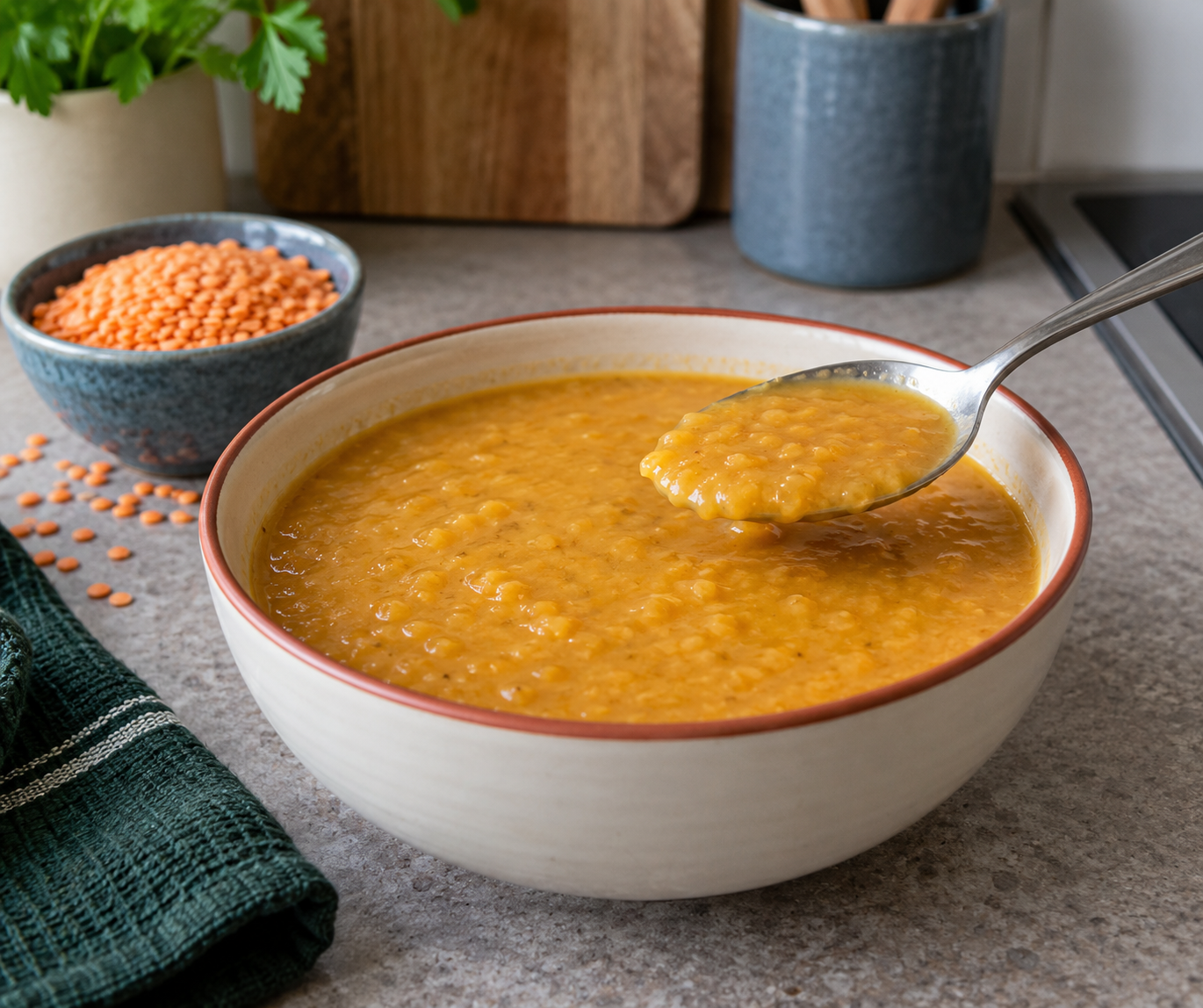
Red split lentils are small orange halves of a pulse. They soften and partly break down, so a spoon and saucepan can make a thick soup without a blender. Whole green or brown lentils behave differently; dried beans, especially kidney beans, need a different method. This is not a way to prepare those foods.
Read your red split lentil packet before weighing anything. Follow required soaking and heating stages, including any initial boiling period. For example, the checked Tesco packet starts 100 g in 500 ml water, with 10 minutes boiling then 15 minutes simmering for a side-dish preparation. Our soup retains liquid and cooks until very soft; it is not that packet's drained side dish. Do not shorten a required heating stage because a lentil looks soft.
This small practice uses water first so you can recognise the texture. It makes roughly two small soup portions, not two guaranteed complete main meals. Ready-to-eat bread can accompany it. A later onion or tomato variation is optional and has its own complete lesson.
Gather the ingredients and tools
- 100 g dry red split lentils, 500 ml cold drinking water and another 250 ml cold water measured separately for small top-ups. Keep more drinking water available if cooking takes longer. If your packet requires a different starting quantity or cooking treatment, use it rather than forcing this ratio.
- Optional at the end: 1 measured teaspoon olive or rapeseed oil, 1/4 teaspoon bottled lemon juice and a small pinch of fine salt. Add one at a time after a cooled taste. No stock cube, hot kettle water or butter is needed for this first practice.
- Scales, sorting plate, securely supported fine sieve small enough to retain lentils, measuring jug, 15 ml tablespoon and 5 ml teaspoon, saucepan around 1.5 to 2 litres, heat-safe spoon, timer, clean testing saucer and two clean testing/tasting spoons, ladle, serving bowls, dry oven gloves and trivet. Set out clean shallow heat-compatible containers, lids and labels if saving soup. If the packet requires post-cooking draining and rinsing, also prepare a heat-safe fine sieve securely supported across a heatproof receiving vessel of at least 2 litres, a second trivet, 250 ml cold rinse water and 300 ml fresh cold soup water.
- Optional only for a scorched-base rescue: a second clean pan and its own spare trivet, prepared before heating. Without those, switch off and start again rather than improvising a hot transfer.
Sort and rinse
- Wash hands and clean the work area. Spread the measured lentils on the sorting plate, look through them and remove stones or other foreign material. Do not eat them dry.
- Place the fine sieve on a secure support over the clean sink. Rinse lentils under cold running water, gently moving them with clean fingers or a spoon until surface dust washes away. Do not lose the halves through a coarse colander. Keep the sieve and food out of contact with the sink base.
- Tip the rinsed lentils into the cold saucepan and add the first 500 ml water, or the packet's starting amount. Keep the spare 250 ml separate. Leave generous space above the liquid for froth. Set the timer and spoon ready before switching on.
Cook until the centre is soft
- Simmer versus boilRecognise the required boil and later gentle simmer.
- Drain food and save cooking water safelyRead why a fine sieve needs its own secure support and a large receiving vessel.
- Storage and reheating basicsFollow the supported cooling, labelling and once-only reheating routine.
- Put the pan on a matching ring, handle away from the edge. Bring to a boil while watching, with the lid off. Set a timer for any packet-required boiling period once that boil begins. Control the heat to maintain that required boil without froth climbing the rim; do not turn it down to a gentle simmer before the required stage finishes. If froth threatens to spill, switch off briefly, let it fall, then resume the required heating safely. Pause the boiling timer while the boil is stopped so it counts the actual boiling period. Do not leave the pan.
- After any initial boiling stage, lower to gentle simmering. Stir across the base and edges every minute or two, more often as it thickens. Complete the packet's simmering time; many red split lentils take about 25 to 30 minutes total heating, but use your packet and texture rather than a universal timer.
- If the soup thickens before lentils are soft, stir in 2 measured tablespoons (30 ml) spare cold water and return to a simmer. Repeat small additions as needed, keeping lentils in liquid and the base from drying. Do not pour in a whole jug at once.
- After the required heating, put a little on the clean saucer with a clean spoon. Let it cool. Press a lentil with a second spoon: it should squash easily with no chalky or firm middle. Taste a cooled sample only now. If gritty or firm, return to simmering for another 3 to 5 minutes with enough liquid, then test again using clean utensils.
- For soup, stir the soft lentils so some break down naturally. Add water 2 tablespoons at a time if too thick, bringing the whole soup back to steaming hot after additions. No blending is required.
- If your packet requires post-cooking draining and rinsing, first switch off and park the pan on its trivet. Place the prepared heat-safe fine sieve securely across the at-least-2-litre heatproof receiving vessel on its second trivet. Ladle small amounts into the sieve while both pan and receiver remain supported; do not hold the sieve by hand or pour a heavy hot pan into it. Let liquid drain without pressing the soft lentils through. Rinse gently with the prepared 250 ml cold water, letting it collect below, then spoon retained lentils back into the emptied pan with gloves for hot handles. Add the prepared 300 ml fresh cold water, return to medium-low and stir until steaming hot throughout. Adjust thickness with the small additions above. Leave the receiving liquid safely to cool before discarding. If you cannot arrange this secure support, choose a packet with a soup method that retains its liquid rather than improvising a hot drain.
- Switch off. Put the pan securely on the trivet using dry gloves for a hot handle. Taste a cooled clean sample, then stir in one optional measured flavouring and compare with another clean cooled taste. Ladle into stable bowls on the counter and allow a spoonful to cool before eating. Start the cooling reminder now for any saved portion.
Solve the texture before changing the flavour
Firm lentils need more cooking and sufficient liquid, not more seasoning. Use the small water additions and three-to-five-minute retests above. If already tender but too thin, simmer uncovered for 2 to 3 minutes, stirring across the base every minute, then reassess. Repeat briefly if needed; do not turn the heat high or leave it to evaporate unattended.
If the base catches, switch off. Do not scrape burnt material through the soup. If the optional second pan is ready, park both pans securely on trivets and ladle only unburnt upper soup into the clean pan, avoiding the scorched layer. Cool a small sample before tasting; discard a bitter or smoky batch. Never taste food to decide whether an unsafe storage history is acceptable. If there is smoke or a dangerously hot pan, leave it in place and let it cool; a rescue is not worth carrying it.
Build on the practice and store the rest
- Make a simple tomato sauce from passataPrepare the optional smooth tomato addition from measured ingredients.
- How to soften onions without burning themLearn the separate onion base before adding that task.
- Storage and reheating basicsFollow the supported cooling, labelling and once-only reheating routine.
- Storage and reheating basicsFollow the saucepan inventory, stirring and hot-centre checks.
For a later tomato version, prepare the small passata sauce separately and stir 2 tablespoons (30 ml) into this soup only after the lentils are soft. Warm through, then compare a cooled taste before adding salt or lemon. If using previously cooked sauce, retain its earlier storage and reheating history; it does not become new food when added to soup. A softened onion base is another later variation; use that complete method instead of assuming raw onion is already cooked.
Divide saved soup into shallow portions and follow the cooling lesson. Use ordinary refrigerated leftovers within 48 hours or freeze promptly, following any shorter ingredient limit. Soup can thicken when chilled. For reheating, add 1 tablespoon water if needed, stir across the base and check several parts are steaming hot throughout. Reheat only once. Do not reheat the whole batch to take out just one serving.