
Fish And Plant Proteins
Prepare and pan-fry firm tofu
Choose firm rather than silken tofu, drain and cut it, then practise turning small pieces until the surfaces are golden.
Before you begin
- How to use hob heat without guessingControl the ring before working with oil.
- Knife confidence: the safe claw gripCut a stable block into similar-sized pieces.
- Read food labels before you cookCheck soya and other ingredients, cooking requirements and storage.
- Measuring accurately without stressUse the scales, jug or marked spoons before heating, rather than guessing the starting amount.
The type of tofu changes the method
Tofu is made from soya and contains the soya allergen. Firm and extra-firm blocks can hold their shape in a pan. Silken tofu is much softer and can break apart; it is useful in other dishes, but is not an equal swap for this turning exercise.
For this first attempt use one 200 g extra-firm block whose actual pack says ready to eat and no pressing required, such as the Cauldron example linked below. Those words describe two separate things: permission to eat without cooking and preparation without a press. This lesson pan-fries it for texture and a hot meal. A different product requiring cooking or pressing must follow its own complete directions, not borrow these timings. Check all ingredients and possible traces on your own pack; soya is not the only possible allergen.
Get ready before the pan heats
- 200 g extra-firm tofu, 1 tablespoon suitable cooking oil and optional 1 teaspoon soy sauce mixed with 1 tablespoon water for finishing. Check the soy sauce too: many contain wheat. Plain tofu is a valid first practice.
- A stable board, sharp knife, disposable kitchen paper, non-stick frying pan around 24 cm, compatible broad turner or tongs, marked measuring spoons, optional sauce cup, clean serving plate, timer and fork for opening a cooked cube. Have a clean testing plate and tasting teaspoon, dry handle protection and a pan trivet. A whole labelled 200 g block avoids a separate weighing step; use scales if portioning a larger block. Also have a clean spoon to support the block while draining and clean kitchen scissors if its pack requires cutting. If using the optional probe check, prepare a food probe and a seconds timer before heating.
- Wash and dry your hands. Put the pack flat on the clean counter and peel the film back from its opening tab. If cutting is necessary, use clean kitchen scissors with the supported pack and fingers clear, not a knife slashed towards your hand. Support the opened pack inside the clean empty sink, hold the block gently back with a clean spoon and tilt only enough to drain any liquid. Set it down flat again and lift the tofu onto the board with clean hands or the spoon. Bin the packaging, set scissors aside for washing and wash hands before continuing.
Dry and cut manageable pieces
- Knife confidence: the safe claw gripUse a supported flat block and protected guide hand.
- Pat the block gently with the disposable kitchen paper to remove surface water. Do not squeeze it until it breaks. A wet surface can spit and delays browning. Bin the paper before heating; keep paper and towels away from the hob.
- With the broad flat face down, steady the block using the knife lesson's claw grip and cut slices about 2 cm thick. Lay each slice flat, cut strips about 2 cm wide, then cut across into cubes. Move fingers back before every stroke and park the knife safely before gathering cubes. Uneven final pieces are fine; smaller loose offcuts will cook faster and need gentle turning.
- If using a firm block whose label asks for pressing, do that before cutting: follow its stated method, or use an appropriate tofu press as instructed. For this no-press first practice, do not improvise a precarious pile of pans or weights. Choose the specified extra-firm product if you have no pressing method.
- Have the optional sauce mixed in a cup and the serving plate ready before switching on the heat. Blot any wet board surface so pieces do not carry puddles into the pan.
Fry, turn and check
- Stir, whisk, fold and turn: four different movementsPractise lifting and turning without tossing the pan.
- Kitchen thermometer basicsPractise placing the sensing area and timing a continuous hold.
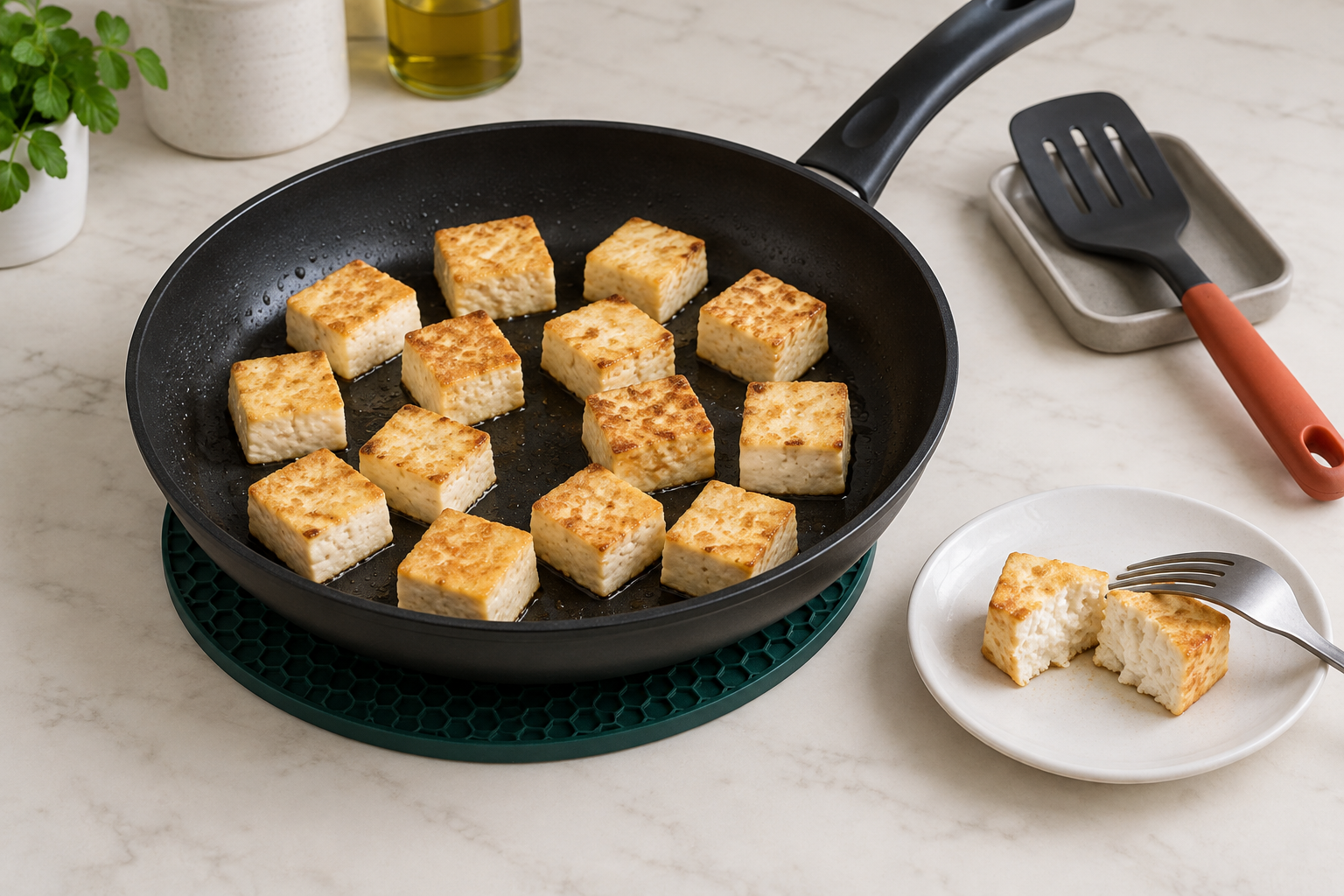
- Add the oil to the cool pan and warm over medium heat. Keep below smoking and follow the pan's limits. Add the dry tofu from close to the pan, leaving gaps between pieces.
- Let the first face cook for about 1 to 2 minutes before checking one piece with the turner. If it clings, give it a little more time rather than tearing it free. Lower the heat if it is darkening quickly.
- Turn onto another face with the turner or tongs, keeping the pan level on the ring rather than tossing. Continue turning gently until several faces are golden, commonly about 6 to 10 minutes for these cubes. The named ready-to-eat product lists a 6-minute hob guideline and asks for a piping-hot result. Use your actual pack if different: a golden outside is a texture cue, not a centre check.
- For the optional finish, lower the heat and wait for a calm sizzle in the food-filled pan with only its thin oil coating. Pour the diluted soy sauce low over the tofu, hands back from steam; stir gently for about a minute. Do not pour liquid into an empty pan of smoking oil. If fierce spitting or smoke prevents a controlled addition, switch off and wait; omitting this optional sauce is better than forcing it.
- Switch the ring off and land the pan level on its trivet, protecting a hot handle. Lift one of the largest cubes onto the testing plate and split it with the fork. Check for a piping-hot centre, not merely a warm golden outside; use a clean food probe if unsure, following the linked placement and continuous temperature/time routine. If the middle is cool, return it and continue over controlled medium-low heat, turning and checking a fresh largest cube. Ready-to-eat status does not make a cool cube a finished hot-texture exercise.
- Once the centre and packet requirements are satisfied, transfer to the clean serving plate. Let a small sample cool, then taste with the clean teaspoon without returning it. Golden faces and a tender middle are the texture targets, not a rock-hard cube. Serve promptly; leave hot cookware supported to cool, confirm the ring is off and clean the tools.
When it breaks, steams or sticks
- Wok and batch cooking basicsPrepare vegetables separately, then combine with the cooked tofu.
- Rice absorption and water ratioCook a plain rice side.
- Storage and reheating basicsCool promptly, label and reheat only once.
- Make a simple tomato sauce from passataMake the optional serving sauce before the quick tofu job.
Broken cubes can simply be served as pieces when otherwise ready; a neat shape is not essential. A prepared tomato sauce is optional, using the linked complete method, not an unspoken extra task. Pale wet tofu usually benefits from better blotting, more space or gentler patient turning, not maximum heat. If a piece sticks, ease the compatible turner flat under it without gouging the coating; a broken piece is preferable to a forced hot-pan movement.
Read the storage directions on your actual product before opening. The named extra-firm example specifies refrigerated storage, a 24-hour limit for leftovers and no home freezing; use that shorter limit for this practice, including a cooked dish, rather than borrowing a generic 48-hour or freezing rule. Keep any uncooked remainder as the label directs. The maker's generic FAQ gives different advice for some blocks: the specific pack takes priority. For cooked portions, follow the linked shallow-cooling routine and reheat only once until hot throughout; never reset their original storage clock by frying again.