
Flavour
Dry frying, toasting and blooming spices
Learn when spices need a dry pan, a little oil or liquid, and how to stop before their flavour burns.
Before you begin
- How to use hob heat without guessingSet gentle heat and rehearse supported pan handling.
- How to soften onions without burning themPrepare its whole-onion base before the short powder stage.
- Make a simple tomato sauce from passataComplete the measured sauce and its gentle simmer before tasting.
- Measuring accurately without stressUse level marked measures, not eating spoons as measurements.
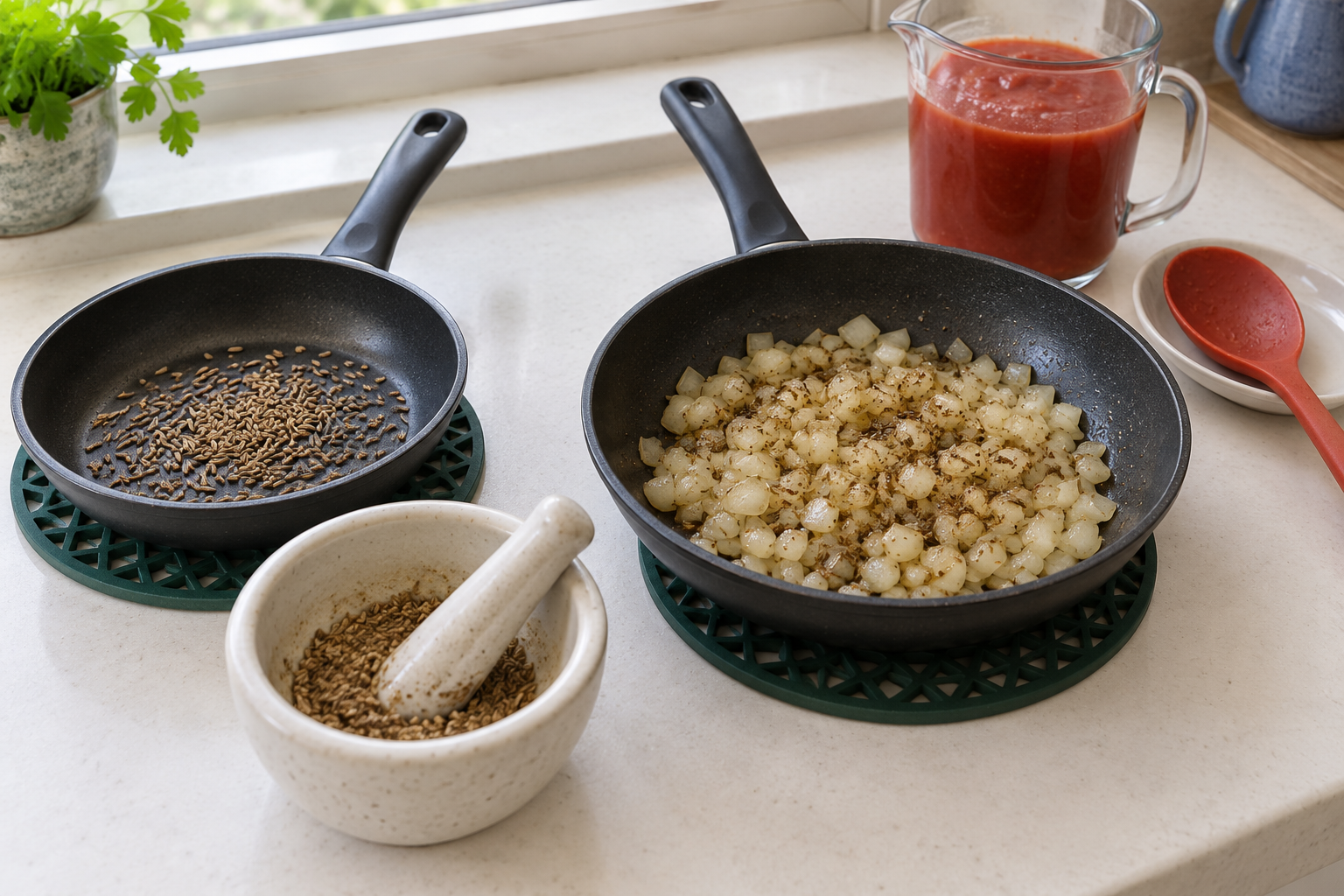
Three ways to develop spice flavour
Dry toasting means gently heating whole seeds without added fat. Blooming means briefly warming a ground spice in fat mixed through food before a wet ingredient is added. Simmering a spice in liquid is a third route. They are different tasks, not steps that every jar must pass through.
Whole cumin seeds are narrow ridged seeds; ground cumin is their fine powder. Whole coriander seeds are a different, rounder seed. Learn one type at a time. Fine powder can scorch quickly on a dry base, so this lesson dry-toasts whole seeds, not ground cumin or paprika.
Neither a fragrant smell nor a toasted colour establishes that all ingredients are safely cooked. For these practices, the spices continue into a complete tomato-sauce method before tasting. The quantities below are small teaching choices, not interchangeable measures for every spice.
What you need
- How to dice an onion without stressPrepare the whole onion before starting.
- Make a simple tomato sauce from passataComplete the measured sauce and its gentle simmer before tasting.
- Read food labels before you cookCheck spices, blends and serving ingredients.
- For dry toasting: 1 level teaspoon WHOLE cumin seeds, a clean dry small frying pan whose maker permits dry toasting, coating-safe spoon, timer, dry gloves, trivet and a clean heatproof plate. Rehearse lifting the empty cold pan to the trivet first. Do not dry-heat a non-stick pan against its instructions; use the liquid route below if you have no suitable pan.
- For crushing: a sound stable pestle and mortar on a non-slip support, and a clean dry measuring spoon. A pestle is the rounded crushing tool; a mortar is its bowl. If you do not have them, leave the seeds whole rather than crushing with fragile glass or an improvised blade.
- To use toasted seeds, prepare a separate cold sauce setup: 250 g plain passata, 1 teaspoon oil and 30 ml water, with the complete passata lesson's pan and tools. You will use only 1/4 teaspoon of the cooled toasted seeds, whole or crushed. The rest can cool completely and go into a clean dry closed jar labelled with the spice and preparation date; use for a later cooked dish and keep dry.
- For the separate blooming practice: ONE whole medium onion in 5 to 10 mm dice, 2 teaspoons oil in total, 1/4 teaspoon GROUND cumin, 250 g passata and 30 ml water already mixed in a jug. Have separate 30 ml onion-water and 60 ml sauce-water reserves. Use the complete onion pan setup, plus the sauce lesson's sample cup and clean tasting utensils. Leave salt, garlic, herbs and chilli out.
- For either sauce, have ready-to-eat bread and a clean plate for serving. Check labels before heating. Measure powder into a dry spoon away from the pan, close its jar, and have the jug ready before starting the short blooming stage. Make each route on a different attempt.
Toast whole spices
- Make a simple tomato sauce from passataComplete the measured sauce and its gentle simmer before tasting.
- Storage and reheating basicsKeep the original cooking time and earliest ingredient deadline.
- Put the level teaspoon whole cumin into the cold DRY suitable pan and spread into one sparse layer with the spoon. Start low to medium heat, staying beside the hob. Move seeds often with the spoon while the pan remains stable; no high lifting or tossing is needed.
- Begin checking after about 1 minute. A warmer aroma and slight deepening of colour, often in 1 to 3 minutes, are cues to stop. They are not a fixed timer or a requirement that every seed pops. Stop before smoke or blackening. Do not lean over the pan to inhale spice dust.
- Switch off. If safe and non-smoking, place the pan on its trivet using dry gloves for the handle. Use the spoon to transfer seeds onto the standing heatproof plate immediately, without touching the hot rim. Spread and let them cool completely; residual pan heat would otherwise keep toasting them.
- For crushed seeds, put the cooled seeds in the stable mortar. Hold its outside steady with one hand and press with the rounded pestle using small circular movements with the other. Stop when seeds are coarsely broken, not necessarily powder. Avoid hard pounding that throws fragments; keep fingers out of the working bowl.
- Measure 1/4 teaspoon cooled whole OR crushed seeds into the separate cold sauce pan with 250 g passata, 1 teaspoon oil and 30 ml water. Follow the full passata lesson's gentle simmer, stirring and endpoint before a cooled clean taste. Expect whole seeds to retain more noticeable texture; do not assume this is the same strength as 1/4 teaspoon ground cumin.
- Serve that finished sauce with bread or begin its cooling routine. Do not taste a spoonful of raw or newly toasted powder to judge the meal. For a later coriander-seed attempt, use the same small single-type dry setup but watch its own aroma and colour rather than copying cumin's exact time; then use a small measured amount in the same fully cooked sauce route.
Bloom ground spices
- How to soften onions without burning themFinish the onion-softening task before blooming.
- Make a simple tomato sauce from passataComplete the measured sauce and its gentle simmer before tasting.
- Open a can and use cooked beansFor a later bean meal, open, prepare and heat cooked beans.
- Pasta water and sauce clingFor a later pasta meal, complete cooking and combining.
- Storage and reheating basicsKeep the original cooking time and earliest ingredient deadline.
- Soften the whole prepared onion with the 2 teaspoons oil by its full method, usually checking tenderness around 8 to 12 minutes rather than stopping at glossy edges. The oil is already in the onion; do not add the plain passata lesson's additional teaspoon.
- Keep the ready 250 g passata and 30 ml water jug beside the pan. Lower heat to low. If the onion is sizzling vigorously, switch off and, only if safe and non-smoking, support the pan on its trivet briefly until activity settles.
- Return to low heat if needed, stir the measured 1/4 teaspoon ground cumin through the food and keep it moving across the base. After about 10 to 30 seconds, as aroma becomes more noticeable, proceed. Do not wait for brown powder, smoke or a dry spice crust.
- Pour the prepared passata-water mixture close to the food-filled pan, keeping hands clear of splashes, and stir thoroughly across the base. This wets fat dispersed in onion, not bare very hot oil.
- Reach gentle bubbles on medium-low as needed, then maintain a gentle uncovered simmer for about 10 to 15 minutes, stirring every minute or two. Follow the sauce lesson's flowing spoon-coating check. For a thickening, normally cooking sauce, switch off, let bubbling settle, stir in 15 ml from its separate water reserve, then return to gentle heat; stop adding once the texture suits.
- Switch off and support the pan. Transfer a little to the sample cup, cool to comfortable tasting warmth and taste with a separate clean spoon. The onion should be tender and no dry powder patch remain. Serve promptly with bread or cool the untouched portion now. For a later bean or pasta meal, complete that food's linked preparation rather than assuming it is ready.
Can spices go straight into water?
- Make a simple tomato sauce from passataComplete the measured sauce and its gentle simmer before tasting.
Yes. A recipe can cook spices in a liquid; blooming is optional, not a universal safety rule. For a simple separate attempt, put 250 g passata, 1 teaspoon oil, 30 ml water and 1/4 teaspoon ground cumin into the COLD sauce pan and stir. Then complete the passata lesson's gentle simmer and endpoint, without onion or a powder-frying stage.
Stir well at the start and while cooking so no dusty patch remains. Taste only a cooled clean sample after the full method. Compare your notes from another attempt: a different aroma is a preference, not evidence that one route is always correct.
Never interpret this as pouring water into bare hot oil. The liquid practice begins cold; the blooming practice adds liquid to an onion-filled pan with little fat. If oil is smoking, use the stop instructions below instead of the sauce jug.
If the spices burn
- Burnt flavour rescue: when to save it and when to stopDecide whether a completed sauce is worth a small flavour test.
Stop at smoke, a harsh burnt smell or blackened spice. Switch off only if safely reachable. Leave a smoking pan in place to cool; do not move it or add water. If there are flames, do not tackle the fire or move the pan: safe controls only, get everyone out, close doors if safe and call 999.
For a small failed dry-toast or onion-spice base, let the pan cool completely before emptying, cleaning and drying it according to its maker. Restart with fresh measured ingredients and gentler heat. Discard a burnt small oil base rather than tasting hot fat or hiding it with more cumin.
For an already fully cooked non-smoking sauce, use the burnt-flavour lesson's separate sample and stop decision. Do not scrape dark residue into it or add sugar automatically. Next time prepare the wet ingredient first and move on at aroma, before darkening.