
Pantry And Ingredients
Chillies: where the heat is and how to control it
Prepare a labelled mild chilli, cook a tiny measured amount into sauce, and compare it without guessing heat from colour.
Before you begin
- Knife confidence: the safe claw gripRehearse a stable board and grips before the small cuts.
- Make a simple tomato sauce from passataComplete the measured sauce and its gentle simmer before tasting.
- Clean and set up your kitchen before cookingPrepare handwashing, equipment cleaning and a separate discard bowl.
- Measuring accurately without stressUse level marked measures, not eating spoons as measurements.
- Read food labels before you cookChoose a labelled mild product and check everyone's requirements.
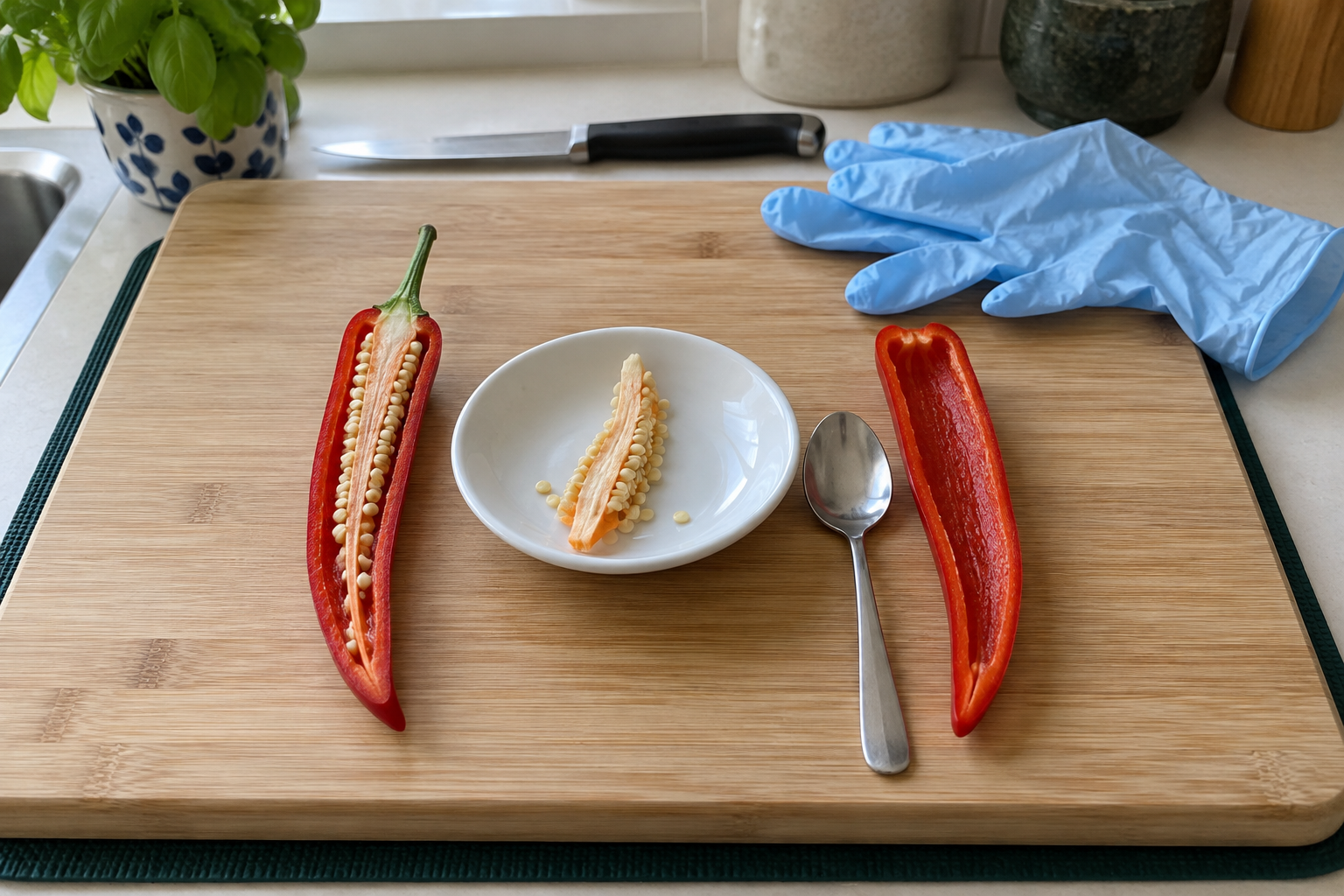
The seeds are not the main source
Chilli heat comes from capsaicinoids associated with the pale inner tissue that holds the seeds, called the placenta. Seeds can carry material from that tissue but are not its main producer. Removing the attached ribs as well as seeds can reduce what goes into a dish; it cannot guarantee a mild result.
Variety and growing conditions affect strength. Red, green, large or small is not a dependable heat measurement. Dried flakes, pure chilli powder, mixed seasoning and table sauce can differ greatly. Read the actual product, not just the colour.
This is not a hot-pepper challenge. Choose a labelled mild chilli you are comfortable trying; omit chilli entirely if it is unsuitable for you or anyone eating. Do not use an unknown pod, a superhot variety or concentrated extract for practice.
Get ready before cutting
- Make a simple tomato sauce from passataComplete the measured sauce and its gentle simmer before tasting.
- Knife confidence: the safe claw gripUse a stable board and keep the supporting fingers clear.
- For the first fresh task, have one sound labelled mild chilli large enough to hold safely. You will use no more than 1/8 teaspoon finely chopped flesh, not the whole pod, and less or none if sensitive. Use a measure actually marked 1/8 teaspoon if taking this route; this records volume, not strength.
- Prepare a stable board on a non-slip support, suitable small sharp knife, ordinary teaspoon for scraping, clean preparation bowl, separate discard bowl and clean lidded container for unused pieces. Put the bin and handwashing supplies within reach without needing to touch your face.
- Wear intact food-safe disposable gloves suitable for your skin and the task; check their packet and avoid material you are allergic to. Gloves help avoid exposure but still carry chilli on the outside. Do not touch eyes, face, contact lenses, phone or cupboard handles with them. Keep children away from the preparation.
- Prepare the full plain sauce setup: 250 g passata, 1 teaspoon oil and 30 ml water, its pan, cooking spoon, trivet and dry gloves. Also have two small bowls, marked 15 ml tablespoon, separate mixing and clean tasting spoons and a used-utensil plate. Leave other herbs, salt and heat sources out.
- Finish all cold chopping and cleaning before the hob starts. Use normal kitchen ventilation while cooking; do not hover to inhale chilli vapour. If cutting feels awkward or unsafe, stop. You can use the separate tiny-flake route without knife preparation, or practise the plain sauce with no chilli.
Prepare a small amount
- Clean and set up your kitchen before cookingWash tools separately and keep sharp equipment visible.
- Storage and reheating basicsKeep the prepared ingredient covered, labelled and promptly refrigerated.
- With the hob off and gloves on, rinse the chilli under cold drinking water and dry it with clean kitchen paper. Put it on its widest stable side. With fingertips tucked back, trim the stalk end. If it rolls or slips, stop and choose a manageable larger mild chilli rather than forcing it.
- Rest it on that stable side, hold with a bridge grip clear of the lengthways cutting path and split it slowly on the board. Park the knife flat. Do not hold a chilli in the air while cutting.
- Rest one half cut-face-up on the board. Hold its outer edges with gloved fingers away from the scraping path; use the ordinary teaspoon to gently scrape out the pale inner tissue and attached seeds into the discard bowl, working away from your body and face. Do not fling seeds or use the knife tip towards your fingers.
- Place the emptied half FLAT CUT-FACE-DOWN, not balanced on curved skin. Hold with tucked fingers and slice lengthways into a few narrow strips. Park the knife before arranging them, then cross-cut supported strips into roughly 2 to 3 mm pieces. Stop before an awkward tip. Transfer using the spoon or scraper, not fingers dragged along the blade.
- Measure at most 1/8 teaspoon chopped flesh into the clean preparation bowl. Put unused chopped flesh into its clean lidded labelled container and refrigerate promptly; use within 48 hours or a shorter packet limit. Put the other half in a separate clean covered container and follow the same short plan. Discard removed tissue, seeds and stalk.
- Park the knife and clear the board. Remove gloves without spreading their outside onto skin: pinch one glove outside near its wrist, peel it inside-out and hold it in the still-gloved hand; slip bare fingers under the second wrist cuff and peel it over the first glove. Bin both, then wash hands thoroughly with soap and water. Wash the knife, board, spoon and touched surfaces by the cleaning lesson; avoid a hidden sharp knife in washing-up water.
- If chilli gets on skin, stop and wash with soap and lukewarm water; avoid touching face even afterwards if irritation remains. For eye exposure, do not rub or add milk, oil or food. Rinse immediately with plenty of clean non-hot water in a gentle flow, holding the eye open for at least 20 minutes. Seek urgent help for persistent pain or worry; severe eye pain or vision changes require A&E or 999. Do not continue cooking during an exposure. If exposure happens after heat has started, get the hob switched off if immediately safe without delaying rinsing, or ask another adult to make it safe.
Choose a measured starting point
The fresh route uses the small prepared amount above. It may still be too hot for someone, so use less or omit it rather than treating 1/8 teaspoon as a comfort guarantee. Keep extra prepared pieces refrigerated, not beside the hob as a prompt to add them all.
For the separate dried-flake route, use a labelled mild food product, check its cooking directions and put only 2 or 3 small flakes in a clean dry dish before heating. Do not use pure powder, extract or an unlabelled blend instead. These are not equivalent doses. Keep the jar away from steam and close it after measuring.
Use ONE route in the comparison below, not fresh chilli plus flakes plus hot sauce. Any packet-required cooking period must be completed before tasting; use the plain practice instead if that period does not fit the method. Write the product name and amount so a later attempt can change one thing.
When the dish is too hot
- How to calm food that is too spicyTest a small compatible dilution and know when to stop.
- Open a can and use cooked beansFor a bean addition, prepare and warm cooked canned beans fully.
Stop eating or sampling if the heat is uncomfortable. Do not add more chilli or keep chasing the sensation with sugar or lime. Dilution means adding more compatible unspiced cooked food, not removing chilli chemicals from the original food.
Use the complete spicy-food rescue guide for a 30 ml affected sauce plus 15 ml fully cooked plain-base test. Raw passata or dried beans are not immediate finished-food additions. Make a plain replacement meal if a small test is still unpleasant; no one needs to finish the spicy portion.
A little suitable ready-to-eat yoghurt or milk may help the mouthful feel less intense, but is not an antidote or proof that a meal has been fixed. Check allergies and labels. Stop and seek medical advice for severe or persistent symptoms; breathing difficulty is an emergency, call 999.
Try a controlled comparison
- Make a simple tomato sauce from passataComplete the measured sauce and its gentle simmer before tasting.
- Storage and reheating basicsKeep the original cooking time and earliest ingredient deadline.
- Storage containers: sizes, lids and useful portionsChoose labelled food containers rated for the freezer.
- Complete the plain passata sauce with no chilli first, using the prepared 250 g passata, 1 teaspoon oil and 30 ml water. After its full gentle simmer, switch off and support the pan on its trivet. Take 2 level tablespoons, 30 ml, into the first bowl with the clean measure; keep it plain.
- With bubbling settled, stir the small prepared fresh amount OR the 2 or 3 mild flakes into the remaining sauce using the cooking spoon. Return the pan to gentle heat with dry gloves as needed. Once gentle bubbling returns, cook and stir for at least another 5 minutes, or the longer packet-required period. If normally thickening, use the passata lesson's small water adjustment; do not add another heat source.
- Switch off, support the pan and transfer 30 ml to the second bowl using the clean measure. Let both reach comfortable tasting warmth. Taste with separate clean spoons, beginning with plain. Pause until the sensation is clear and has settled before another taste; no timed pause guarantees readiness. Stop if uncomfortable and use the rescue choice, not a compulsory second bite.
- Write down the chilli product and small amount, the cooking stage and your preference. The remaining sauce may have a different heat concentration from a future full batch; do not multiply automatically. Eat tasted samples promptly or discard them. Serve the untouched portion or begin its original cooling routine now.
- For longer storage of unused chopped fresh chilli, while fresh and with a suitable known history, put separately measured 1/8 teaspoon portions into clean small FREEZER bags, one portion per bag. These must be food bags rated for freezing, not ordinary sandwich bags. Flatten each portion through its bag, gently push out excess air without touching chilli, seal, and label the product, date, amount and that it contains chilli. Freeze promptly at -18 C; choose a short use-first plan such as one month for this practice, not a promise of a tested shelf life. No oil is added and freezing does not remove heat. Use gloves if touching fresh chilli, then remove them and wash hands as above.
- To use a frozen portion, prepare a new cold sauce pan with 250 g passata, 1 teaspoon oil and 30 ml water. Open ONE labelled bag and release its entire still-frozen measured portion with a clean spoon into the cold ingredients. Do not put it into hot plain oil or use a knife to force a stuck frozen packet. Complete the entire passata method, including full melting, stirring and gentle simmer, and check there is no frozen piece before a cooled taste. Use less or no chilli where needed; a whole portion is not a guarantee of comfort. Keep remaining bags frozen and sealed. Discard an unidentified or unsuitable portion rather than guessing what it is.
Sources and further reading
- New Mexico State University: where chile pungency comes from
- National Capital Poison Center: capsaicin exposure and prevention
- NHS: eye injuries, rinsing and urgent help
- Food Standards Agency: cleaning hands, surfaces and equipment
- Food Standards Agency: chilling, freezing and defrosting
- University of Nebraska Extension: freezing peppers and glove precautions