
Guided Practice
Learn gentle sauce heat with a carbonara practice
Choose suitable eggs and pancetta first
- Make a white sauce, then a cheese sauceUse the complete alternative, not this egg recipe with one ingredient omitted.
- Read food labels before you cookCheck suitability with the people eating before preparation.
This produces lightly cooked egg, not a fully cooked egg sauce. Choose clean, undamaged hen eggs carrying British Lion or Laid in Britain assurance, within their best-before date and stored as directed. Do not use unmarked, cracked, duck or other non-hen eggs for this route. A glossy coating does not establish a safe cooked-egg temperature.
UK advice permits raw or lightly cooked assured hen eggs for most people, including ordinarily vulnerable groups. The exception is someone severely immunocompromised who needs a medically supervised diet: follow their clinician's advice. If the egg source or eater's suitability is uncertain, choose the complete white/cheese-sauce lesson instead, with its own quantities and preparation. Do not use residual pasta heat as a substitute for that decision.
Choose small ready-diced pancetta explicitly sold for pan-frying. Read the actual pack's complete oil, heat, time, storage, opening and reheating directions. Cured does not mean ready to eat. Do not choose a product that forbids reheating once cooled for this sequential practice: its temperature may fall while pasta cooks. The linked Waitrose example has that restriction. Choose another appropriate pack or the cooked cheese-sauce practice; do not override it.
For example, the linked Tesco diced product specifies medium pan-frying in a non-stick pan without added oil and a short cooking interval. That is not a universal method, an exemption from cooking all through, or permission to ignore the packet in your hand. Online pack sizes and directions can change: weigh 80 g rather than assuming half a pack. Resolve missing instructions before switching on.
Use pasta, egg and cheese to practise gentle heat, gradual liquid adjustment and stopping before a sauce scrambles.
Before you begin
- Read food labels before you cookChoose appropriate eggs and pan-fry pancetta; check actual dates, allergens and cooking/reheating restrictions.
- Clean and set up your kitchen before cookingKeep raw pork and egg contact away from clean finishing tools and serving bowls.
- Measuring accurately without stressWeigh the pasta, pancetta and cheese; the spoon help below explains small water additions.
- Pasta doneness: why tasting mattersApply its two-portion scaling and your actual packet method, not its one-portion practice quantity.
- Drain food and save cooking water safelyRehearse the loaded lift and supported reserve-water/draining route before heating.
- Crack an egg and beat it with a forkCheck each egg separately and complete raw-egg hand/surface cleaning.
- Prep tools: bowls, graters and food processorsUse safe grater support, short strokes and a safe leftover block, not fingertips near the teeth.
- How to use hob heat without guessingIdentify the controls and a safe heatproof pause place.
- Stir, whisk, fold and turn: four different movementsKeep the pan steady and move through its base rather than stirring only on top.
The lesson is controlling the last minute
This small two-portion practice teaches a coating sauce: egg, finely grated cheese, pork fat and a little starchy cooking water mingle around the pasta. Gentle warmth thickens the egg; excessive heat makes curds. The useful skill is stopping and adjusting, not juggling two hot pans or perfecting a photograph.
Read the whole method before opening ingredients. Cook and check the pork first, then immediately cook the pasta, then finish off the ring. Prepare every tool beforehand. This is a continuous meal-making session with a short pause, not a lesson in keeping meat warm for an hour.
This KINALO-authored teaching adaptation uses different quantities and a sequential workflow from the linked Good Food recipe. Its off-heat mixing informs the technique; its garlic, butter, timing and four-portion recipe are not instructions for this version. These quantities and reminder intervals have not been physically tested here. The egg-suitability and actual product instructions below still govern the meal.
Ingredients and equipment for two
- Measuring accurately without stressUse a marked metric spoon and distinguish 5 ml from 15 ml.
- Kitchen thermometer basicsRead before any optional thorough recovery or reheat.
- Thermometer cleaning and carePrepare the whole compatible cleaning/disinfection method, not a dirty cloth wipe.
- 160 g plain dried pasta, 80 g the suitable chilled ready-diced pancetta above, 2 medium assured hen eggs and 40 g finely grated Parmesan or similar hard cheese. Use either an adequately large block and an appropriate fine grater, or ready-finely-grated cheese whose label suits the task. No cream, garlic or extra garnish is needed. Check wheat, egg, milk and the actual pork/cheese ingredients and warnings.
- For a packet that permits it, use 1.5 litres drinking water in a saucepan holding at least 3 litres, with ample boiling headroom; otherwise use the required packet water and a suitably larger pan. Optional salt: a level marked 1/4 teaspoon (1.25 ml) of fine salt, or omit it. Set out a few turns of black pepper. Add oil only if the pork packet requires it, measured with the correctly marked spoon to that instruction rather than guessed; have a marked 5 ml spoon if a teaspoon is specified.
- Digital scales, clean dry bowls for pasta, cheese and weighed raw pork, a mixing bowl holding at least 500 ml with cover, separate small egg-check cup, fork, shell-waste dish and a small spoon for removing shell. For block cheese, have a stable board/non-slip support, a fine grater with known safe support/grip and its cleaning brush. The original cheese pack stays away from the raw pork area.
- Saucepan with secure handles, approximately 24 cm compatible frying pan, timer, dry heat-resistant gloves, two full-base trivets, heat-safe raw-pork cooking spoon and separate clean finishing tongs or two broad spoons safe for the pan coating. Have separate rests for raw-contact and clean tools. Use tongs for long pasta; two spoons are for short shapes, not an instruction to pick up long strands with fingers.
- Standing heat-safe colander in the clear sink, heat-safe ladle, supported heatproof jug holding at least 300 ml with a readable 150 ml mark, and a marked long-handled heat-safe 15 ml measuring spoon or ladle for small cooking-water additions. Have a small heatproof waste bowl and metal spoon only if excess fat needs removing. Set them on a heatproof surface, not the scales.
- Clean spoon, saucer and eating fork for the cooled pasta test, two serving bowls, normal eating cutlery and clean serving tools. For optional leftover/recovery heating below, also prepare a suitable food probe, its complete cleaning/disinfection kit, clean rest and seconds timer. Saved food needs shallow containers, covers and date labels. Do not rely on a household eating spoon to measure 15 ml.
Prepare the cold station
- Drain food and save cooking water safelyPlan the complete scoop-and-cool-water route if the cold loaded lift is unmanageable.
- Crack an egg and beat it with a forkUse its supported fork movement and cleaning sequence.
- With both rings off, clear the preparation area and sink. Put the colander flat so it stands without being held, with its food base above any backed-up water. Clear a short route and set out the receiving frying pan, jug and trivets. Follow the draining lesson's actual cold-weight rehearsal with the water amount you will use. If the lift is uncomfortable, arrange its supported scoop route or help before heating; do not discover this with boiling pasta.
- Select grams on the scales. Tare each clean bowl before weighing 160 g pasta and 40 g cheese. If grating a block, keep it chilled and large enough to hold safely. Use the fine grater's own stable support, grip only its safe handle and keep the food-holding fingertips behind the working end. Make short light strokes and stop with a safe ungrated remainder. Park the grater before spooning out and weighing the particles; do not scrape teeth with fingers. Chill the unused block promptly. Ready-finely-grated cheese simply needs weighing.
- Put the mixing bowl on a non-slip support. Crack one egg into the separate cup by the egg lesson, remove any shell with a clean spoon, then transfer it to the bowl; repeat with the second. Bin shells and finish the egg lesson's hand and tapping-surface cleaning. Pierce yolks with the fork and move it in small circles through the liquid until white and yolk are even, not foamy. Stir in all 40 g cheese and the prepared pepper until particles are distributed. Cover and refrigerate the bowl while cooking pork and pasta; do not taste it.
- Measure the cold pasta water into the saucepan, leaving it off. Prepare any optional salt and packet-required oil before raw handling. Place the serving bowls and clean tools away from splashes. Open the pork packet by its designed tab in the raw area. Put its separate bowl on the scales, tare it to zero, then tip in pieces carefully to weigh 80 g without touching clean equipment with raw-food hands. Chill the remainder by the original label, and clean any contaminated scales as their care instructions allow. Wash and dry hands after raw contact and before controls; never wash the pork.
Prepare the sauce before the pasta finishes
- Pasta doneness: why tasting mattersTest the middle without putting mouth-contact cutlery back into the pot.
- Drain food and save cooking water safelyUse the supported ladle and jug, not a hand-held dip.
- How to use hob heat without guessingRead the full smoke/fire stopping instructions before frying.
- Cook the pork first using the entire actual packet pan-fry method: its pan type, measured oil if any, preheat, heat and quantity-appropriate cooking time. Tip the weighed pieces from their raw bowl without reaching over the pan. Use the raw-pork cooking spoon to spread and turn them, reaching across the base with slow movements. Keep the handle safe and watch the pan throughout. Browning adds flavour but does not prove the centre cooked; finish the stated method and ensure the pieces are cooked all through, not just seared on one face.
- Switch that ring fully off. If there is no smoke and it is safe to move, grip the frying-pan handle with dry protection as needed and put its full base on the prepared trivet. Keep the cooked pork and released fat there while immediately cooking the pasta. Set its raw-contact cooking spoon on the separate rest, not beside the egg bowl or serving tools. Wash hands before clean tools. Do not begin another preparation job or leave the pork for a long interruption.
- Usually this small amount needs no fat removal. If an unusually large pool would swamp the coating, wait off heat until it is calm and no longer spitting. Keep the pan flat; take small low spoonfuls with the metal spoon into the stable heatproof waste bowl, leaving a thin film and a little fat around the pork. Do not tip or carry hot fat, hold the waste bowl in the air, add water to hot fat, or chase an exact hot-fat measurement. Leave the waste bowl secure until completely cool.
- Bring the measured pasta water to a continuous boil by the foundation lesson, add the optional measured salt, then the 160 g pasta. Stir early to separate it. Long pasta must soften at its submerged ends before being gently eased down with the utensil; do not force stiff strands or put hands near the water. Follow your packet's timer start and method, adjusting heat to steady bubbling with headroom. Use its stated time as a reminder and a cooled test near the end, not a guarantee of tenderness.
- For the test, lift one piece with the clean spoon onto the saucer and let it cool before biting with the eating fork. That fork does not go back in the cooking pan. The middle should no longer be hard or chalky. Give it another 30 to 60 seconds and repeat if needed. Do not wash tools or leave the hob while it is on.
- When pasta is ready, switch its ring off. Ladle about 150 ml water into the supported heatproof jug, keeping face and hand out of steam; do not dip a hand-held cup. Follow the rehearsed supported drain or scoop route. With the colander secure, use the clean finishing tools to lift small portions into the pork pan. Do not carry an overloaded dripping colander or shake it beside your face. Take the covered egg bowl out with clean dry hands only when ready for finishing.
- Keeping the pan steady, turn small bundles of long pasta with tongs: grip a little, lift only a few centimetres within the pan, turn your wrist gently and lower it into another part. For short pasta, use one broad spoon to steady a small portion while the other sweeps underneath and folds it towards the centre. No high tossing or squeezing a huge bundle. Mix pork and pasta before adding egg.
- If the pan and food need a little more warmth, use the lowest suitable ring briefly while moving the pasta, then switch off and put it back on the trivet. This is the brief finishing stage of one continuous freshly cooked meal, not reheating a cold stored pork portion. If the meat fully cooled, was left during an interruption, or its history is uncertain, stop this route and choose a fresh meal with its full lesson. Do not treat a five-second warm as thorough reheating.
- With the pan off the ring and no fierce sizzle, uncover and give the egg-and-cheese bowl a short fork stir. Pour it over the pasta and immediately mix through the entire pan with the described low tongs or spoon movements, so egg does not sit on one hot patch. Rest the egg-contact fork and bowl away from clean serving tools. Heat retained in the food starts thickening the coating; the egg selection at the start remains essential.
- Add one level 15 ml spoonful of reserved water and continue mixing. Keep the jug supported on its heatproof surface. With the long-handled heat-safe marked measure, dip only its cup into the water, keeping your hand on the handle clear of steam and using dry protection if needed. Lift level only a short distance, move it low over the pan and tip in; never scoop with fingers or a hand-held cup. Add another 15 ml only if the pasta remains sticky or the coating needs loosening. Do not empty the jug into the sauce.
- Stop when there is a thin coating and the pasta moves easily without an obvious watery pool. If mixing off heat leaves it very loose, use the lowest ring for about 5 seconds while mixing continuously, then switch off and return to the trivet to assess. Repeat only while the food remains controlled; bubbling or firm egg specks mean stop heating. This interval is a texture adjustment, not a safety hold.
- Check both rings are off and use clean serving tools to divide into the waiting bowls. Eat promptly, cooling your own bite before eating. Do not taste the sauce during assembly, wait for everyone to arrive, or claim its shine proves the egg fully cooked.
What to look for
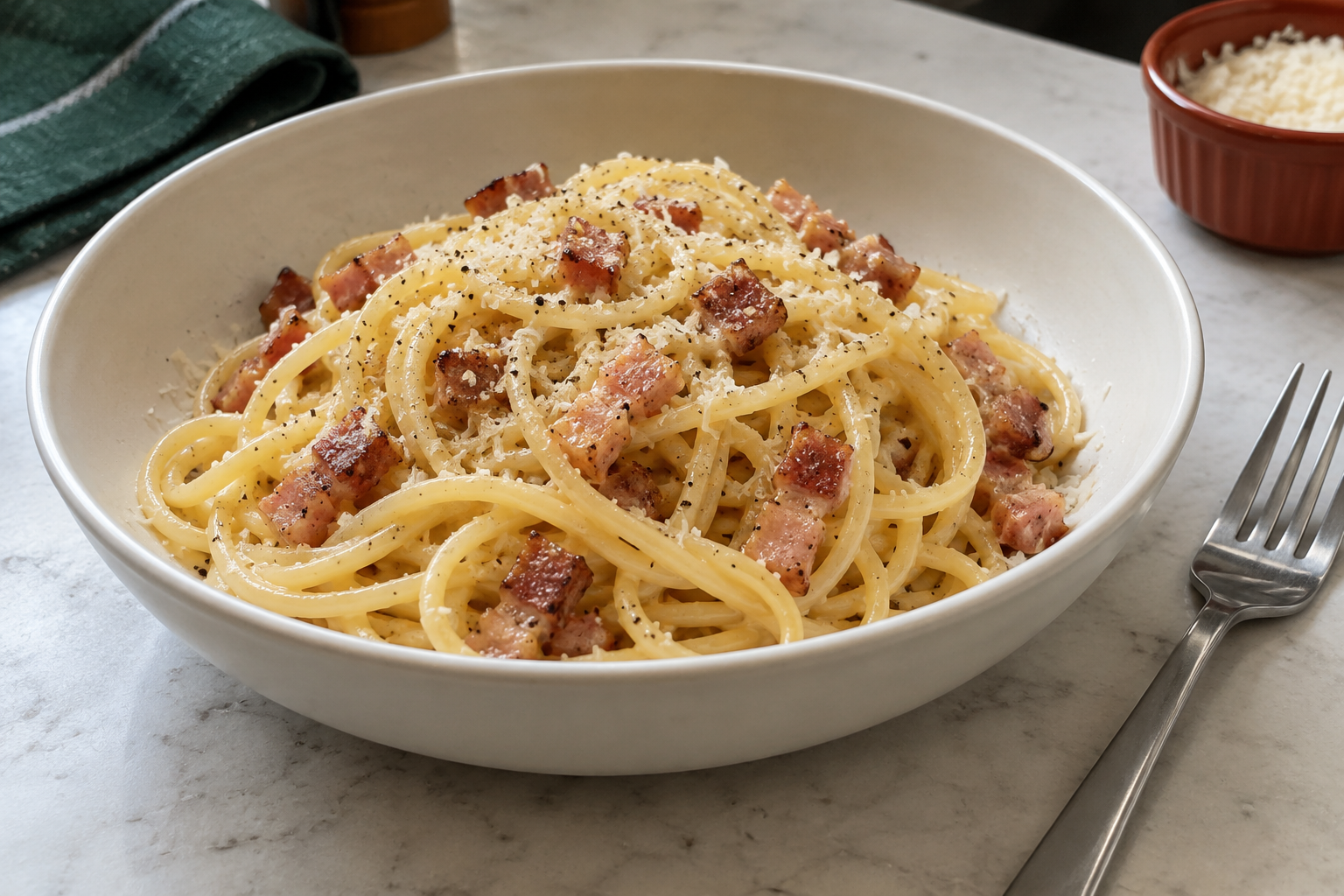
Look at how the coating moves, not just its colour. It should cling lightly while strands or short pieces separate readily. Sticky pasta gets one more 15 ml water addition and mixing off heat. A visible puddle gets mixing first, then only the brief controlled warm stage if needed. Stop adjustments as soon as the coating is useful; it thickens further as it stands.
A few firm yellow-white specks mean egg is setting into curds. Larger lumps will not become smooth again. Neither a creamy appearance nor a curd proves safe ingredient choice, adequate pork cooking or safe storage. Those are separate checks, not details you can read from the photograph.
When the sauce scrambles
- Kitchen thermometer basicsUse whole sensing depth and continuous holds, not one reassuring number.
- Thermometer cleaning and careClean and disinfect after undercooked-food checks.
Switch off and put the controlled pan on its trivet. Add one 15 ml spoonful of reserved water only if dry, then fold gently. The curds stay curds, but it can still be an enjoyable egg-and-pasta meal when the eggs were suitable, pork fully cooked and handling safe. Do not add another raw egg to reverse the texture.
If you discover the pork was not fully cooked before mixing, do not serve this as lightly cooked carbonara. If the handling history is still safe and you have the suitable probe and preparation below, use the thorough-heating route, accepting set egg. Otherwise choose a different safely prepared meal. More heat cannot rescue unsafe storage or unknown history.
Thorough heating for recovery or leftovers
- Kitchen thermometer basicsFind cooler centres and cover the sensing area throughout the timed hold.
- Thermometer cleaning and careUse the complete food-contact cleaning method.
- Storage and reheating basicsDo not use thorough heating as a storage rescue.
- This separate route sacrifices the glossy sauce. It is for a just-made, safely handled undercooked-pork recovery, or a properly cooled and stored leftover that has never been reheated and whose packet permits it. Do not use it for a missed cooling window, uncertain history or a no-reheat product. Take only the portion to eat; keep other eligible leftovers chilled. Read and practise the linked probe and care lessons first.
- Have the pan, heat-safe broad spoon or tongs, dry gloves, trivet, clean serving bowl/tools, supported jug of drinking water, heat-safe 15 ml measure, cleaned suitable probe and seconds timer ready. For a chilled portion, put it in a cold pan with two level 15 ml spoonfuls water. For the immediate recovery, start with one 15 ml reserved-water addition if needed, keeping the hot pan controlled. Do not splash water into smoking or spitting fat.
- Use medium-low heat and stir/fold frequently through the base and centre, gently separating compact cold pasta so heat reaches it. Add another 15 ml water only when needed to prevent catching. Do not leave the pan; lower heat if the base catches before the middle warms. There is no fixed safe reheating time. For fresh recovery the pork must cook all through; brown appearance alone is not the result.
- Move the controlled pan off the ring onto the trivet for a probe check. Use the complete sensing area in potentially cooler parts of the mixed food, not against the hot pan, in an air gap or only in liquid at its edge. Check pork as well: a suitable thin-tip probe must fit the whole sensing area in the centres of the larger cubes. If your probe cannot do that, do not guess that a pasta reading proves undercooked pork safe.
- For this thorough route, each potentially cold checked area must stay at or above 75 degrees C continuously for 30 seconds. Wait for a settled display and time the full hold with the probe positioned as its instructions permit. Clean/disinfect between foods and after any undercooked check. Low or falling results need further controlled heating and a fresh check with incomplete holds restarted. Do not average a cold spot with a hotter result.
- Only after the whole portion and relevant pork checks pass, remove the probe, switch off, keep the pan stable and serve with clean tools. Eat promptly; allow your own bite to cool. A leftover reheated this way has used its one reheating allowance: do not cool/freeze it to reheat again. Retain any earlier pork reheating history rather than giving it a new allowance when mixed into pasta.
Repeat one useful change
- Storage and reheating basicsUse small shallow portions and the original cooking clock.
- Storage and reheating basicsFinish a full fridge thaw and retain earlier reheating history.
On another freshly prepared attempt, keep quantities the same and change just the cooling pause before egg mixing. Note whether the coating thickened too rapidly or remained loose. You are learning your own pan's retained heat, not chasing a universal dial number. Prepare everything again rather than repeatedly heating this batch for practice.
Ideally make just what will be eaten now. For untouched eligible spare food, begin the cooling reminder when pork cooking first finishes, before pasta and sauce assembly. Separate with clean tools into small shallow portions. Cool and refrigerate within one to two hours of that original point; label the original pork cooking date/time and any reheating history. Combining it with pasta does not restart the clock.
Use refrigerated food within 48 hours of original cooking or an earlier applicable ingredient limit; freeze promptly only where ingredient directions allow, following the complete storage lesson. Fully fridge-thawed food has its own 24-hour use limit or stricter directions. If cooling/storage cannot be established, do not keep it. Reheat only once by the thorough route above, not the five-second sauce finish. Accept changed texture rather than underheat to keep it glossy.
Finish and reset the pasta station
- Clean and set up your kitchen before cookingComplete separate raw-contact cleaning and safe cookware cooling.
- Prep tools: bowls, graters and food processorsFollow safe brush cleaning and protected storage.
Check the two heating controls are off; a timer does not switch them off. Leave the pan, remaining cooking water and any waste fat secure and out of reach until cool. Follow cookware care before washing; do not pour cold water into a very hot pan. Fully cold solidified waste fat can be scraped into appropriate household food/general waste according to local guidance, never poured into the sink.
After the hot task has ended, wash raw-contact bowls, spoon/rest, egg cup/fork, serving tools and worktop by the setup lesson, disinfecting contaminated food-contact surfaces as its labels require. Brush the grater safely by its own care instructions, never with fingertips against teeth, and store it protected. Clean/disinfect and dry any used probe and its sheath. Wash hands after contaminated cleanup, and finish chilling saved portions within their original window; washing up does not grant extra cooling time.
Sources and further reading
- Food Standards Agency: home food fact checker
- Food Standards Agency: cooking and reheating food
- Food Standards Agency: chilling, freezing and defrosting
- Tesco: example of product-specific diced pancetta cooking directions
- Waitrose: pancetta example with a no-reheat-after-cooling restriction
- Food Standards Scotland: separate raw and ready-to-eat foods and utensils
- Good Food / Angela Nilsen: off-heat egg-and-cheese mixing and cooking-water adjustment; a different recipe