
Sauces
Make a white sauce, then a cheese sauce
Make a small roux, add milk without a panful of lumps, and recognise a sauce ready for cooked vegetables or pasta.
Before you begin
- Measuring accurately without stressWeigh the flour and butter and measure the milk.
- How to use hob heat without guessingUse gentle heat while stirring a thick sauce.
The three ingredients have different jobs
A roux is a cooked paste of fat and flour. The fat helps spread flour through the sauce; the flour's starch thickens the milk as it heats. White sauce, also called bechamel, is this basic milk sauce. Cheese sauce starts with the same method and adds cheese at the end.
This lesson makes about 250 ml, enough to coat two modest side portions of cooked vegetables or a small pasta dish. It uses a relatively thick coating consistency. Keep the first attempt plain so you can see the paste become a smooth liquid without extra ingredients in the way.
Measure before heating
- 25 g butter and 25 g plain flour, weighed separately. Do not use self-raising flour.
- 250 ml milk in a jug, plus up to 60 ml additional milk in a separate small jug for measured thinning if needed. Read the milk label and check its storage/date; do not use questionable dairy as a cooking practice.
- For the later cheese version only: 40 g ready-grated Cheddar in a small bowl, checking its ingredients, plus optional pepper. This avoids assuming a grater skill during the first hot-sauce task. Taste before salt because cheese already supplies it.
- A compatible heavy-based saucepan around 1 to 1.5 litres, coating-safe heat-safe spoon/spatula and whisk, scales, jugs, marked tablespoon measure, timer, clean tasting teaspoon, clean testing plate and serving bowl. Set out dry oven gloves and a trivet. For optional sieving, also prepare the supported heat-safe fine sieve and receiving pan below while cold.
- This version contains milk and wheat, and cheese may have additional ingredients. Use a separately developed recipe for a dietary substitute rather than assuming every plant drink or gluten-free flour behaves identically.
Cook a pale roux
- Stir, whisk, fold and turn: four different movementsLearn the spoon and whisk movements before beginning.
- Put the butter in the saucepan over low to medium-low heat. Let it melt gently. If it browns or smells burnt, restart for a white sauce rather than hiding the flavour with milk.
- Add all the weighed flour and stir until no dry flour remains. Move the utensil over the base and into the corners so the paste heats evenly.
- Cook the paste for about 2 minutes while stirring. It may look foamy or sandy but should stay pale. Lower the heat if it starts colouring quickly.
- Switch the ring off and move the pan with dry handle protection onto its trivet before adding the first milk. Keep the pan supported there throughout the cold-milk mixing; a hand does not hold the pan in the air while the other whisks.
Add milk in stages, then thicken
- Stir, whisk, fold and turn: four different movementsLearn the supported spoon and whisk movements.
- Boil and steam vegetables without guessingCook vegetables by their complete method before coating.
- Pasta doneness: why tasting mattersCook and drain pasta before coating.
- Use the marked measure to add 2 tablespoons (30 ml) milk from the main 250 ml jug. Stir or whisk until no dry pockets remain; the mixture initially thickening into a rough paste is normal.
- Add another 2 measured tablespoons (30 ml) and mix smooth. Once loosened, add the remaining main-jug milk in roughly 50 ml portions, mixing each thoroughly before the next; use the final smaller remainder too. Reach the sides and base, not just the centre. These stages use the original 250 ml, not extra milk at each step.
- With all main-jug milk mixed in, return the pan to its matching ring and switch to low to medium-low. Stir continuously across the base and corners as it warms; use the compatible whisk briefly for small lumps.
- Watch for the sauce becoming thicker and the first gentle bubbles. Keep it at a very gentle simmer for around 5 to 10 minutes, stirring, so the flour cooks and the sauce loses its raw flour taste. Do not taste before this cooking stage.
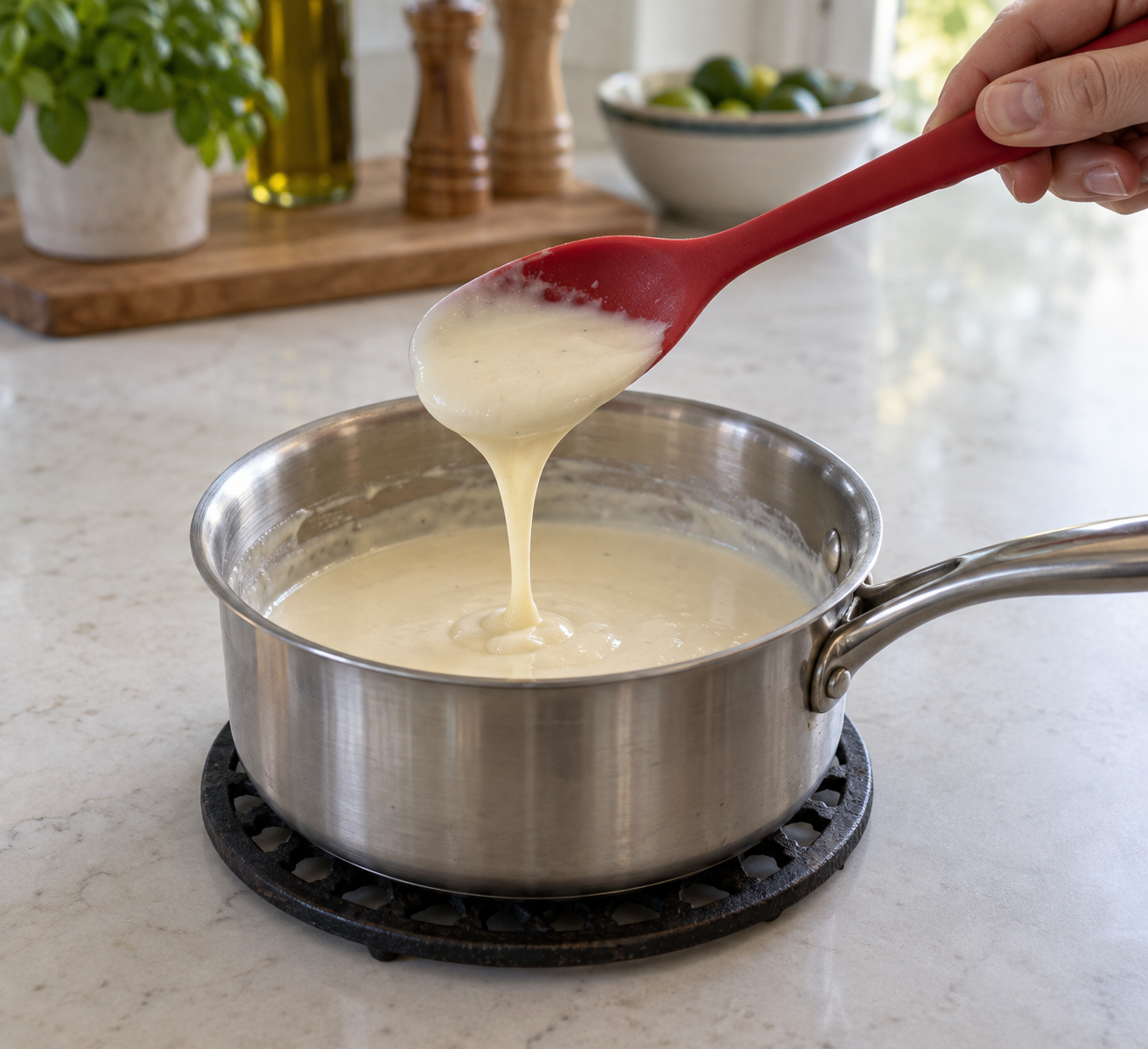
- Lift the spoon: sauce should coat it and fall in a thick ribbon, not a watery stream or a solid lump. If it is too thick for your dish, add 1 tablespoon milk, stir fully, warm through and reassess.
- Switch the ring off and land the pan on its trivet. Put a sample onto the clean teaspoon, cool and taste; do not return the tasted spoon. For a white-sauce practice, spoon the finished sauce into the supported bowl. For a meal, coat food already cooked by its complete linked method; the sauce does not cook raw vegetables or pasta. Leave hot cookware to cool safely before cleaning.
Turn it into cheese sauce
- Have the weighed ready-grated cheese in its clean bowl before heat starts. Make and fully cook the white sauce first; optional cheese is not a substitute for cooking the flour.
- With the ring off and pan on its trivet, add cheese in two or three small portions, stirring each until melted before the next. Keep the stirring spoon clean and the pan supported.
- Cool a clean sample to taste. Adjust optional seasoning only afterwards. If cheese will not melt in the warm sauce, return to low heat briefly while stirring, then switch off and land the pan again. Do not boil hard to force it; oil or graininess means overheating rather than a need for more dry flour.
- Spoon over cooked broccoli or stir into cooked drained pasta. Adding cheese sauce does not cook raw vegetables or raw pasta.
Fix lumps without creating a new problem
- Drain food and save cooking water safelySet up a supported heat-safe fine sieve and receiving vessel while cold.
Switch off, support the pan on its trivet and whisk in small controlled circles, steadying its handle through dry protection if hot. Add 1 measured tablespoon (15 ml) of the extra milk only if too stiff to move. Do not whisk a hot pan held in the air or sprinkle more dry flour into the liquid.
If you choose to sieve it, use a clean heat-safe fine sieve with supports fitted securely over a clean receiving saucepan, both resting on a heatproof support. Check this arrangement while cold and leave room below the sieve for all 250 ml or so of sauce. With the original pan also supported and ring off, spoon small amounts low into the sieve, letting sauce pass through. Use the back of the spoon gently on lumps without shifting the support; stop if it tips, jams or steam obscures the route. Discard retained hard lumps. Return the receiving pan to low heat and finish any remaining flour cooking, stirring, then switch off and cool a clean sample. You may instead serve a coarser fresh sauce if otherwise fully cooked and suitable.
If the base burns, switch off before spooning only usable upper sauce into a clean supported pan, without scraping black residue. Continue gentle cooking only if still needed. Bitter burnt sauce is a reason to stop, not to hide it with more cheese. A blender is not needed for this first lesson.
Serve now or cool promptly
- Storage and reheating basicsStore the sauce separately or follow the shortest limit of the whole dish.
The sauce thickens further as it cools and may form a skin. Stir and loosen gently with milk when reheating, rather than adding a large amount at once. For leftovers, cool in a shallow container and refrigerate within one to two hours, use within 48 hours or freeze, and reheat only once until steaming hot throughout.