
Mistake Recovery
Burnt flavour rescue: when to save it and when to stop
A calm guide to stopping burnt flavour spreading, moving clean food, and deciding whether a dish can be saved.
Before you begin
- How to use hob heat without guessingSwitch off the correct ring and recognise its remaining heat.
- Make a simple tomato sauce from passataMake the fresh plain base completely before tasting or diluting another dish.
- Storage and reheating basicsCheck food history before attempting a flavour rescue.
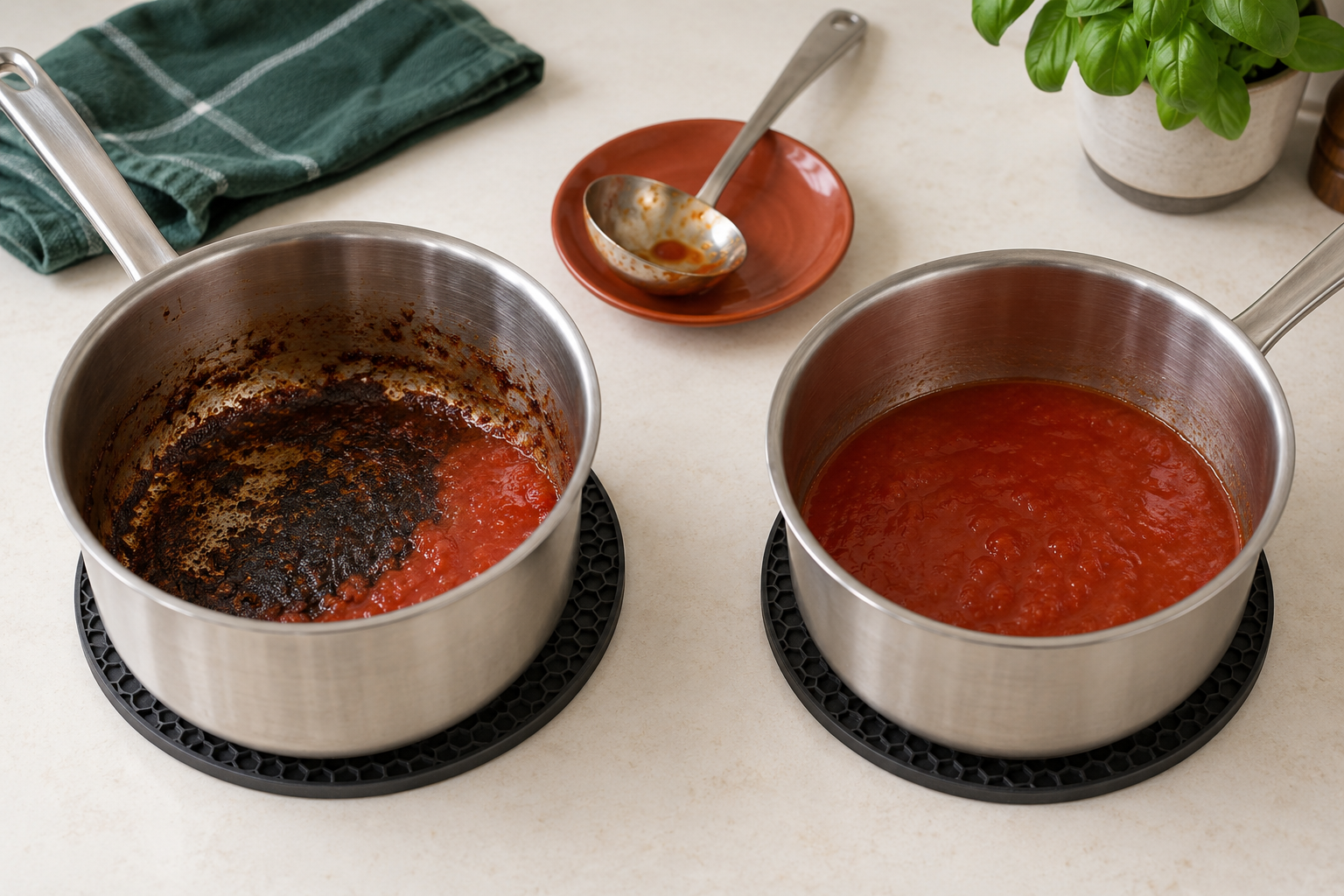
Protect food that has not burnt
If sauce or rice catches at the base, switch off before stirring: scraping can spread the scorched layer through the remaining food. A golden cooking deposit and a dark bitter residue are not interchangeable. Do not lean over a pan to sniff or taste its stuck base.
A smoking oil pan is not a food-rescue exercise. Switch off only if safe and leave it to cool; do not add water or carry it to the sink. If there are flames or the situation is unsafe, do not tackle the fire or move the pan. Switch off only if safe, get everyone out, close the door behind you and call 999 from safety.
The transfer method below is only for a stopped, non-smoking, non-burning pan that can be approached safely. Your first practice is cold water, not deliberately burnt food. If you cannot safely reach the controls or equipment, leave the food; a meal is not worth a burn.
Transfer without scraping
- Kitchen thermometer basicsUse the actual centre reading and full hold time for meat, not sauce colour.
- Brown mince and make a simple meat sauceFor a mince dish, continue its complete cooking and centre-check method.
- Storage and reheating basicsUse the original cooking time and earliest ingredient deadline.
- First rehearse with no heat: stand two clean saucepans of at least 1 litre on separate stable trivets, handles back from the edge. Measure 250 ml cold drinking water in a marked jug and put it in one. Set a long-handled small ladle on a separate utensil plate between them. Lift small ladlefuls from the upper water into the standing receiver, lowering the ladle before tipping. Leave a little at the bottom instead of scraping. This teaches the movement without a hot incident; empty the cold water when finished.
- For an actual caught sauce, switch off and leave the original supported where it can be approached safely; do not move a smoking pan. Prepare the clean receiving saucepan on its own nearby trivet without crowding the hob. Have the ladle, utensil plate, dry gloves, sampling cup and separate tasting spoon ready. Keep cloths away from the hob and your face clear of steam.
- Use the ladle to lift small amounts from the top into the standing receiver, without dragging across the stuck base. Stop as soon as you approach the scorched layer. Protect a hot handle with a dry glove if steadying the pan. Do not tilt a full hot pan to decant, scrape black residue into the food or add liquid to dissolve that residue.
- For a freshly fully cooked tomato sauce, transfer a little from the receiver to the sampling cup, let it reach comfortable tasting warmth and taste with the separate spoon. Decide whether it is acceptable, faintly affected or strongly bitter before adding anything.
- If the dish contains unfinished meat, do not taste it or put it aside for much later. Continue its complete cooking method immediately in appropriate clean cookware, then use a clean thermometer to verify the coldest thick centres, for example 75 C for 30 seconds, before a cooled taste. If you cannot finish it properly, discard it; a burnt base does not prove a cooked centre.
- If already refrigerated food was being reheated, retain its original history: finish heating the transferred portion until steaming hot throughout during that single reheating and serve it. Do not cool and start another reheating as a second rescue. If safe transfer leaves no useful food or its history is uncertain, stop.
When a mild problem can improve
- Make a simple tomato sauce from passataMake the fresh plain base completely before tasting or diluting another dish.
- Storage and reheating basicsUse the original cooking time and earliest ingredient deadline.
- Only attempt a flavour comparison with fully cooked food of a suitable known history and a faint problem. Make a separate fresh plain tomato base by the complete 250 g passata, 1 teaspoon oil and 30 ml water method, leaving salt and oregano out. Raw passata is not a finished tasting base.
- If preparing that base means a delay, begin cooling the affected fresh sauce by its original routine rather than leaving it warm during another task. For already reheated leftovers, choose serving or discarding now, not cooling for another reheating.
- Set out a clean small bowl, marked 15 ml tablespoon, separate serving utensils for the two pans and a clean tasting spoon. Mix 2 tablespoons, 30 ml, affected fully cooked sauce with 1 tablespoon, 15 ml, fresh cooked plain base. Cool to comfortable tasting warmth and taste. Keep the clean-base measure out of the affected sample and never return tasted food to either pan.
- If the small test is genuinely useful, begin with 2 tablespoons, 30 ml, plain base in the small affected batch, stir fully and warm through as its history requires. Check another clean cooled sample before more. If the bitterness remains, stop: a larger batch of the same unpleasant flavour wastes more ingredients.
- Serve promptly or cool untouched fresh food under its original deadline. Acid, sugar, cream or herbs may change the eating impression, but do not remove the scorched material already mixed through the food. Do not pile them in to avoid making a stop decision.
When to stop
- Make a simple tomato sauce from passataMake the fresh plain base completely before tasting or diluting another dish.
Stop if the sauce is strongly bitter throughout, the small dilution test does not help, almost everything is stuck, or the food or cookware cannot be handled safely. A burnt smell is a quality warning, not a test that the remaining food has safe storage or cooking history.
Discard an unusable affected portion and choose a simpler replacement. Ready-to-eat bread with an appropriate labelled topping is enough to avoid another urgent hot task. If making a new tomato sauce, use clean suitable cookware and the complete method rather than the scorched pan.
Do not force yourself to eat a badly burnt meal because you spent time on it. The useful lesson is noticing the stage to change next time, not finding an ingredient that disguises every mistake.
Match the prevention to the cause
- Rice absorption and water ratioFollow its lid, water and gentle simmer sequence.
- Rice leftovers safelyUse the separate rice cooling and storage routine.
- Garlic colour: fragrant, golden or burntFor a later dish, use the controlled garlic method.
- Dry frying, toasting and blooming spicesLearn the separate brief spice-heating task.
- How to use hob heat without guessingMatch ring, pan and changing heat demand.
- For thick sauce, lower the heat as the liquid level falls and stir across the base and corners more often. Prepare additions before heating, stay with the pan and use short timer checks. A timer is a reminder, not permission to leave the hob unattended.
- For rice, use the complete water, fitted-lid and low-simmer method and switch off at its endpoint. Do not scrape a caught base into the loose grains. Keep the separate rice cooling rules if saving unaffected cooked food.
- For later garlic and ground-spice cooking, have the next ingredient measured and ready before heating. Follow their full methods rather than using the sauce's long simmer time for dry garlic or spice frying.
- A thin or uneven pan can heat unevenly. Match it to the ring and task, and stop using a pan whose handle or surface is damaged. Changing cookware is not a reason to leave the original heat too high.
Clean after the pan cools
- When to replace kitchen equipmentCheck equipment condition before reuse.
- Can you wash a cast-iron pan?For a later cast-iron pan, use its separate care method.
Leave the original pan supported away from edges until safely cool. Then discard its affected contents and clean by its manufacturer's surface instructions. Do not pour cold water into a very hot pan or use an abrasive that its coating does not permit.
If the handle is loose, coating is damaged or you do not know whether overheating made it unsuitable, stop using it and consult the maker before another meal. Cast iron and coated cookware may need different care; do not assume one soaking or scraping method suits both.
Write down what happened just before it caught: leaving to find an ingredient, keeping high heat as sauce thickened, using the wrong ring or forgetting to switch off. Change that step next time. Practise the cold transfer if useful, not the burning.