
Meat And Poultry
Brown mince and make a simple meat sauce
Break up beef mince, understand browning versus safe cooking, and finish a small tomato sauce with an explicit centre-temperature check.
Before you begin
- Clean and set up your kitchen before cookingSeparate raw-contact equipment from clean serving equipment.
- How to use hob heat without guessingControl the ring before working with oil.
- Kitchen thermometer basicsPlace and clean the probe, and use temperature with its holding time.
- Measuring accurately without stressUse the scales, jug or marked spoons before heating, rather than guessing the starting amount.
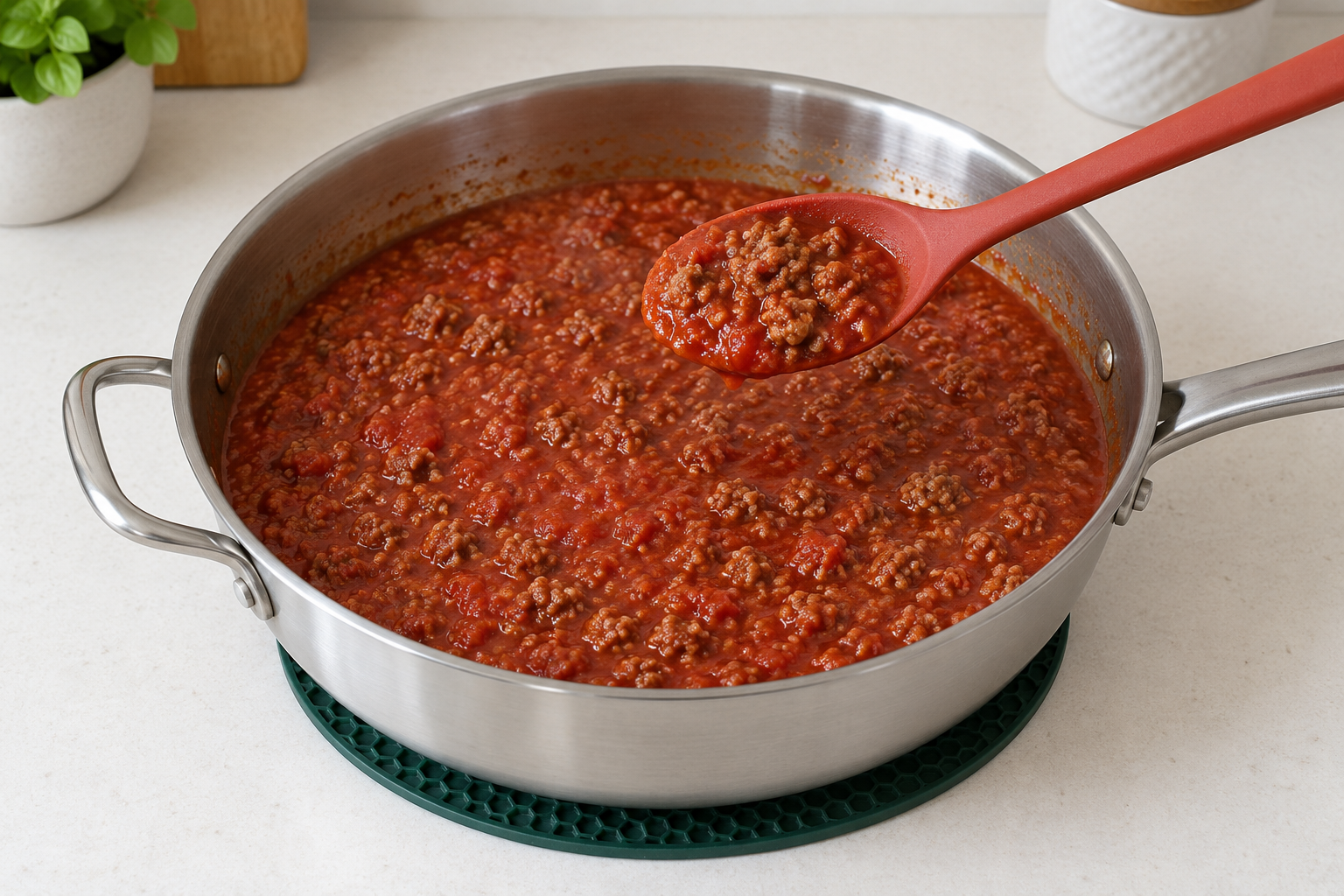
Mince is different from a whole steak
- Read food labels before you cookCheck dates, ingredients and the actual cooking directions.
- Storage and reheating basicsAllow the food to thaw fully in the fridge before this method.
Mincing breaks meat into small pieces and can distribute contamination throughout. Beef mince must be cooked thoroughly; the pink-centred whole-steak exception does not apply. Browning is a flavour step, not a complete safety test.
For this lesson use 250 g plain chilled beef mince, or mince fully defrosted in the fridge within its permitted storage period. This makes roughly two sauce portions, depending on appetite. Turkey, pork, frozen mince and meat-free products need their own preparation instructions, so do not assume this example covers every product called mince.
Measure and separate before heating
- Clean and set up your kitchen before cookingPrepare separate raw-contact and serving areas.
- Read food labels before you cookCheck dates, ingredients and the actual cooking directions.
- 250 g beef mince, 1 teaspoon cooking oil, 300 g plain passata and 100 ml water. Optional salt or pepper is added after cooking, not tasted from the raw mixture.
- A wide deep-sided hob-compatible frying pan around 24 cm, compatible heat-safe stirring tool and rest, jug, scales with clean measuring bowls, marked teaspoon/tablespoon, seconds timer, dry handle protection, pan trivet and food probe. Have a raw transfer spoon, optional kitchen scissors for the pack, separate clean tasting/serving spoons and supported serving bowls. For the optional fat-removal or shallow-sauce correction below, also have a heat-safe waste bowl, ladle and clean small saucepan around 1 litre on its own trivet. Set these out cold rather than searching with a hot pan.
- Measure passata and water into their own vessels first; plain passata is smooth strained tomato, not a concentrated puree. Check all labels and open passata before touching meat. With clean hands, put the mince pack flat in the raw area and peel its tab; use kitchen scissors away from fingers only if needed. Weigh the 250 g portion in a separate raw-contact bowl, cover and refrigerate unused mince promptly, then bin packaging and wash hands. Do not wash mince. Keep raw-contact scissors, bowl and transfer spoon away from the later clean tasting and serving equipment.
Break up and brown a small batch
- Stir, whisk, fold and turn: four different movementsBreak and turn the pieces with a supported tool.
- Put the measured oil in the cool pan and warm over medium heat. Once it flows easily but does not smoke, use the raw transfer spoon to add mince low over the pan, hands back from splashes. Set that spoon aside and wash hands before touching controls. Use the separate heat-safe stirring tool for the cooking; it too needs washing if it touches raw meat before being reused for finished food.
- Use the spoon edge to press and separate the meat into small crumbles, roughly pea-sized or smaller. Spread it over the base in a shallow layer. Large compact lumps cook less evenly.
- Let surfaces contact the pan briefly, then stir and turn them, breaking any remaining lumps. Continue for roughly 6 to 8 minutes, adjusting the heat to keep a steady sizzle without blackening. Released water may need to evaporate before good brown patches appear.
- If the meat is piled deep, reduce the batch size next time. For this small practice, keep stirring until the pieces are separated and some browned surfaces develop. Do not taste them yet or decide they are safe simply because pink colour has disappeared.
- For this small batch, leaving a little fat in the sauce is fine. If excess fat pools, switch the ring off, land the pan level on its trivet with dry handle protection and wait for bubbling to calm. With the heat-safe waste bowl supported alongside, spoon only the excess surface fat low into it, never tilt the pan to drain towards yourself. Cool the waste for appropriate disposal, never down the sink. The food will still need its complete cooking step.
Simmer and check the complete sauce
- Kitchen thermometer basicsPractise placing the sensing area and timing a continuous hold.
- Thermometer cleaning and careClean before checking and again after an undercooked reading.
- Simmer versus boilKeep steady gentle bubbling rather than a spitting boil.
- Switch the ring off and check the base with the pan supported on its trivet. If deposits are black and smell burnt, spoon only usable meat into the clean small saucepan without scraping; discard badly burnt food. Otherwise use the original pan. Wait for a calm sizzle with no pool of very hot excess oil. Add the passata and water slowly low over the food, keeping hands back from steam, then stir to combine. Do not pour water into smoking oil or an empty hot oily pan.
- Return the pan to the matching ring and bring to gentle bubbling, then lower to a simmer for about 20 to 30 minutes. Stir regularly across the base, breaking any clump with the tool edge. If it becomes too thick before cooking finishes, add 1 measured tablespoon room-temperature water low over the gently bubbling sauce, stir and reassess. Keep raw-contact tools away from tasting. This is a small teaching sauce, not a long-cooked ragu.
- Stir thoroughly, then switch the ring off and land the pan on its trivet for a supported check. Immerse the cleaned probe's entire sensing area within the stirred sauce and small meat pieces, not against the base, at several locations; check any larger remaining clump too. For this first practice, use the lowest checked point and maintain at least 75 degrees C there continuously for 30 seconds, with the seconds timer. If below target or dropping during the hold, return to gentle cooking, clean the probe, stir and repeat a full check. Temperature of metal or one hot sauce surface is not the food result.
- If the sauce cannot surround the probe's sensing area, keep the original pan on its trivet and ladle small amounts low into the waiting smaller saucepan on its own support. Do not pour a heavy hot pan in the air. Return that saucepan to gentle heat, stir and repeat the supported check. If your probe still cannot give a proper food reading, do not invent one; use a suitable probe before serving this exercise.
- When the full cooking check is satisfied, keep the ring off and pan on its trivet. Lift a clean spoonful onto the testing spoon, cool it and taste without returning that spoon. The mince should be tender small crumbles in a coating sauce; add modest optional seasoning only now. Spoon low into supported bowls, then leave cookware and waste fat safely to cool before cleanup. For a first task, serve with bread; pasta or vegetables are optional separately taught tasks, not raw ingredients that this finished sauce cooks.
Store portions, not a repeatedly reheated pan
- Pasta doneness: why tasting mattersCook the pasta separately before combining.
- How to soften onions without burning themPrepare a tender onion base for another attempt.
- Storage and reheating basicsCool promptly, label and reheat only once.
Serve what you need now. Cool spare sauce in shallow containers, refrigerate within one to two hours and use within 48 hours or freeze. Defrost in the fridge and use within 24 hours after fully defrosting. Reheat only once until steaming throughout, stirring to remove cold pockets. Any shorter ingredient restriction takes priority; do not reset the date by adding fresh passata or a later warm-up.
For a later version, add an onion prepared with the softening lesson or a measured herb. Change one thing at a time and keep the mince cooking and checking sequence intact.