
Essentials
Storage containers: sizes, lids and useful portions
Choose food-safe containers that fit your meals and learn what fridge, freezer, microwave and oven labels actually permit.
Before you begin
- Clean and set up your kitchen before cookingPrepare a clean workspace and clean the equipment afterwards.
Choose the container for the next job
Use a container sold for food storage and read the instructions for its exact range, base and lid. Find out whether it accepts hot food, freezing, microwave reheating, oven heat and dishwasher cleaning. Permission for one job is not permission for every job. If you cannot identify the instructions, do not put it into heat as a test; use a known suitable vessel.
Even one brand has different rules. Sistema KLIP IT PLUS, for example, allows reheating without its lid, whereas its Microwave range has a steam vent that must be open during heating. Its Ultra range is not recommended for freezing or microwaving. These examples explain why you check your own product; they are not instructions for every tub. Keep plastic storage containers off a hob and out of ovens or grills unless their exact maker explicitly allows that use.
Do not substitute a household cleaning tub or assume takeaway packaging is suitable for indefinite reuse, acidic sauce or hot fatty food. Glass also needs its own thermal-shock instructions: a fridge-cold vessel may not tolerate sudden oven heat. Transfer cold food to suitable cookware instead of guessing.
A small set that gets used
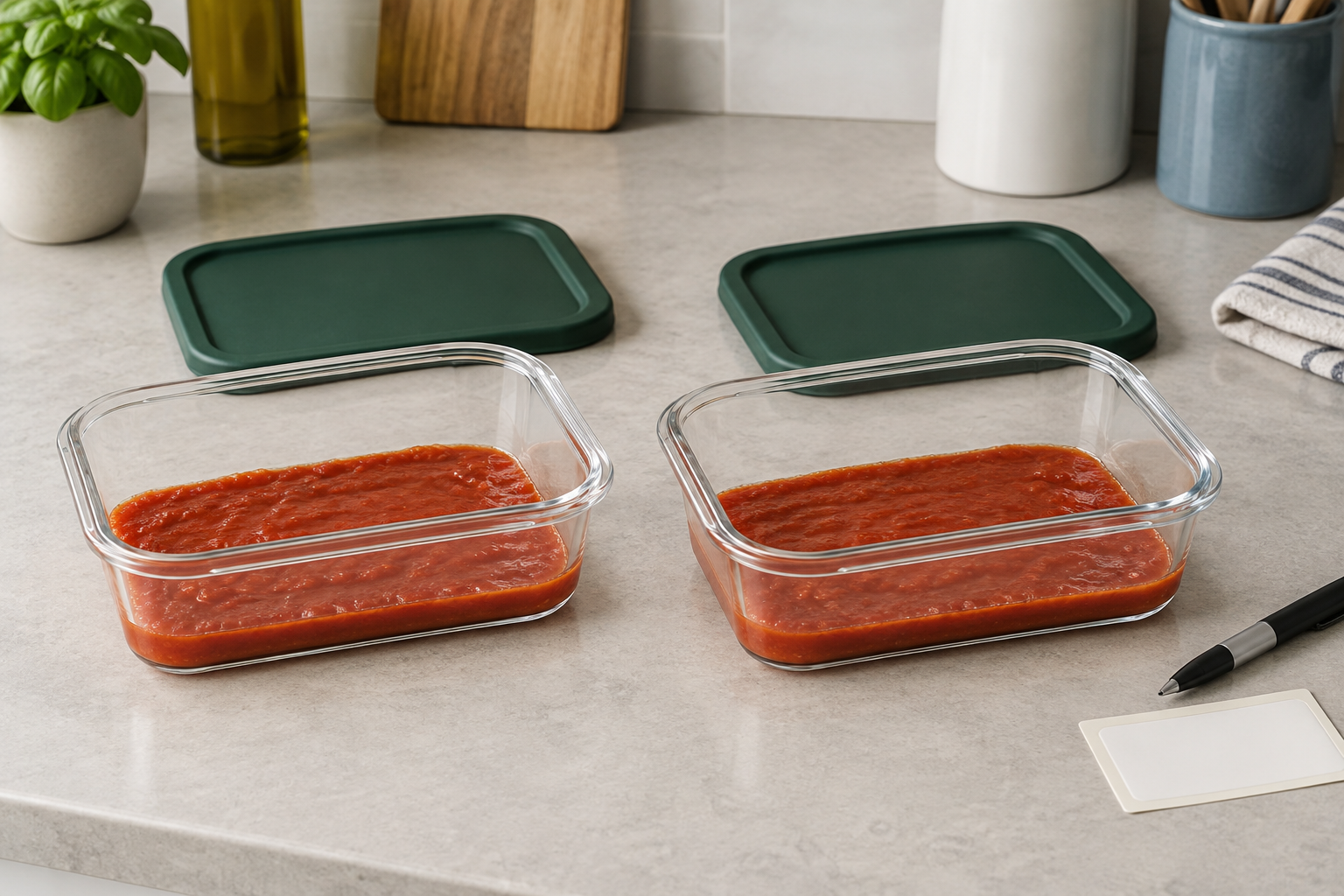
- Start with one or two broad shallow containers rather than a very deep pot. A nominal 500 ml tub can be a useful starting size for a small sauce portion, not a promise that every meal portion fits. The cold fit exercise below checks your actual vessel.
- Have matching lids, a pen and food-storage labels or suitable tape. Record food name, cooking date and time, planned use deadline and any previous reheat. A neat box does not supply missing history.
- Check the vessel fits your fridge shelf with room for cold air to move around it, and the freezer if needed. Store ready-to-eat food above sealed raw meat or fish. Do not choose a huge container just to reduce the number of lids.
- For cooling hot sauce, choose a shallow vessel explicitly suitable for that temperature. If your storage tub is not rated for hot food, cool promptly in appropriate shallow heatproof cookware, then transfer with clean utensils after cooling; keep the original cooling clock.
Put cooked leftovers away
- Storage and reheating basicsFollow the supported cooling, labelling and once-only reheating routine.
- Rice leftovers safelyUse the shorter rice routine rather than the ordinary leftovers limit.
- Storage and reheating basicsThaw the centre fully and retain the label history.
- Wash and dry the container and lid as the maker directs. Before cooking, have clean serving utensils and enough suitable shallow vessels ready for the amount being saved. Do not save food left on someone's plate with the untouched portion.
- Divide the spare cooked food promptly into thin shallow portions. Put them in a clean cooling area protected from raw-food splashes; do not stack warm tubs. Start the time reminder when cooking ends. Use the linked routine, including its supported cold-water-bath option if cooling is slow.
- For ordinary cooked food, cool and refrigerate within one to two hours. Once cooled, close the lid and label. Do not wait overnight for a big deep pan to cool. Rice has the shorter routine: cool ideally within one hour and use within 24 hours refrigerated; read its full lesson if storing rice.
- Write the food name and actual cooking date and time, with the earliest relevant use limit and reheating history. Changing the tub, adding fresh food or freezing does not reset an old cooking or reheating history.
- Use ordinary chilled leftovers within 48 hours or freeze promptly, respecting any shorter ingredient limit. Before freezing, check both vessel and food instructions. Leave the maker's expansion space for liquid, seal after cooling and label the freezing date too.
- Defrost one suitable portion covered in the fridge using the storage lesson, keeping it in a vessel that catches leaks. Use within 24 hours after fully thawed, or a shorter instruction. Do not force an ice-stiff lid or hurry the food on the worktop.
Reheat with the correct lid and vessel
- Storage and reheating basicsFollow the saucepan inventory, stirring and hot-centre checks.
- Use a microwave and check for even heatingUse the complete permitted-cover, stirring and standing routine for the microwave option.
A storage lid is not automatically a microwave cover. Remove or vent it as your product directs, and use only permitted covers. Never microwave a tightly sealed tub. Follow the appliance and food instructions for power, stirring and standing. Lift a cover away from your face and protect hands from hot contents.
For a first small soup or sauce portion, the linked saucepan routine is a clear alternative: transfer cold food with a clean spoon to a suitable saucepan, heat with regular stirring and check the centre as well as the edges. Switch off, put the pan on a trivet and serve. The container need not be heated at all.
Reheat only the portion being eaten, and only once. The whole portion must be steaming hot throughout, not merely have a hot edge or warm lid. Do not save a partly eaten reheated bowl for another reheating.
Cleaning and replacement
After use, wash the body and lid with warm soapy water or the permitted dishwasher setting, then dry before storing. Remove a seal only if the maker says it is removable, and reassemble as directed. Do not pry out a fixed seal with a knife. Check corners and lid grooves for trapped food.
Replace a cracked vessel, a damaged lid or seal, or a deeply scratched container that cannot be cleaned properly. Persistent unwanted odour also deserves attention. Tomato staining by itself differs from physical damage. If you cannot clean it or confirm its suitability, choose another vessel rather than testing it in an oven.
Try a portion before buying a set
- Measuring accurately without stressRead a jug marking at eye level for the cold capacity test.
- Batch cooking: make extra without making a messTry a small measured sauce batch after the cold exercise.
- For a cold fit exercise, wash and dry a known food container and its matching lid. Set it on a stable worktop with a measuring jug. Measure 250 ml cold drinking water and pour it into the container; this is a capacity test, not stored food or a safe hot fill limit.
- Check the water sits below the rim with room for the lid to close normally. Keep the container upright; do not turn it over to test whether it is leakproof. Look at the depth: a narrow deep tub gives a deeper layer than a broad shallow one at the same quantity.
- Check the closed tub fits the chosen fridge shelf without blocking airflow. Empty the test water, dry the vessel and put it away. Freezing needs the maker's own expansion allowance; do not freeze this test just because the lid fits.
- For a real first portion, use the measured tomato sauce from the batch lesson. Save about half in a suitable shallow container using the cooling routine, then notice whether that amount was useful for one meal. Increase your collection only when you know what sizes you actually use.