
First Kitchen Skills
Use a microwave and check for even heating
Choose a suitable container, match the power setting, stir and allow standing time, then check the centre rather than trusting a hot bowl.
Before you begin
- Clean and set up your kitchen before cookingSet up clean utensils, dry gloves and a heatproof landing space.
- Read food labels before you cookUse the exact portion, output power, opening and heating instructions on the soup you choose.
Find the microwave setting and power
Read the appliance label or manual for its microwave output in watts, often written as W. This is not necessarily the electrical input printed elsewhere on the machine. Packet instructions may give different times for different output powers. Choose the matching set or the manufacturer's guidance rather than guessing a universal conversion.
A combination microwave may also grill or heat like an oven. For this lesson select microwave-only mode. Identify the power, time, start and stop controls with the appliance off. Do not run it empty to experiment with the controls.
Identify pause, cancel and restart before cooking. For example, the Panasonic NN-E28JMM/E28JBM/E27JWM manual sets microwave power, then time, then Start. During heating one Stop/Reset press pauses; a second cancels the programme. Closing the door after stirring does not restart it without Start. These are examples, not universal button names: follow your own manual and read the remaining time before restarting. A kitchen-timer setting can count down without heating food.
Set out the soup and tools
- Open a can and use cooked beansFollow the can-opening section if your soup is in a can; the bean-cooking steps are not needed.
- One portion of soup explicitly labelled for microwave heating, with its instructions for your output power and portion size. Choose a pack you can open safely; do not put a metal can in the microwave. The can-opening lesson is available if needed.
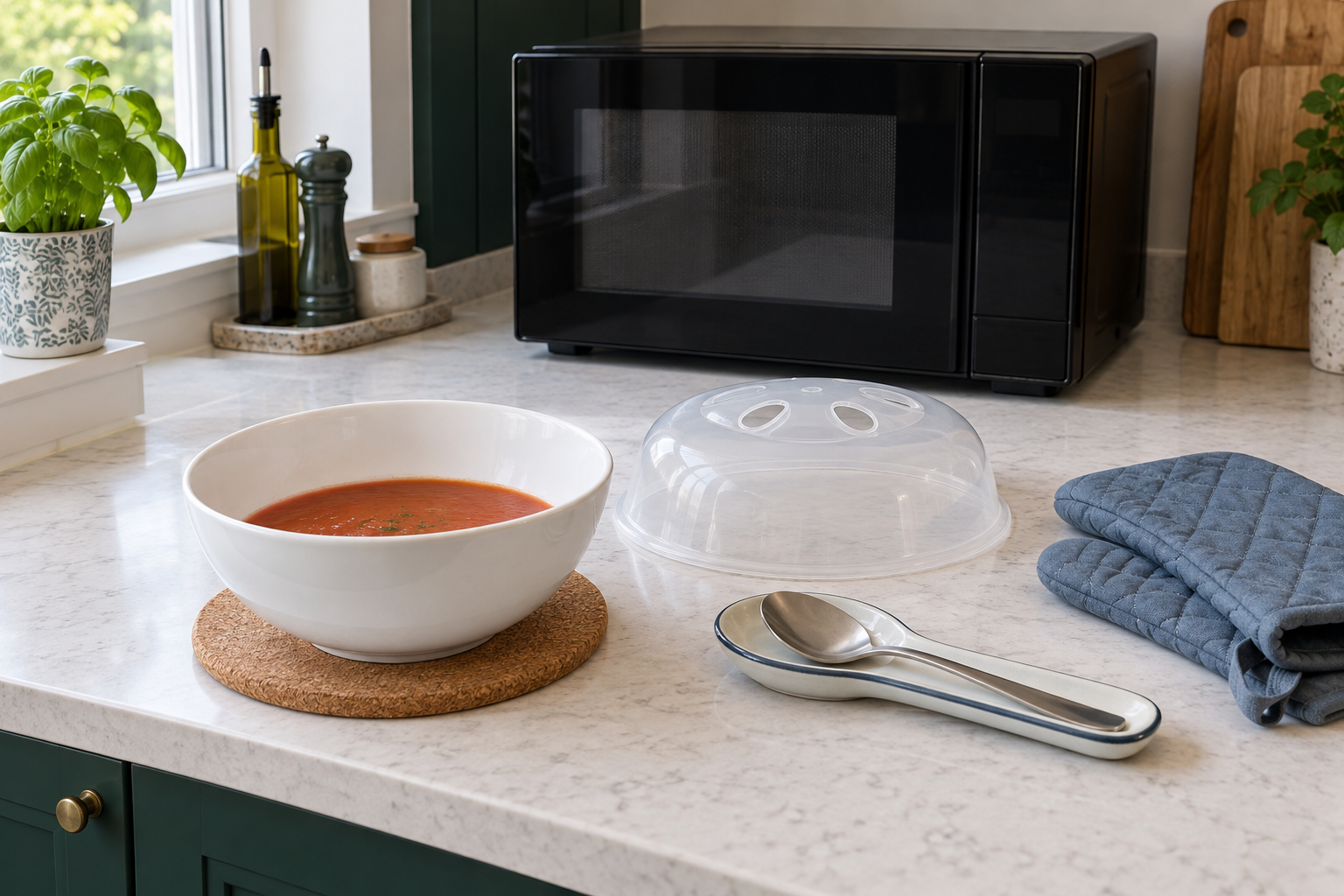
- A microwave-safe bowl and vented cover if the pack requires transfer, a clean stirring spoon, clean tasting spoon, dry oven gloves and a stable heatproof trivet. The bowl must have space above the soup and must fit and rotate freely if the machine has a turntable. Do not use a narrow-necked bottle.
- A timer for any standing time, and a clean food probe if using the optional temperature check. Take the probe and stirring spoon out before every heating interval.
- Check that the door closes normally, its seal is undamaged and ventilation space follows the manual. Do not use an appliance with damaged door/seal, cord or plug, or attempt an internal repair.
Choose the container before the food
- Use a container and cover specifically suitable for microwave use. Plain microwave-safe glass or ceramic and approved plastic are possibilities; appearance alone is not enough.
- Do not use metal, foil, metal-decorated dishes or ordinary takeaway packaging unless the appliance and product instructions explicitly permit the exact item and method.
- A cover limits splashes but must allow steam to escape as directed. Never seal a container tightly. Keep cling film away from food and use it only if its instructions permit microwave use.
- Do not heat a whole egg in its shell, a whole hard-boiled egg, a sealed jar or a closed tin. Foods with a skin may need piercing according to their cooking instructions. Never invent a microwave method for ordinary sealed packaging.
Practise with a microwave-ready soup portion
- Kitchen thermometer basicsFor the optional probe check, measure the stirred soup away from the bowl walls and base.
- Stir, whisk, fold and turn: four different movementsMove the spoon gently through the whole bowl without splashing.
- Choose one labelled microwave-ready soup portion and read its full preparation, heating, stirring and standing instructions. Check the date, storage history and suitability for everyone eating it.
- Prepare the pack exactly as directed, or empty it into the microwave-safe bowl if instructed. Stir the soup before heating where accessible, then remove the spoon. Fit the cover with its vent open as directed. Leave headroom; never fill to the brim or seal the lid tightly.
- Place it centrally on the turntable if the appliance has one, with room to rotate. Fit the vented cover as directed and close the door.
- Set the packet's matching power and first heating interval, check the display, then start. Stay nearby. At the stated stirring point, pause or let that interval finish. Open the door only once heating has stopped. Use dry gloves for the bowl and move it to the trivet if that is safer than reaching inside.
- Lift the far edge of the cover first so steam escapes away from your face. Stir carefully from the edges to the centre and across the bottom. Remove the spoon, replace the vented cover, return the bowl securely and close the door. Resume or enter the next packet interval as your controls require; do not restart the whole original time by mistake.
- Let the full stated standing time pass without microwave power, keeping the cover as the label directs. Liquids can become very hot without obvious bubbling, so do not add extra time just because the soup looks still. Avoid leaning over it; stir carefully again after standing and before serving.
- After stirring, check that the whole soup is steaming hot, not just its edges. If cool patches remain, continue with brief extra heating intervals as the packet/appliance advises, stirring and checking again and allowing its stated stand. Do not taste lukewarm soup as a safety test. If using a food probe, remove the bowl safely first and follow the linked centre-check method; never leave the probe in the running microwave.
- Set the bowl on a heatproof surface. Stir and let a serving spoonful cool before eating. The bowl being comfortable to hold does not mean the food cannot scald you.
Why a hot edge is not enough
Microwaves can leave cool pockets beside much hotter food. Stirring and turning are parts of the cooking method, not optional presentation steps. Dense foods such as lasagne may heat more evenly in smaller portions. Use the packet's checks or the relevant cooking lesson as well as the time.
Never put an ordinary metal temperature probe into a running microwave. Stop the appliance, remove the food safely and take a reading with a clean probe. A microwave-approved sensor is different equipment and must follow its own instructions.
Defrosting is a separate job
- Storage and reheating basicsCheck storage and reheating limits before using leftovers.
Defrost mode uses a different heating pattern; it does not mean the food has been cooked. Prefer planned fridge defrosting. If using the microwave to defrost, follow the food and appliance instructions, turn or separate pieces when directed, and cook immediately afterwards. Do not leave partly warmed raw food waiting on the worktop.
When to stop the appliance
Stop immediately for sparks, smoke or a damaged container. If there is smoke or fire, keep the door closed, switch off only if safe, leave and call 999 from safety. Do not restart until the fault has been resolved by appropriate service. After ordinary use, allow spills to cool and clean the interior, door and seals according to the manual, with the appliance disconnected when it requires. Do not remove its outer casing.