
First Kitchen Skills
Decide whether food is still safe to use
Check known identity, dates, handling and storage before deciding to use, keep or discard food; do not substitute a smell test for its history.
Before you begin
- Read food labels before you cookRead the actual pack, its ingredients, date and storage instructions.
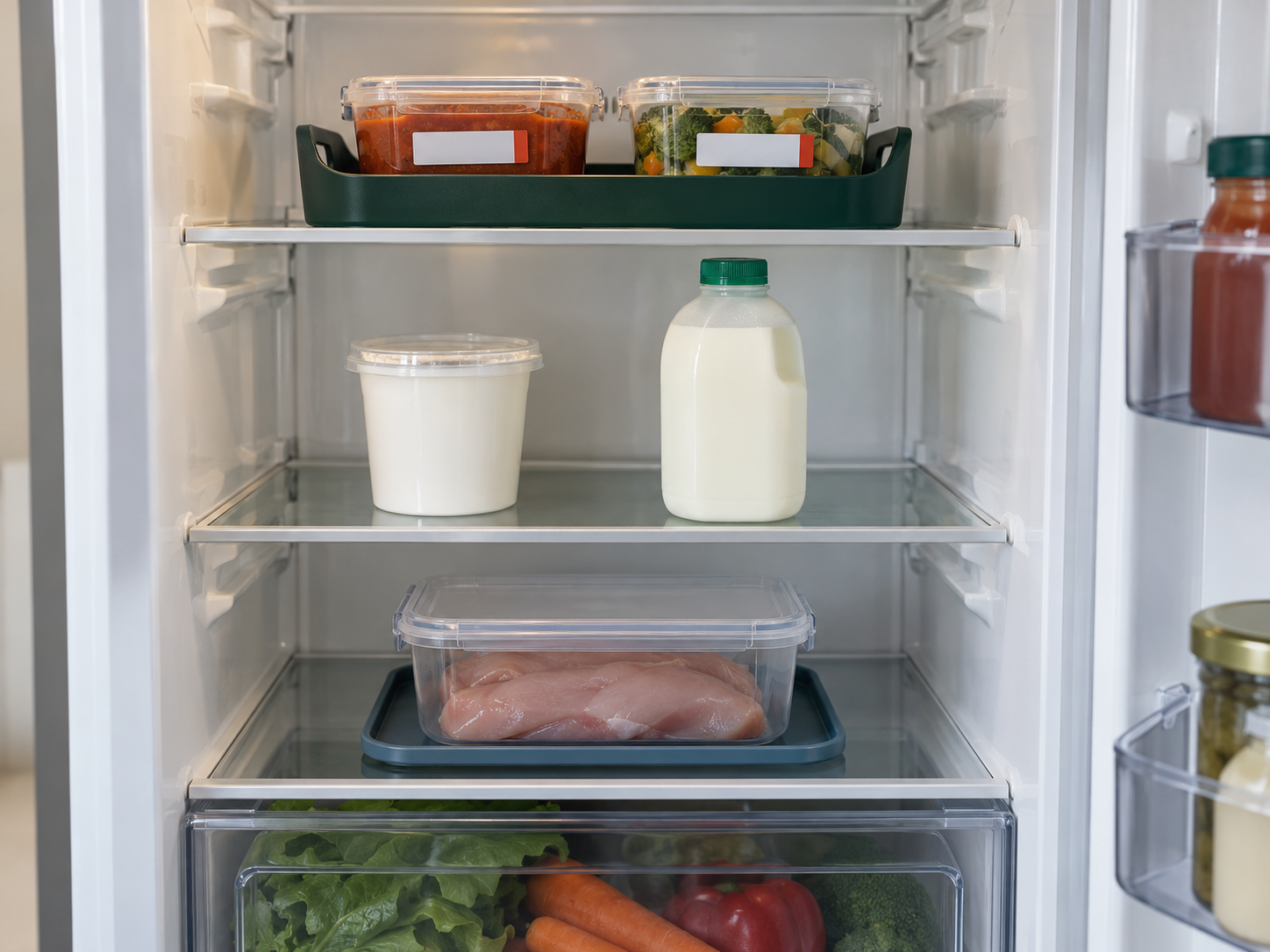
Start with known facts
- Read food labels before you cookRead the actual pack, its ingredients, date and storage instructions.
This is a decision task, not a cooking rescue. Choose one food you are considering using and find its original packaging or reliable label, opening or cooking time, and where it has been kept. Keep chilled food chilled while checking. You need enough light to read, a pen and a reminder label; no tasting is required.
If you cannot establish a fact that the safe decision depends on, stop. In this beginner guide the conservative choice is not to serve that uncertain food. A new label, extra seasoning, freezing or another boil does not recreate its missing history. Ask the person who prepared it only if they can give reliable information, not a guess.
Make the decision in order
- Storage and reheating basicsFollow the complete cooling, labelling and original-clock routine.
- Rice leftovers safelyUse its shorter rice routine and previous-reheat checks.
- Identify what it is and who will eat it. Retain ingredient and allergy information; do not taste an unknown food to check suitability. For a medically prescribed diet, follow the person's professional advice rather than this general guide.
- Read the date type and after-opening instructions. A use-by date concerns safety; do not eat beyond it unless it was properly cooked or frozen on or before that date and remains within its separate storage limits. A best-before date concerns quality, not permission to ignore poor storage.
- Check storage before AND after opening against the actual label. A cupboard jar can require refrigeration once opened. Correct dates alone do not clear food kept incorrectly. If opening time is needed for a short limit but is unknown, do not give it a fresh clock today.
- For homemade leftovers, establish original cooking time, cooling and any previous reheating. Use the complete storage lesson to assess the appropriate limits, with the rice-specific lesson when relevant. Food chilled now may still have spent too long warm earlier.
- Check for contamination or a compromised pack. Food reached by raw juices, cleaning chemicals or broken glass is not a flavour-adjustment exercise. Keep suspect food separate so nobody eats it while you decide. Do not wash ready-to-eat food and assume contamination has gone.
- Choose one outcome: use it by its complete preparation method while within all limits; keep it only under its actual permitted storage instructions; or discard when unsafe or necessary history is unresolved. Record a real deadline only AFTER deciding that keeping it is appropriate.
Smell is not a safety certificate
- Open a can and use cooked beansCheck an intact can before the complete safe opening method.
Food with a use-by date cannot be cleared by a normal smell: you cannot reliably smell the organisms that cause illness. Egg floating indicates age, not a safety test. Do not take a taste of suspect meat, dairy or leftovers to settle the question.
For a correctly stored best-before food, appearance, smell or texture may help assess quality. That is different from clearing unknown storage or damaged packaging. For the first practice, choose a clearly identified in-date item; you do not need to prove that an older food can be used.
Discard mouldy bread rather than trimming the visible spot, and reject bulging or leaking cans. Keep the container closed where practical and dispose of it according to local waste guidance, preventing accidental use. Wash hands and clean anything contaminated.
A power cut needs its own checks
- Open a can and use cooked beansFor a suitable ready-cooked canned product, use the safe opening steps.
Note when the outage started and keep fridge and freezer doors closed. FSA estimates are up to four hours for a closed fridge, 48 hours for a full freezer or 24 for a half-full one; appliance, room conditions and opening affect these, so they are not guarantees.
Normal fridge guidance is 5 C or below. FSA outage advice permits storage below 8 C. If it reaches 8 C or above, food needing refrigeration should be eaten within four hours and discarded afterwards unless power was restored within four hours. The restoration exception is not proof that an unknown earlier history was safe.
When duration or temperature history cannot be established, do not infer safety from the appliance being cold again. This guide takes the conservative route of discarding uncertain perishable food. Use the current official outage advice for your known circumstances; keep existing food dates and suitability checks.
Choose a verifiably suitable cupboard food whose pack explicitly permits eating without cooking when you cannot cook safely. Follow a complete can-opening lesson if needed. Do not operate an outdoor barbecue or camping stove indoors. Get qualified help for a faulty appliance rather than trying electrical repairs.
Practise a clear stop-or-go decision
- Fridge zones and the use-first boxFor a later organisation task, keep only eligible known-history food in the use-first area.
Example: an unopened labelled yoghurt, known to have stayed correctly chilled, within its date and suitable for the person eating, can be used according to its pack. Read any new opening limit and write the true opening date when you open it.
Different example: a closed tub that looks like yoghurt, has no identity or date, and might have been on the worktop overnight cannot be cleared by its white colour or familiar smell. Do not invent what it contains or place it at the front to eat soon.
Finish by saying what you know, what limit applies and what you decided. Choosing not to use doubtful food completes the task. A useful food system reduces missing information next time, rather than rewarding every attempted rescue.