
Meat And Poultry
Cook sausages through without burning the outside
Read the product, arrange a small tray, turn with control and check the middle rather than trusting a brown skin.
Before you begin
- Clean and set up your kitchen before cookingSeparate raw-contact equipment from clean serving equipment.
- Use an oven: settings, preheating, shelves and the grillSelect the oven mode, preheat and handle a hot tray.
- Kitchen thermometer basicsPlace and clean the probe, and use temperature with its holding time.
Choose the right starting product
- Read food labels before you cookCheck dates, ingredients and the actual cooking directions.
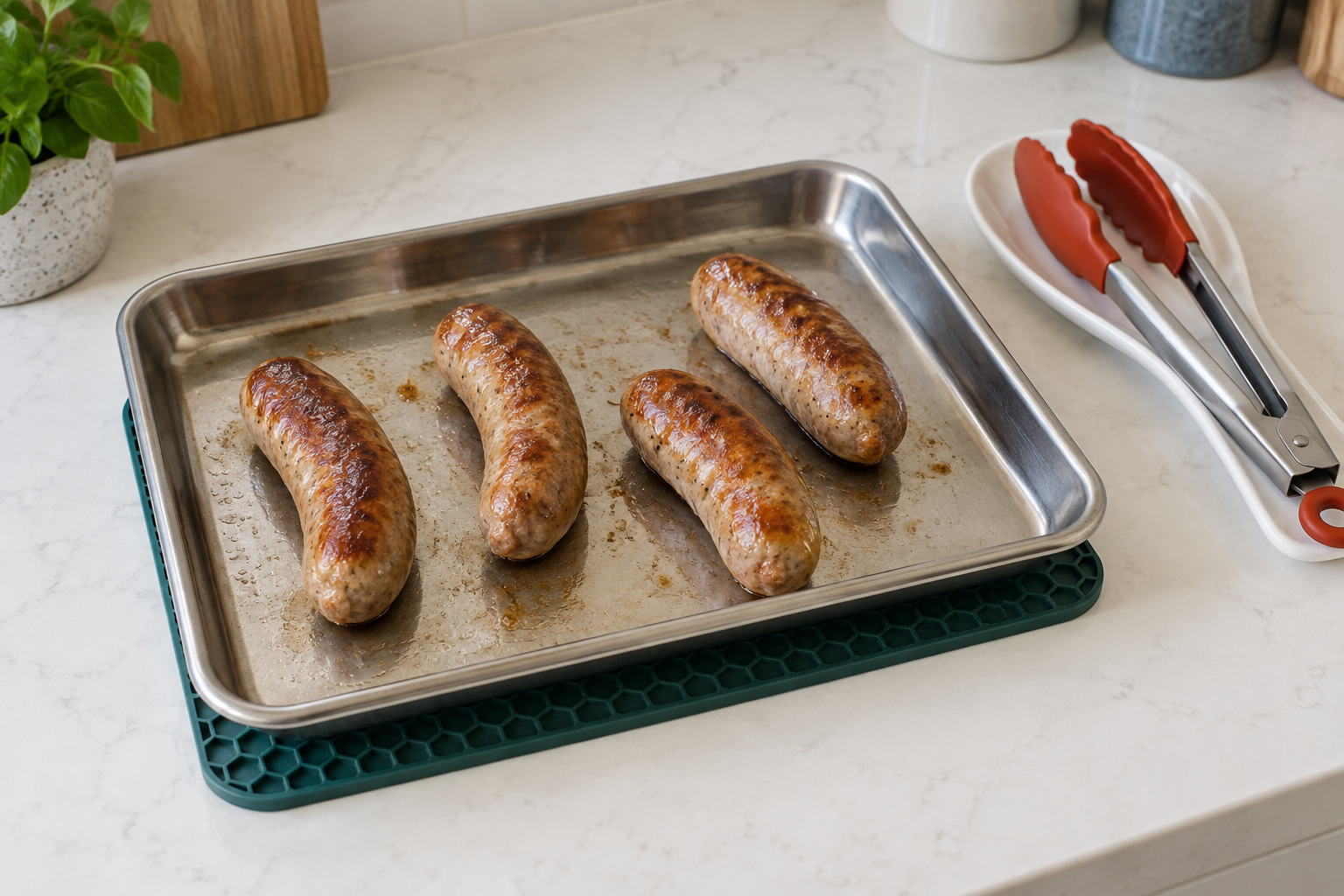
Use four ordinary chilled raw pork sausages, roughly 50 to 75 g each, for two adjustable portions. They contain minced meat and need thorough cooking in the centre. A browned casing does not establish that. Check the label for allergens, including possible wheat or sulphites, and for storage and preparation directions.
This example is not for a large sausage coil, frozen sausages, cooked frankfurters, dry-cured sausage or a meat-free product. Follow the specific product method for those. If your chosen pack specifies a different oven setting or longer cooking, use its instructions and still check doneness.
Set up a simple oven batch
- Clean and set up your kitchen before cookingPrepare separate raw-contact and serving areas.
- Four sausages and about 1 teaspoon suitable cooking oil if needed for the tray and the product permits it. Some products need no added oil.
- A small unlined rimmed metal oven tray rated for the setting, raw-transfer tongs, clean turning tongs and separate clean serving tongs or correctly washed replacements. Have a probe, seconds timer, two dry oven gloves, tray-sized trivet, clean plate and rests for used tools. A marked teaspoon measures optional oil; a spoon spreads it on the cold tray before raw-food contact. Clean kitchen scissors are optional for linked casings or a pack without a peel tab.
- With clean hands, open the pack flat in the raw preparation area using its tab, or scissors cutting away from fingers. For linked sausages, lay them flat on the cold tray, keep fingers out of the scissors' path and snip only the narrow connecting strip, not the sausage itself. Remove all outer packaging, leave ordinary edible casings on and do not pierce them for this method. Set raw-contact scissors and tongs aside for cleaning and wash hands after preparation.
Arrange, turn and monitor
- Put a shelf near the oven middle while cold. Preheat to 190 degrees C conventional or 170 degrees C fan for this example, unless the packet gives a different required method.
- Spread the measured oil thinly on the cool tray if using it. Add the sausages with gaps between them and roll with the raw-contact tongs to coat lightly. Do not stack or tightly crowd them.
- Wash hands and set the raw-contact tools aside for cleaning. Put the tray into the preheated oven and set a reminder for 10 minutes. A standard sausage often takes around 20 to 25 minutes at this setting, but size and formulation vary.
- At the first reminder, open the door from a safe stance and land the tray level on its trivet with both dry gloves; close the door while turning. Use the clean turning tongs to roll each sausage onto another side, not fingers or a wet cloth. If the filling is still undercooked, those tongs now need cleaning before a final serving task. Return the tray with both gloves and set the next reminder for 10 minutes.
- At about 20 minutes, land the tray safely again and begin the centre check. Follow any longer full packet cooking requirement. If the outside darkens too fast, lower the oven by about 20 degrees C and continue with short reminders until the centre passes. Brown skin over a cool filling is not the endpoint; do not switch to an unsupervised fierce grill to catch up.
Probe the centre and finish
- Kitchen thermometer basicsPractise placing the sensing area and timing a continuous hold.
- Thermometer cleaning and careClean before checking and again after an undercooked reading.
- With the tray level on its trivet and oven door closed, steady one sausage with tongs. Insert the cleaned probe from an end along its length into the thickest centre, so the sensing area is surrounded by filling, not next to the casing or through into air. Keep fingers clear of hot fat and the probe tip. Use the probe's instructions for its sensing length.
- Check all four sausages in this small batch; different positions and sizes may heat differently. For the first exercise, verify at least 75 degrees C continuously for 30 seconds in each thick centre, using a seconds timer only after the stable reading reaches the target. Keep the sensing area in place during the hold. If it drops or starts below target, that piece needs further cooking and a new full check, not scattered seconds added together. Do not use the casing colour as an alternative.
- If any fails, remove the hand-held probe, return the tray with both gloves for about 3 to 5 minutes and reset the reminder. Clean the probe after an undercooked check and before checking again. Do not leave an ordinary hand-held probe in the oven. Continue until all four checks and any full packet requirement are satisfied.
- Switch the oven off. With the tray on its trivet, transfer low to the counter-supported serving plate using separate clean serving tongs, not the pair that touched undercooked filling. Let a small first bite cool because hot fat can burn. For a first exercise serve with bread; another hot side is optional and needs a plan. Leave cookware supported to cool before cleaning and confirm the oven is off.
Keep a useful note and store leftovers
- Boil and steam vegetables without guessingCook a small vegetable side.
- Mashed potatoes: even cooking without a gluey textureMake a complete potato side.
- Storage and reheating basicsCool promptly, label and reheat only once.
Record the pack, approximate size and actual time that worked with your oven, but still check future batches. For a first side, use the vegetable or mash lesson and plan its timing before starting the sausages.
Cool spare cooked sausages promptly, refrigerate within one to two hours and use within 48 hours or freeze, following shorter pack restrictions. Reheat only once until steaming hot throughout. The centre still matters when reheating a cut-up sausage in sauce.