
Charts And References
Meat temperatures: a practical UK cooking reference
Use a temperature and holding time together, measure the right place and distinguish fully cooked food from steak preferences.
Before you begin
- Kitchen thermometer basicsFind the sensing area and make a complete temperature-and-time check.
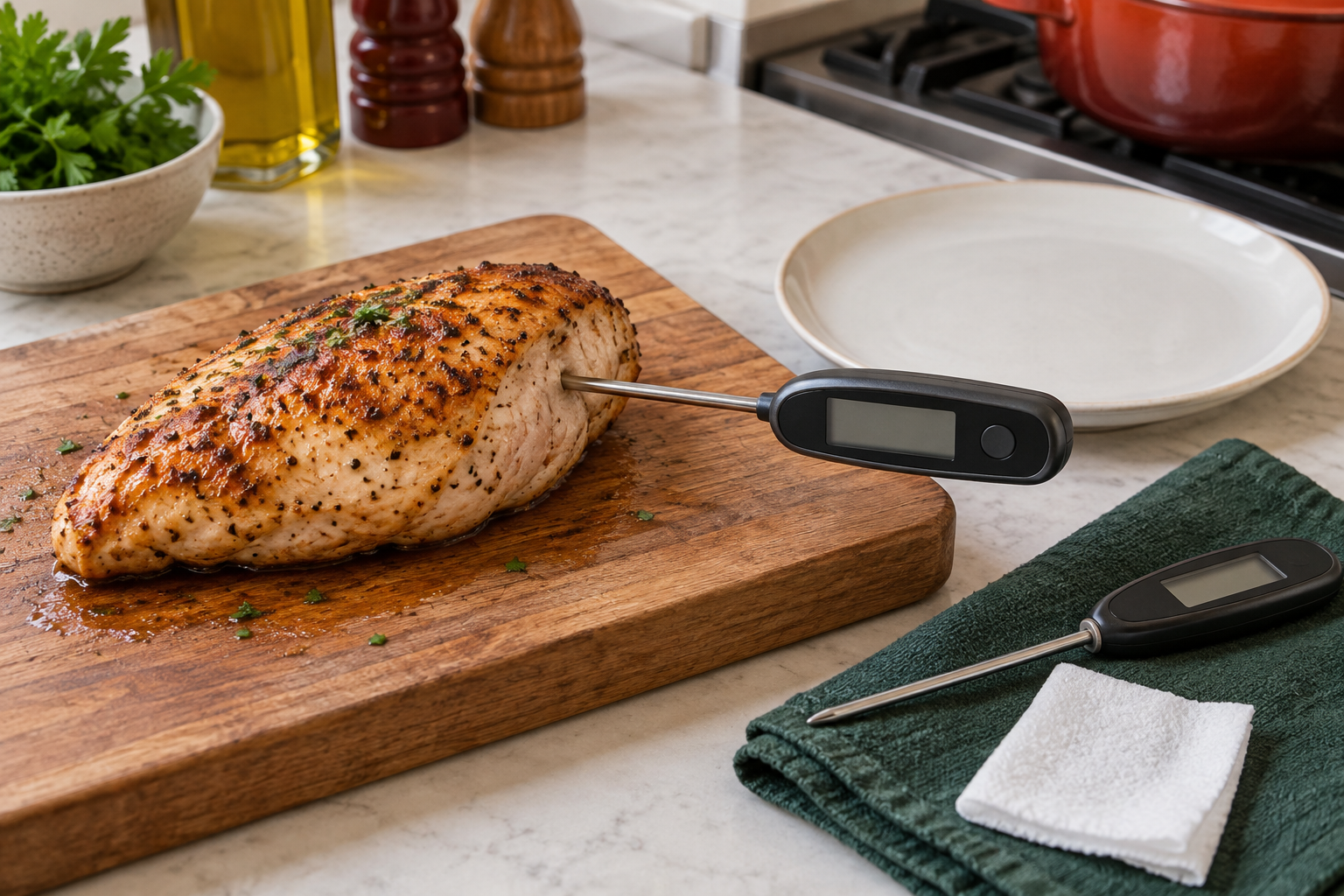
Temperature and time work together
A food thermometer measures the temperature around the probe's sensing area. It does not measure the whole dish at once. To judge thorough cooking, put the sensing area in the centre of the thickest part and give the reading time to settle. Touching a hot tray or a bone can give an unhelpful reading.
The Food Standards Agency gives equivalent combinations of temperature and holding time. Reaching a number for an instant is not the same as holding it for the required time. For a beginner cooking at home, 75 C for thirty seconds is a practical combination to remember; 70 C for two minutes is another.
Core means the middle of the food, not the oven air, hot pan, browned surface or liquid around a solid piece. This table is for checking thorough cooking, not for choosing a rare steak preference or holding a meal warm. Read the food's complete method before using it.
Thorough-cooking reference
These are FSA core temperature and time combinations. Keep the food at or above the temperature for the whole stated period. They are not oven settings.
| Core temperature | Minimum time at that temperature |
|---|---|
| 70 C | 2 minutes |
| 75 C | 30 seconds |
| 80 C | 6 seconds |
Foods that need thorough cooking
- Brown mince and make a simple meat sauceCheck a stirred meat sauce and any larger clumps.
- Cook sausages through without burning the outsidePosition a probe in the sausage filling.
- Storage and reheating basicsUse shallow cooling, dated storage and a single thorough reheat.
- Poultry, including chicken and turkey, and pork.
- Burgers, sausages, minced meat, rolled joints, offal and meat skewered through the centre. Surface contamination can be carried inside by processing.
- Stuffed meat, including both the meat and the centre of the stuffing.
- For reheated leftovers, check steaming hot throughout and follow the reheating guide. Reheating cannot make badly stored food safe.
Take a useful reading
- Thermometer cleaning and careClean before checking and again after an undercooked reading.
- Cook a plain chicken breast in the ovenUse a complete single-breast method.
- Cook sausages through without burning the outsideUse a supported end-entry check for the small four-sausage batch.
- Brown mince and make a simple meat sauceUse a stirred deep-sauce check rather than touching a shallow pan.
- Have a working food probe, a timer or clock showing seconds, dry gloves if moving an oven dish, a trivet and clean serving utensils. Learn the probe's sensing area and response time from its instructions. Clean it using the probe-care lesson.
- For a hot oven dish, land it level on the trivet with dry gloves and close the oven door. Keep food supported there. Insert into the thickest centre, avoiding bone, metal and large fat pockets. Enter a thin piece from the side if that places the full sensing area in the centre; never accept a display while its sensing area sits in air or against the dish. Use the linked complete method for that food's handling.
- Wait for the reading to stabilise. With this small first batch, check every chicken breast or sausage, and more than one thick location within a larger piece. For a sauce, stir and check the stirred mixture and any remaining large clump as the mince lesson explains; one warm surface is not a whole-meal result.
- If below the selected target, continue cooking. Clean the probe before checking again so raw contamination is not transferred to cooked food.
- Once the lowest checked centre is at least 75 degrees C, start a 30-second timer and keep the probe in that point while the food rests securely on the trivet. Confirm the reading stays at or above 75 throughout. If it drops below, continue cooking, clean the probe and start a new full check. For the 70 degrees C alternative, the whole continuous hold is 2 minutes. Do not add together scattered seconds from separate checks or treat a later five-minute rest as proof that the temperature was maintained.
- Clean the probe after use and serve using a clean plate and utensils.
Where steak is different
- Steak: browning, turning and restingUse a complete steak practice with an explicit starting target.
An intact whole beef or lamb steak can be served pink when its entire outside has been properly cooked, subject to the eater's needs and the product instructions. This does not apply to chicken, pork, burgers, rolled or stuffed meat, or products mechanically tenderised through the surface. Rare-steak preference charts are not substitutes for a thorough-cooking chart. If you cannot establish what cut or process you have, cook it thoroughly.
Use and print the reference
Read the food category before choosing a number, then pair that number with its time. Print this page for the kitchen if useful, keeping the source and review date with it. If an appliance or product gives stricter instructions, follow those. No photograph, hand-press test or clear-juice check gives the precision of a properly placed, working probe. Open your browser's main menu and choose Print, then paper or a PDF destination offered by your browser. Check the preview contains the table, food categories and source notes before printing. This prints the full lesson, rather than providing a separate compact chart attachment.