
Eggs
Boiled eggs: soft, jammy and hard
A complete beginner guide to boiled egg textures, cooling, peeling and what overcooked eggs look like.
Before you begin
- How to use hob heat without guessingSet the ring and respond to the food rather than relying on a dial number.
Start timing from a defined moment
Egg timing depends on size, starting temperature and whether you begin in cold or already hot water. This guide uses large hen eggs from the fridge, gently lowered into water that is already boiling, then cooked at a steady gentle boil. Do not apply these times unchanged to a cold-water method.
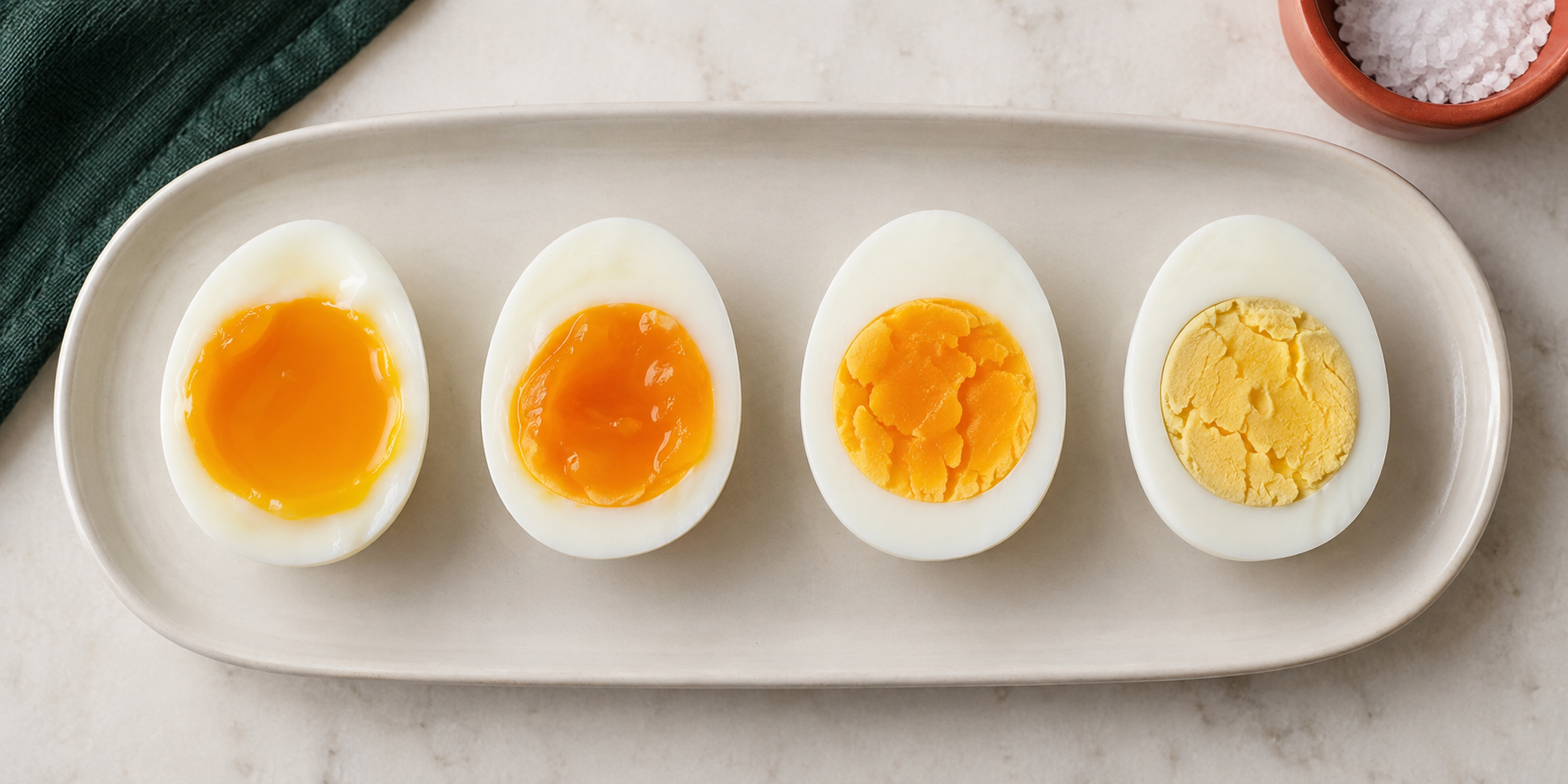
Soft means a set white with a runny yolk. Jammy means the yolk is thick and spoonable. Hard means it is firm throughout. Choose the target before you start and have the cooling water ready.
Choose eggs for the result you want
- Egg freshness, storage and separating yolksCheck the assurance mark before choosing a runny yolk.
Choose in-date British Lion or Laid in Britain hen eggs for a lightly cooked result. If their assurance is uncertain, cook white and yolk fully. Other species need thorough cooking. A medically supervised diet for severe immune suppression takes priority; ask the clinical team about eggs.
What you need
- One or two large hen eggs from the fridge; an intact saucepan holding around 1.5 to 2 litres; enough cold drinking water to cover them by about 2 cm while leaving several centimetres below the rim; a long-handled spoon for lowering; a separate clean slotted spoon for lifting cooked eggs; and a timer. Check the cold water depth with the eggs in place, then lift them out onto a plate before heating that water.
- A stable bowl of cold tap water, with ice if available, large enough to cover the cooked eggs; a clean plate; a fork for splitting a peeled firm egg; a clean teaspoon and stable egg cup if opening a soft egg; dry oven gloves; and a heatproof trivet. Set the cooling bowl beside the hob but away from the heat, not in your other hand while lifting eggs.
- Use a single layer without crowding and reject damaged or dirty shells. Do not prick the shell for this first practice. With everything cold, rehearse lowering one egg on the spoon without letting it roll off, then lift it out. Your hands stay above the water; do not drop eggs into the pan or put fingers into hot water.
- Choose one target texture for the first batch. Prepare any accompaniment first. You will lift the eggs out individually, so there is no need to carry or drain a pan of boiling water.
Cook, cool and peel
- Simmer versus boilKeep the water moving gently, not violently.
- Scrambled eggs: soft curds, dry curds and when to stopA fully set recovery if an opened egg is softer than required.
- Put the pan on a matching ring with its handle safely turned in, away from other rings. Bring the water to a boil, then carefully lower each egg on the spoon until it rests in the pan. Start the timer as the first egg enters; add the second promptly so their timings are close. Put the lowering spoon aside, separate from clean serving tools.
- Adjust to a gentle steady boil rather than a violent rolling movement. The eggs should not crash around the pan.
- For this method, begin with about six to seven minutes for soft, eight to nine for jammy, and ten to twelve for hard. These are starting ranges, so check your first result and adjust for your eggs.
- Switch off the ring and lift each egg with the clean slotted spoon. Let hot water drip back over the pan, then lower the egg into the prepared cold-water bowl, keeping hands and face out of steam. Leave the pan safely on the hob or trivet until its water has cooled. Cool a soft egg until comfortable to handle; for peeling firmer eggs, leave in cold water for several minutes and replace warming water as needed.
- For a firmer egg, dry it and gently tap and roll on a clean surface to crack the cooled shell. Start at the wider end and lift away small pieces with the thin membrane underneath. Put shell in a separate dish; rinse a peeled egg with clean water if small fragments cling. For a soft egg, do not roll it: place it pointed-end up in the stable egg cup, tap gently around the upper shell with the teaspoon and lift off a small cap. Pick out fragments with a clean teaspoon and do not eat the shell.
- For a peeled firm egg, put it on the plate and gently split through the centre with the fork. For a soft egg in its cup, spoon into the centre to see the yolk. Compare the texture with the target. If you need fully cooked egg but find a soft centre, do not serve it as hard-boiled; use the immediate recovery below or discard it and make the next attempt longer.
If an opened egg needs further cooking
- Scrambled eggs: soft curds, dry curds and when to stopLearn low heat, spatula movement and the fully set endpoint.
This option is only for the egg you have just cooked and opened with clean tools, not unknown leftovers. Peel away all shell. Have a small non-stick pan, heat-safe spatula, 1 teaspoon (5 ml) oil, clean plate and trivet ready. Put the oil in the pan and warm gently on low to medium-low heat. Break the egg into small pieces in the pan, pressing through any soft yolk with the spatula so it is not trapped inside a whole white.
Turn and move the pieces until every part is hot and the yolk is firm throughout, not liquid or a soft paste hidden in a large piece. Switch off, land the pan on the trivet and serve promptly. This finishes the egg as broken pieces rather than restoring a neat boiled shape. Never microwave a whole boiled egg, even peeled: it can burst.
Why peeling can be difficult
Very fresh eggs can cling more firmly to the inner membrane. An older, properly stored egg may peel more easily, but that does not justify ignoring its date or storage history. Cooling and a gentle approach can help. If the surface tears, chop the safely cooked egg for a filling or salad rather than discarding it for appearance alone.
A green-grey ring and rubbery white
A green-grey ring can form through reactions during prolonged heating and cooling; it is often a sign of overcooking. It does not measure freshness or prove overall safety. A rubbery white and dry yolk suggest shortening the next cook or cooling more promptly. Do not keep the eggs in hot water after the timer and expect the texture to stop changing.
Keep a repeatable note
- Storage and reheating basicsUse the cooling and fridge-storage routine for eggs saved for later.
Record egg size, fridge starting temperature, hot-start method, time and yolk texture. Use the same pan and water amount next time, adjusting the time if your first result was too soft or firm. For this first practice, cook only what you plan to eat. If saving properly cooked eggs, cool and refrigerate promptly using the linked UK leftovers routine: keep covered and use within 48 hours for this beginner plan, not the longer US storage schedules you may find elsewhere.