
Vegetables And Pulses
Boil and steam vegetables without guessing
Use a small batch of carrots or broccoli to learn water level, gentle cooking, steam safety and the difference between tender and mushy.
Before you begin
- Knife confidence: the safe claw gripLearn a stable cutting position before preparing the vegetables.
- Washing vegetables and keeping prep cleanWash and trim your chosen vegetable before cutting.
- How to use hob heat without guessingSet and adjust the ring rather than leaving it on maximum.
- Drain food and save cooking water safelyBefore boiling, rehearse a steady pour while the pan and water are cold.
Choose one vegetable for the first attempt
Boiling cooks food in water. Steaming suspends it above gently boiling water in a purpose-made basket, with a lid to retain the steam. Both soften vegetables without needing them to brown. Carrots and broccoli cook at different speeds, so start with one type rather than a mixed pan.
For two small side portions, use about 200 g carrots or broccoli. Have a suitable sharp knife, stable board, 1.5 to 2 litre saucepan, measuring jug, fork, heat-safe spoon, testing plate, serving bowl, timer, dry oven gloves and heatproof trivet ready. For boiling, set out a heat-safe standing colander with holes that retain the pieces, or a slotted spoon for the no-lift alternative. For steaming, use a purpose-made basket or insert and lid that fit the pan, with its own instructions available. Do not improvise a tower of bowls.
Prepare pieces that cook evenly
- Washing vegetables and keeping prep cleanWash, peel and prepare produce without spreading soil.
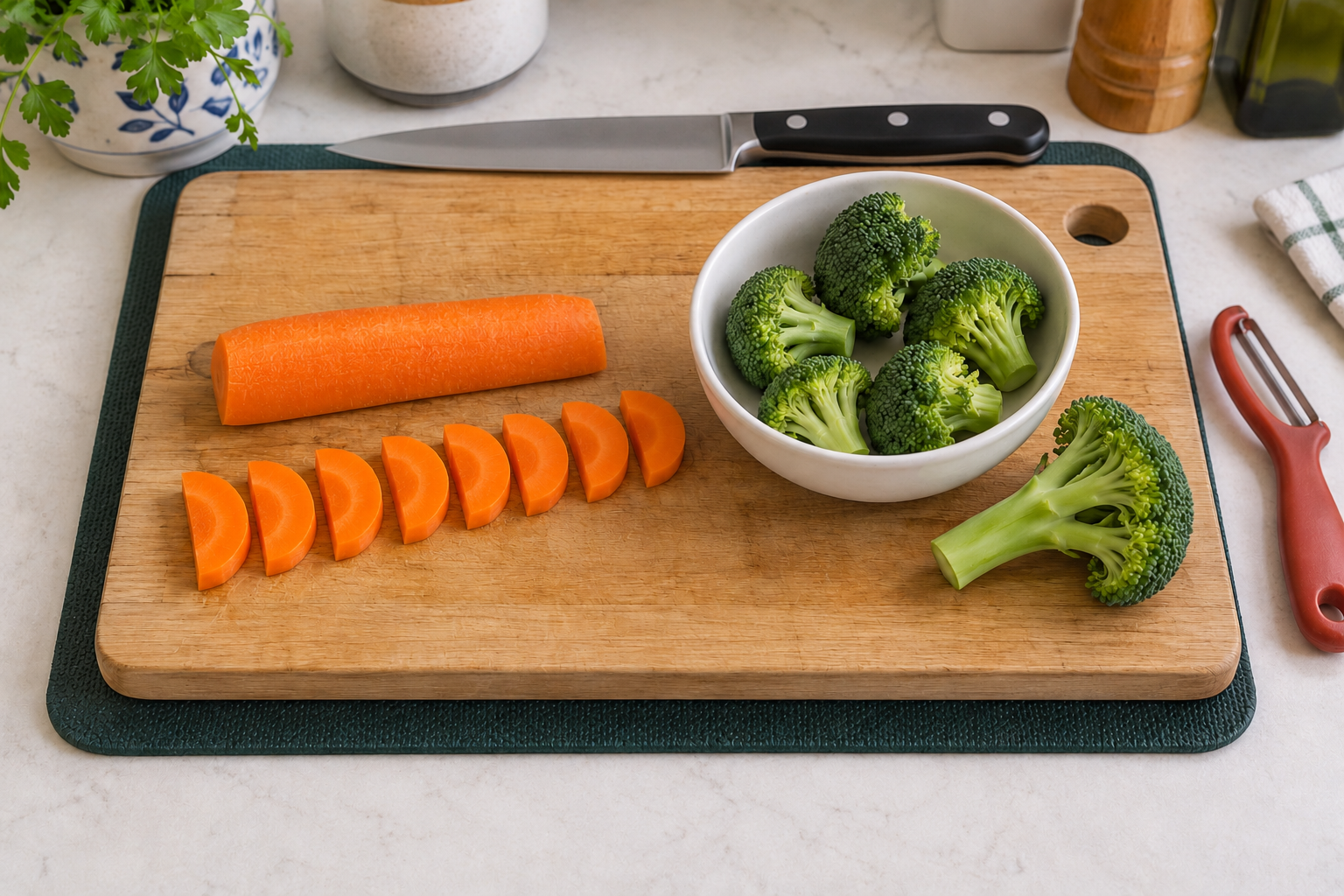
- Wash hands and the vegetables. Scrub carrots under running water, or wash and peel if preferred. Remove the hard top and a thin slice from the tip. Cut each carrot into manageable shorter lengths.
- If a carrot rolls, use the knife lesson's bridge hold to cut each manageable length in half lengthways, keeping both sides of the holding hand outside the cut. Put a half on its flat face. Use the claw hold to slice across into half-rounds about 5 mm thick. If the first lengthways cut needs force or feels unstable, use pre-cut carrots for this first cooking task rather than forcing the blade. Leave any last small end that you cannot hold safely.
- For broccoli instead, rinse the head and cut the small branching florets from the central stalk. Split large florets down their stems so most pieces are about 3 to 4 cm across. Smaller equal pieces are easier than one large crown.
- You can use the broccoli stalk too: cut away the dry end and tough outer skin with a knife or peeler you can control, then cut the tender interior into roughly 5 mm slices. Leave this extra preparation for another attempt if it feels awkward.
Boil a small batch
- Drain food and save cooking water safelySet up and empty the hot saucepan safely.
- Set the colander securely in the empty, freely draining sink and rehearse carrying and tipping the full cold pan using the linked draining lesson. Put about 750 ml cold tap water in the 1.5 to 2 litre pan: it needs to cover the vegetables once added, with several centimetres of empty space below the rim. If pan shape needs more water, check the cold full weight again. Choose the slotted-spoon method before heating if a full pour is not comfortable.
- Put the pan on a matching ring and bring the water to a boil, then lower the vegetables in small spoonfuls, keeping your hands above the water and clear of splashes. Do not drop a whole bowl from a height. The water will briefly stop boiling when the cool vegetables enter.
- Once bubbling returns, lower the heat to a steady, controlled boil. Leave the lid off for this practice so you can see the movement.
- Start the timer when bubbling returns. Begin checking 5 mm carrot half-rounds at about 5 minutes, or 3 to 4 cm broccoli florets at about 3 minutes. Many small batches take roughly 5 to 8 minutes for carrots or 3 to 5 for broccoli, but thickness and your preferred texture decide the endpoint.
- Lift a thick piece onto a plate with a spoon. Push a fork into its centre: it should enter with the resistance you want, not hit a hard core. Cool a sample before tasting. Continue for a minute and retest if too firm.
- Switch the ring off. Follow the prepared draining method, or keep the pan securely on the trivet and lift vegetables into the bowl with a slotted spoon, letting each spoonful drip back into the pan. Leave the water to cool before emptying it. Serve promptly, adding butter or oil and a little seasoning if wanted. Do not carry the bowl while still holding a hot pan.
Steam instead of boiling
- With everything cold, read the basket's water-level and lifting instructions. Fit it in the pan and check that its legs or insert support are stable. Add the specified amount of water below the basket base, leaving the food above the water. Rehearse access to the handle or lifting tool while cold. A basket that needs a fork hook is not handled like a two-handled steamer insert.
- Put the prepared vegetables in the cold basket in a loose layer, fit the lid and put the pan on a matching hob ring. Heat until water boils and steam is being produced, then lower the setting to maintain steady steam without violent boiling. Keep face and hands away from any lid vent. Start timing once steaming is established.
- Begin checking broccoli florets around 5 minutes or thin carrot half-rounds around 7 minutes. With dry gloves as needed, lift the far edge of the lid first so steam escapes away from your face; set it on a heatproof surface. Lift a thick piece onto the testing plate with a spoon and check its centre with a fork. Cool a sample before tasting. Replace the lid and cook a little longer if too firm.
- Stay beside the pan and watch for signs that steaming has stopped or the base water is running low. Do not wait for a burning smell. If you need a top-up, switch off, let the steam clear and follow the maker's safe filling method. Do not pour through an unknown basket or reach into rising steam. If you cannot top up safely, stop this attempt. Never let the base boil dry.
- When the pieces are tender, switch off and remove the lid away from your face. For the simplest finish, leave the basket supported in its pan and lift the vegetables into the serving bowl with the spoon or tongs. If lifting the basket, use only the designed handles or lifting feature as its maker directs; keep it level and land it on a heatproof plate or trivet, not directly on your hand. Leave the hot base water to cool before emptying.
Frozen vegetables need their own instructions
Follow the packet's method from frozen, including its full cooking and standing times. Do not treat thawed peas or sweetcorn as automatically ready to eat: some frozen vegetables must be cooked before eating, even for a cold salad. Do not add their packet time to the fresh-vegetable examples as if the two were identical.
Correct the next attempt
Hard centres need a little more cooking; large uneven pieces may need cutting smaller next time. Mushy vegetables cannot be made firm again. Drain them promptly and consider a mash or soup if they have been safely handled. A strong boil and repeated stirring can break tender pieces, so choose calmer movement once the water is hot.
Record the piece size and time you liked. The useful lesson is knowing how to check the centre, not memorising a time that every carrot is supposed to obey.