
Pantry And Ingredients
Stock cubes, stock pots and strength
How stock adds savoury depth, why strength matters, and how to avoid making soups, sauces and rice too salty.
Before you begin
- Read food labels before you cookCheck the exact stock product and everyone's requirements.
- Measuring accurately without stressRead a liquid mark with the jug standing level.
- Clean and set up your kitchen before cookingPrepare clean hands, tools and a clear pouring area.
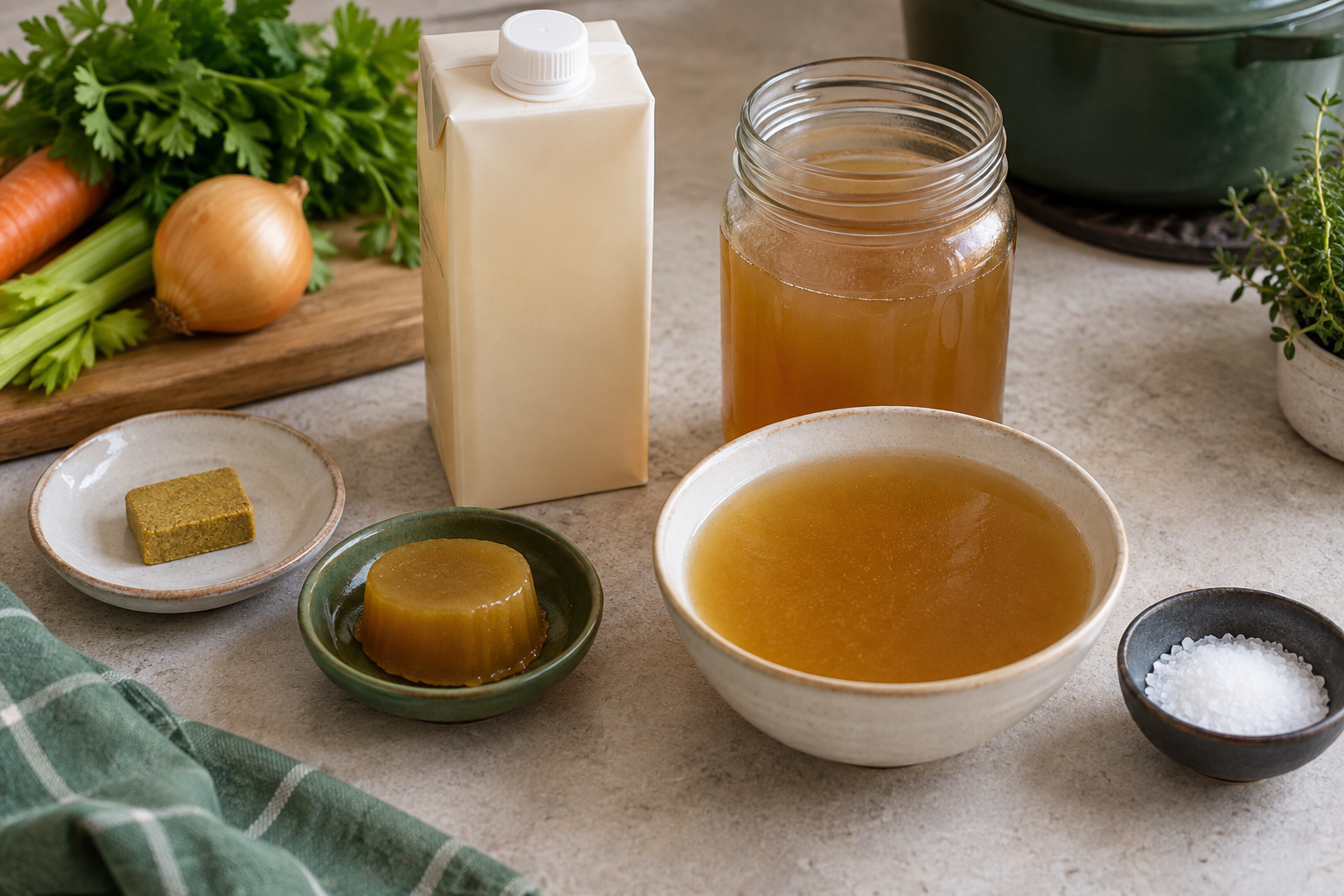
Stock adds flavour and often salt
Stock is a savoury liquid used in soups, sauces and other dishes. A cube or stock pot is a concentrate: flavour packed into a small amount that may need water. A carton may contain ready-to-use stock or concentrate. Check the preparation wording rather than judging by the container.
Dilution means adding water to reduce concentration. Using one whole cube with half its directed water makes roughly twice the intended starting concentration, not a smaller batch of the same strength. Stock can already contain salt; taste the finished dish before adding more. A plain water-based soup is a useful first practice too.
Read the label first
- Find the water quantity for one whole cube or pot and whether the product only needs dissolving in boiling water or a further cooking stage. The mixing practice below is for a product that needs only dissolving. Choose one with those directions for this first attempt.
- Check ingredients and allergens, including celery and any wheat, milk or animal ingredients. Vegetable does not mean allergen-free. The cited Knorr vegetable cube contains celery. Recheck your pack; formulas and products can differ.
- Knorr's vegetable cube directions use one cube in 450 ml boiling water; its organic vegetable pot directions use one pot in 500 ml. Those are different products, not two interchangeable instructions. Your actual pack takes priority.
- Write the directed water quantity and your recipe's required liquid quantity separately. For example: make one cube with 450 ml water; use 250 ml of the mixed stock. Do not put the whole concentrate into a recipe simply because it asks for 250 ml stock.
- Set out an undamaged electric kettle and its own base, a heatproof measuring jug of at least 1 litre with a clear mark for the required water amount, a heat-safe spoon, clean small dish, dry oven gloves and a stable heatproof jug landing place. A jug labelled only for cold liquid is not suitable for this boiling-water task.
- For the comparisons, have two clean tasting cups, separate clean tasting spoons and 15 ml tablespoon and 5 ml teaspoon measures. For measuring a recipe portion, add a clean heatproof receiving jug of at least 500 ml with a 250 ml mark and a ladle.
- For saved stock, prepare a shallow heat-compatible container, matching lid, label and pen. Read the full cooling method before heating. Keep children, pets and anyone passing through away from the pouring area.
Make the amount you need
- Measuring accurately without stressRead the separate water and stock marks without assuming concentrate has no volume.
- Storage and reheating basicsFollow the full shallow-portion cooling and labelling routine.
- Read the kettle manual first, including first-use cleaning, its minimum fill and maximum mark. Use only water in it. With everything cold, wash hands, clean the area and unwrap the cube. Crumble it into the clean small dish with clean dry fingers; keep foil out of the food. For a stock pot, peel its lid while cold and leave the concentrate in its little pot until the water is measured.
- Put the measuring jug on its heatproof landing place, back from the edge. Identify the required water mark before heating. With the kettle off and cool, lift it off its unpowered base to fill away from the electrics with fresh cold drinking water. Stay within its own permitted levels, enough for the pack's water amount. Extra water needed to meet its minimum does not have to go into the stock. Close the lid securely. Keep the base and hands dry.
- Put the base on a stable dry surface, with its cable away from the edge and heat. Connect its plug to the appropriate socket with dry hands and place the kettle on its own base. Switch on using its own control. Many use I for on and O for off; the cited Russell Hobbs model switches itself off at boiling. Wait until boiling has finished and it has switched off. Do not open a hot lid or put a hand over the spout. Do not use a damaged or malfunctioning kettle.
- Lift by the handle and pour slowly into the standing empty jug to the water mark: 450 ml for the named cube example. Keep your face and free hand out of steam; do not hold the jug under the spout. Set the kettle back securely before doing anything else. If steam obscures the mark, stop pouring and let it clear before checking; do not lean over the jug.
- With the jug still supported, use the spoon to lower small bits of concentrate into the water without dropping them from height. Stir gently until no concentrated lumps remain. For the stock-pot alternative, first measure its own directed water quantity, then scoop the concentrate from its pot with the spoon and dissolve the same way. Do not add cold water merely to raise the final stock level back to the original water mark.
- For the flavour check, transfer a teaspoonful with a clean spoon into a tasting cup, let it cool and taste with a separate clean spoon. Never return a tasted sample or a mouth-used spoon to the stock. A pleasant taste does not prove a stored stock is safe.
- If the recipe needs 250 ml, leave the large jug standing and ladle stock into the prepared smaller heatproof jug to its 250 ml mark. Use dry gloves for any hot handle and do not carry a brim-full jug. Use only this measured portion. Do not divide a hard cube by eye and call it an exact half.
- Use stock needed for immediate cooking promptly. Start the cooling reminder for the remainder now, not after the meal. Ladle into the prepared shallow vessel and follow the cooling lesson: refrigerate within one to two hours, use within 48 hours or the pack's shorter limit, or freeze promptly if suitable. Label its preparation time and history. Leftover hot kettle water can stay safely in the switched-off kettle to cool; unplug and let the appliance cool before cleaning.
Compare strength before committing
- Wash and dry the tasting cups and utensils after the earlier teaspoon taste. Keep the prepared stock unchanged. Put 1 measured tablespoon stock in each clean cup, using a clean measuring utensil. Add 1 teaspoon cold drinking water to only the second.
- Let both samples cool to a comfortable tasting temperature. Taste with separate clean spoons. Compare the weaker sample with the original: notice saltiness and savoury flavour separately. This is a preference comparison, not a product ranking.
- If dilution helps, use a milder mix in the next dish rather than adding another cube. Discard tasted samples or eat them yourself promptly; do not return them to the jug. Keep the remaining stock's cooling clock running during the comparison.
Reduction changes the concentration
- Cook red lentils and make a simple soupUse its water additions and full heating checks for the first soup.
- Simmer versus boilRecognise controlled simmering rather than turning the heat high.
Reduction means letting water evaporate while a liquid cooks. Salt remains, so a pleasant starting stock can become too salty. A long-reduced dish may benefit from unsalted stock or a milder starting mixture. Do not add another cube just because a sauce is thin: thickness and saltiness are different questions.
For a correctly cooked soup that is simply too concentrated, switch off and test 1 tablespoon soup with 1 teaspoon drinking water in a clean cup, then cool and compare. For a modest whole-pan adjustment, add water 1 tablespoon at a time, stir and recheck. Return the food to its required hot endpoint before serving. This does not repair an unsafe storage history or replace a recipe's cooking stage.
Stock pots are not automatically better
A cube, pot and carton differ in convenience, ingredients, flavour and the quantity they make. Compare at each product's directed dilution rather than comparing a concentrated pot with a weak cube. Choose the one you enjoy and can use; a higher price is not a reliable shortcut to the right strength.
Store unopened concentrate as its label directs, usually away from heat and damp. An opened pot, carton and made-up liquid stock can have different limits. Instructions for storing undiluted concentrate do not tell you how long a cooked dish or a jug of made-up stock can stand.
Use the learning in one meal
- Cook red lentils and make a simple soupFollow the complete small soup method.
- Storage and reheating basicsFollow the full shallow-portion cooling and labelling routine.
For a later version of the complete red-lentil soup, replace part of its first 500 ml water with 250 ml freshly made, correctly diluted vegetable stock and 250 ml cold drinking water. Measure both separately. This is deliberately milder than using all stock; it is not the product's standard dilution. Keep the soup's spare top-up water plain.
Read and prepare the soup method first, including sorting, rinsing, pan and testing tools and the lentil packet's required boiling and simmering stages. The stock is not a reason to shorten them. Use the mixed starting liquid in its cold pan with the rinsed lentils, then follow those stages. Taste only after complete cooking and a cooled clean sample; leave optional salt out initially. Record the stock product and liquid quantities.
Use freshly prepared stock for this first variation. A previously stored portion keeps its original deadline and once-only reheating history when added to soup; adding it to something new does not reset either.