
Pantry And Ingredients
Pancake pan heat: bubbles, colour and flipping
How to read pancake bubbles, pale centres, golden colour and over-browning so you know when to flip.
Before you begin
- How to use hob heat without guessingIdentify the ring, heat control and safe stopping position before cooking.
- Measuring accurately without stressUse scales, a jug and marked 5 ml and 15 ml measures, not eating spoons.
- Crack an egg and beat it with a forkPrepare the egg separately and clean raw-contact equipment.
- Stir, whisk, fold and turn: four different movementsPractise the utensil movements before using a hot pan.
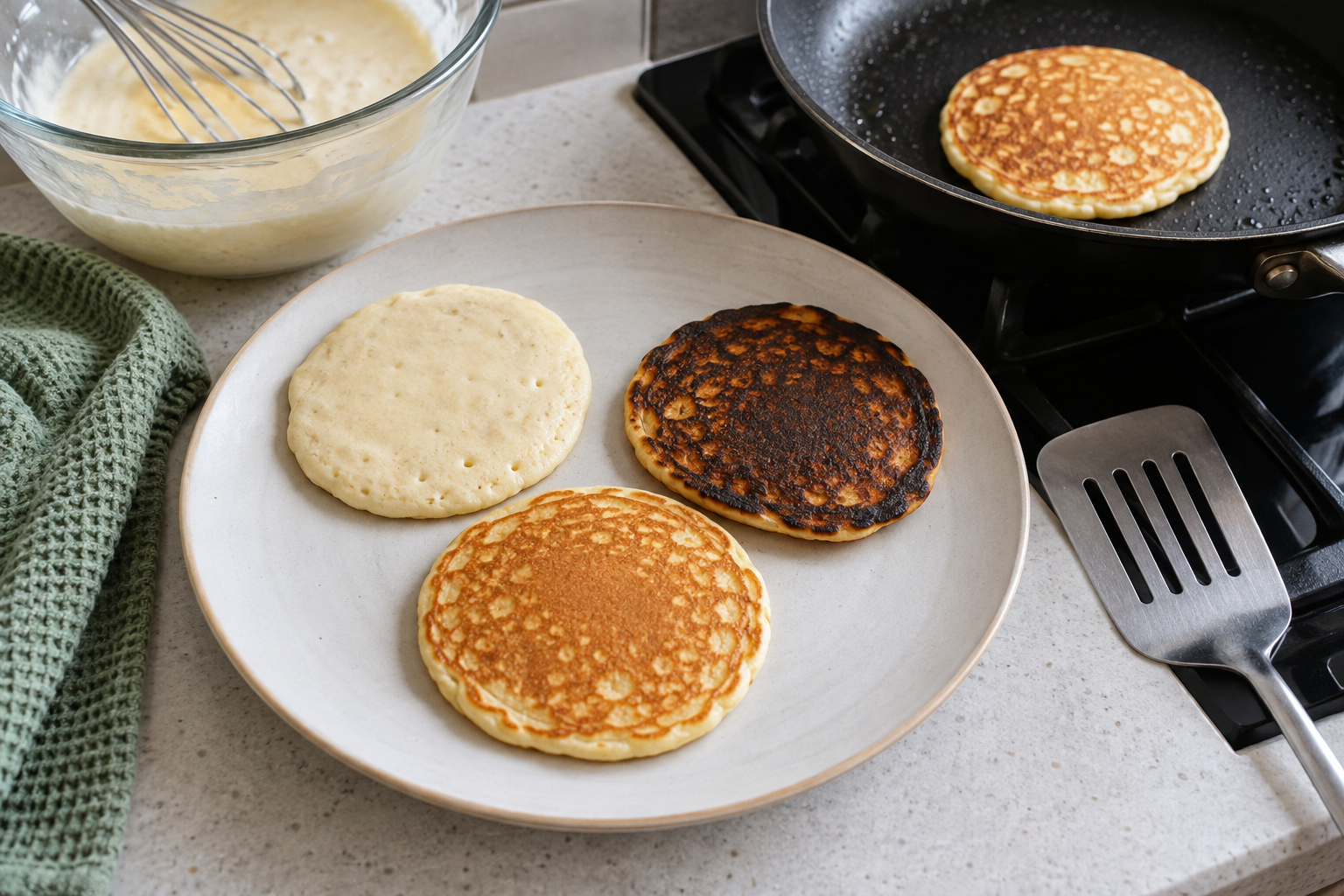
Use a thick small pancake to learn the cues
A small thick pancake is a useful way to learn moderate heat: the outside needs time to colour while the centre sets. It is not a thin crepe or permission to judge cooking only by a golden underside. Make one at a time on this first attempt.
Use the measured plain batter below, with no topping needed. The timings are starting checks, not a physically tested guarantee for every pan or flour. Read the egg and flour labels first. Raw flour and raw batter are not ready to taste.
For a small practice batch
- Measuring accurately without stressUse scales, a jug and marked 5 ml and 15 ml measures, not eating spoons.
- Read food labels before you cookCheck the actual flour, baking powder, egg, milk and oil labels.
- Stir, whisk, fold and turn: four different movementsPractise the utensil movements before using a hot pan.
- 100 g plain flour, 1 level 5 ml teaspoon baking powder, 1 egg, 125 ml milk and 5 ml plain cooking oil for the batter. Have up to a further 5 ml oil available for the pan, used only in small measured additions as needed. Check wheat, egg, milk and any other allergens; an untested replacement may need its own recipe.
- A stable mixing bowl holding at least 1 litre, small egg cup, whisk or fork, scales, measuring jug, marked 1/4 teaspoon, 5 ml and 15 ml measures, sound nonstick frying pan, two coating-safe broad turners, timer, dry oven gloves and full stable trivet. Read the pan's heat limits.
- Have a checking plate, a separate clean serving plate, table knife and fork for centre checks, a separate clean tasting fork and utensil rests. One turner handles cooking and possible wet batter; keep the other for serving fully cooked food. Wash the checking plate and tools after any wet-centre contact before another finished-food check.
Mix the batter before heating the pan
- Crack an egg and beat it with a forkUse the separate cup, shell-fragment removal and raw-egg cleanup.
- Stir, whisk, fold and turn: four different movementsWhisk with the head in the liquid.
- Keep the hob off. Weigh flour into the stable bowl, add the level baking powder measure and stir them together with the clean dry whisk or fork.
- Crack the egg into the separate cup using the full egg lesson; remove any shell piece with a clean teaspoon, then beat lightly with the fork. Tip the egg into the flour and add about half the measured milk. Whisk gently at first, keeping the head in the mixture, until no dry flour remains underneath.
- Add the remaining milk and the batter's 5 ml oil. Whisk until combined and thick but spoonable, checking the bowl base. Stop rather than beating indefinitely; small soft lumps differ from a dry pocket. Do not taste the raw mix.
- Park the raw-batter spoon and whisk on their own rest. Wash hands, raw-contact surfaces and the egg cup before heating. Put milk and remaining eggs back as their labels require. Keep the finished-food turner and plates away from raw batter.
Cook the first small pancake
- How to use hob heat without guessingIdentify the ring, heat control and safe stopping position before cooking.
- Stir, whisk, fold and turn: four different movementsUse the supported low lift, not an airborne flip.
- Set the pan level on its compatible ring, handle inward. Add a small measured part of the available pan oil, about 1/4 teaspoon, and warm on a moderate-to-low setting within the maker's limits. Spread it with the coating-safe cooking turner into a thin film. Do not rub paper around a hot pan or heat it until it smokes.
- Use the 15 ml measure to place two level spoonfuls of batter together in the pan. Let it spread into one small round about 8 to 10 cm across rather than piling a thick mound. Put the batter spoon back on its raw-contact rest.
- Stay at the pan. After about a minute, look for the edge losing its wet gloss and surface bubbles leaving holes. The underside should begin to release and colour, not turn black. The first side may take about 1 to 2 minutes; reduce the heat if browning runs ahead of setting.
- Slide the broad cooking turner under an edge, then far enough to support most of the pancake. Keep the pan steady using dry protection for a hot handle. Lift only a little, smoothly roll the pancake onto its other side and lower it gently. Do not throw it into the air. If it resists while still wet, wait briefly and try the edge again rather than tearing it.
- Cook the second side gently, starting to check after about a minute. Move the pancake onto the checking plate using the cooking turner. Turn the ring off before the centre check so an empty pan is not heating while you inspect.
Read colour and centre together
- Clean and set up your kitchen before cookingSeparate raw-contact tools and wash them before finished food.
- How to use hob heat without guessingIdentify the ring, heat control and safe stopping position before cooking.
- With the checking plate flat on the worktop, hold the pancake with the fork and cut through its centre using the table knife, fingers clear of the blade. A finished centre is set and hot, with no wet batter line or dry flour pocket. Outside colour alone is not enough. Do not taste an unfinished centre.
- If the centre is wet but the surface is not burnt, use the cooking turner to return both halves to the supported pan. With heat still off, wash and rinse the checking plate, fork, knife and any raw-batter-contact turner, then dry and return them ready. Stay in the kitchen. Turn on a lower heat and cook the halves gently, cut faces down at first, checking again after about a minute and in short intervals thereafter. Repeat the supported off-heat centre check with clean tools.
- If a pancake is badly blackened or the centre will not cook without further burning, discard that pancake. Do not eat a raw or burnt sample for the sake of the comparison. Let the pan cool and reset the temperature before a new attempt.
- Once fully cooked, use the clean serving turner to move it from the checking plate to the clean serving plate. Let a small piece cool to comfortable warmth before tasting with the separate tasting fork. Wash any tool that touched your mouth before it touches shared food.
Avoid pressing it flat
Do not press the pancake down with the turner. This does not cook a wet centre reliably and can make the texture dense. A smaller round and gentler heat give the centre more time while the outside colours.
The picture compares pale, golden and very dark surfaces, but does not show their centres. The blackened example is not a target or safe tasting sample. Use a coating-safe turner even though the photograph includes a metal tool.
Keep the batch consistent
- Storage and reheating basicsFollow the original cooking clock, shallow cooling and earliest ingredient deadline.
Cook the remaining small rounds by the same measured spoonfuls, one at a time. Check the centre of each, using clean checking tools. Later rounds can colour faster as the pan warms: turn the ring down, or switch off and let it settle before another. Add only a small part of the remaining pan oil if needed; turn off and land the pan securely before making a careful measured addition. Never add oil to a smoking pan.
For the first session, plan to cook the small batch now rather than setting out an unexplained raw-batter storage task. If you stop early, discard the unused raw batter. Serve the cooked pancakes plain. Start shallow cooling for any finished portions you intend to save instead of waiting for the entire batch to finish; cool within 1 to 2 hours, refrigerate at 0 to 5 C and use within 48 hours or the earlier ingredient deadline. Follow the complete storage lesson for any reheat. Switch off and let tools cool before washing.