
Baking Basics
Baking basics: raising agents, sifting and oven doors
Check a small sample
- Stock cubes, stock pots and strengthLearn the exact kettle fill, controls, steam clearance and supported pour before this optional warm-water test.
- Kitchen thermometer basicsLearn sensing-area coverage and a settled reading; do not use a meat-cooking threshold for warm test water.
- Thermometer cleaning and careUse the actual probe care directions before measuring drinking water.
- Read the ingredient label and storage/date first. Replace damp, contaminated or unidentified powder. This optional activity check is not an identification test or a guarantee of a successful bake. You may instead use a fresh correctly stored labelled packet and follow the muffin recipe without doing a water test.
- Have separate clean bowls, dry marked 2.5 ml half-teaspoon and 15 ml tablespoon measures, a straight-backed table knife and clean filling/stirring spoons. Half a teaspoon is one LEVEL 2.5 ml measure, not a guessed half-height 5 ml spoon. Do not put a wet spoon into either packet.
- For the baking-powder water test only, use a clean heatproof jug holding at least 1 litre, with readable 200 and 300 ml markings, a dry trivet, and a cleaned suitable food probe. First practise the linked kettle controls and probe-reading/care instructions. Put 200 ml cold drinking water in the jug on the trivet. Boil drinking water in the kettle within its own minimum/maximum fill limits; slowly add hot water to the jug up to its 300 ml line, keeping face and hands back from steam. Do not fill the kettle with only 100 ml if below its minimum.
- Stir with a clean spoon, then measure the mixed water with the probe sensing area fully covered, away from jug sides/base, display dry. Aim for 35 to 45 degrees C; if hotter, leave the jug supported to cool and recheck. If cooler, use the linked kettle pour to add a small amount of hot water to the supported roomy jug, then stir and recheck before measuring the test portion. Do not hold a measuring spoon under the boiling spout. Do not test with a finger, lip or absence of visible steam. This is a KINALO warm-water setup, not a food-cooking safety threshold or a temperature stated by the linked powder-test source. If you lack suitable equipment, choose the fresh-packet option rather than handling guessed hot water.
- Only once cooled to that warm range, hold the 15 ml measure level over the test bowl and fill it with the clean filling spoon. Tip in and repeat: two level tablespoons give 30 ml water. Stir in one level 2.5 ml measure of baking powder. Look for prompt bubbling and foam, keeping your face back; do not taste it.
- The separate bicarbonate test needs no kettle or probe: use ordinary labelled edible food vinegar, not cleaning vinegar. Measure one level 15 ml tablespoon into the other bowl and stir in one level 2.5 ml measure of bicarbonate of soda. Look for prompt fizzing. Plain water is not the same test.
- Weak or absent expected activity means replace the packet, not double the recipe amount. Pour these small cooled test mixtures away slowly into the sink. Wash bowls, jug and spoons, clean/dry the probe as directed and store the packets dry and closed. Test mixtures never go into the recipe. Use clean DRY measures to level and measure the actual recipe powder.
Tell baking powder from bicarbonate of soda, check whether they still work and understand the small handling details that affect a cake.
Before you begin
- Measuring accurately without stressUse scales, a marked jug and level measuring spoons.
- Use an oven: settings, preheating, shelves and the grillChoose the cooking function, preheat and move the hot tray safely.
Start by reading the exact ingredient
Bicarbonate of soda is also called baking soda. It reacts with suitable acidic ingredients and moisture to produce gas. Baking powder contains an alkali and acids, so it works differently in a recipe. They are not equal-spoon replacements for one another. Self-raising flour already contains raising agents; strong bread flour and plain flour do not do the same job.
These powders can lose effectiveness through poor storage or age. The practical question is whether they still generate enough gas, rather than assuming an old packet works forever. Keep them labelled, dry and tightly closed. Never use an unidentified white powder.
When sifting is useful
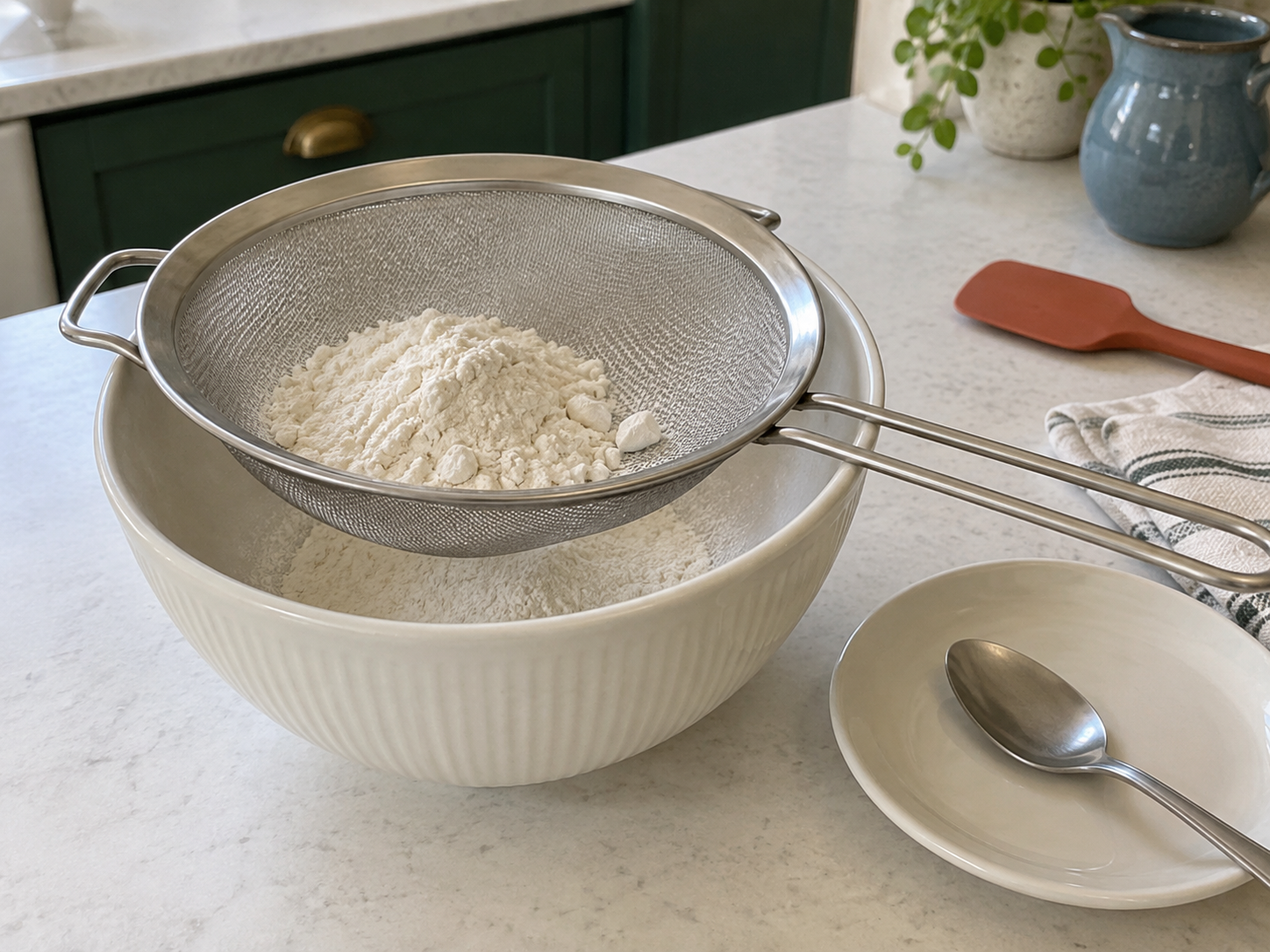
Sifting passes a dry ingredient through a fine mesh to break up lumps and distribute it. Modern flour often does not need sifting for a straightforward bread or cake, but cocoa powder, icing sugar and delicate mixtures may benefit. Follow the recipe when it explicitly requires sifting, especially for a light sponge.
Weigh the recipe flour first in a dry bowl. Place a clean dry fine-mesh sieve across a larger stable bowl, checking its supports fit without tipping. Hold its handle; add only a shallow layer of the weighed flour and measured recipe baking powder. Tap the rim lightly with the other hand, keeping it over the bowl. Refill in small amounts rather than shaking a flour cloud into the room. With the sieve still supported, press ordinary soft flour lumps gently through with the back of a spoon. Never force unidentified material or contamination into food. Stir the collected powder to distribute it. If the sieve does not fit securely, choose a better bowl/sieve pairing before starting.
Transfer all the weighed flour, including powder clinging to the first bowl, so the recipe amount is not accidentally reduced. Sifting changes how much space flour occupies, not its gram weight. This is why a cup measured before sifting can differ from a cup measured afterwards. Do not taste raw flour; clean spills and utensils before handling the finished food.
Why an oven door can matter
- A first muffin bake: measure, mix and check the centreComplete one measured bake, including supported hot-tin handling and the crumb check.
A rising cake contains gas bubbles held by a structure that is still setting. Repeated early opening loses heat, and a sharp knock can disturb a delicate unset mixture. That does not mean any ordinary door closure inevitably ruins every cake. Keep the door closed during the early stage, use the oven light where available and close the door gently after checks.
Near the recipe's suggested checking time, assess its specific doneness cues, such as a set centre and a skewer without wet batter for an ordinary sponge. A sunken cake can also result from inaccurate amounts, an unsuitable tin, underbaking or too much raising agent. Do not blame the door without checking those basics.
Use the muffin lesson for a first complete bake. It includes the quantities, case support, mixing motion, first checking time and what a skewer with wet batter means. You do not need to infer a cake recipe from the explanation of raising agents.
A useful first baking habit
Before mixing, lay out the recipe's flour, raising agent and tin. Confirm the names and sizes, then preheat the oven. Measure carefully and make one recipe without substitutions. A repeatable baseline lets you work out whether a later problem came from an ingredient, the mixing or the bake itself.