Essentials
Frying pans, saucepans and stock pots: choose by the job
Match the pan to the food, understand materials and protect a non-stick surface without buying a large matching set.
Before you begin
- Clean and set up your kitchen before cookingPrepare a clean workspace and clean the equipment afterwards.
- How to use hob heat without guessingSet and adjust the heat while watching the food.
Shape matters as much as material
- Colander, sieve and draining toolsSupport the receiving bowl and ladle hot liquid through a sieve.
A frying pan is wide and shallow, so moisture can escape and food can touch a hot surface. A saucepan has higher sides and usually a lid, making it useful for boiling pasta, simmering sauce and cooking rice. A stock pot is a larger, deeper pot for substantial quantities of liquid. It is heavy when full, so choose a size you can lift safely.
For one or two people, a roughly 24 cm frying pan and a two- to three-litre saucepan can handle many first meals. These are starting sizes rather than a shopping requirement. Check what you already own, whether a lid fits and whether the pan sits steadily on your hob.
Leave generous space below the rim for the food, bubbling and stirring, and respect any lower maker fill limit. Pan volume on a label is not a cooking fill target. A larger pot is not automatically right for a small sauce, and a deep vessel can feel much heavier once filled. Decide cold whether you can control the actual quantity; choose a smaller batch or retaining scoop before heat if not. For keeping a hot liquid, read the full supported sieve-and-ladle setup, not a one-handed stock-pot pour.
Understand the main surfaces
- Can you wash a cast-iron pan?Use the separate care method only after identifying bare iron or enamel.
- Wok and batch cooking basicsUse the complete supported, utensil-moved small-batch method for a later wok task.
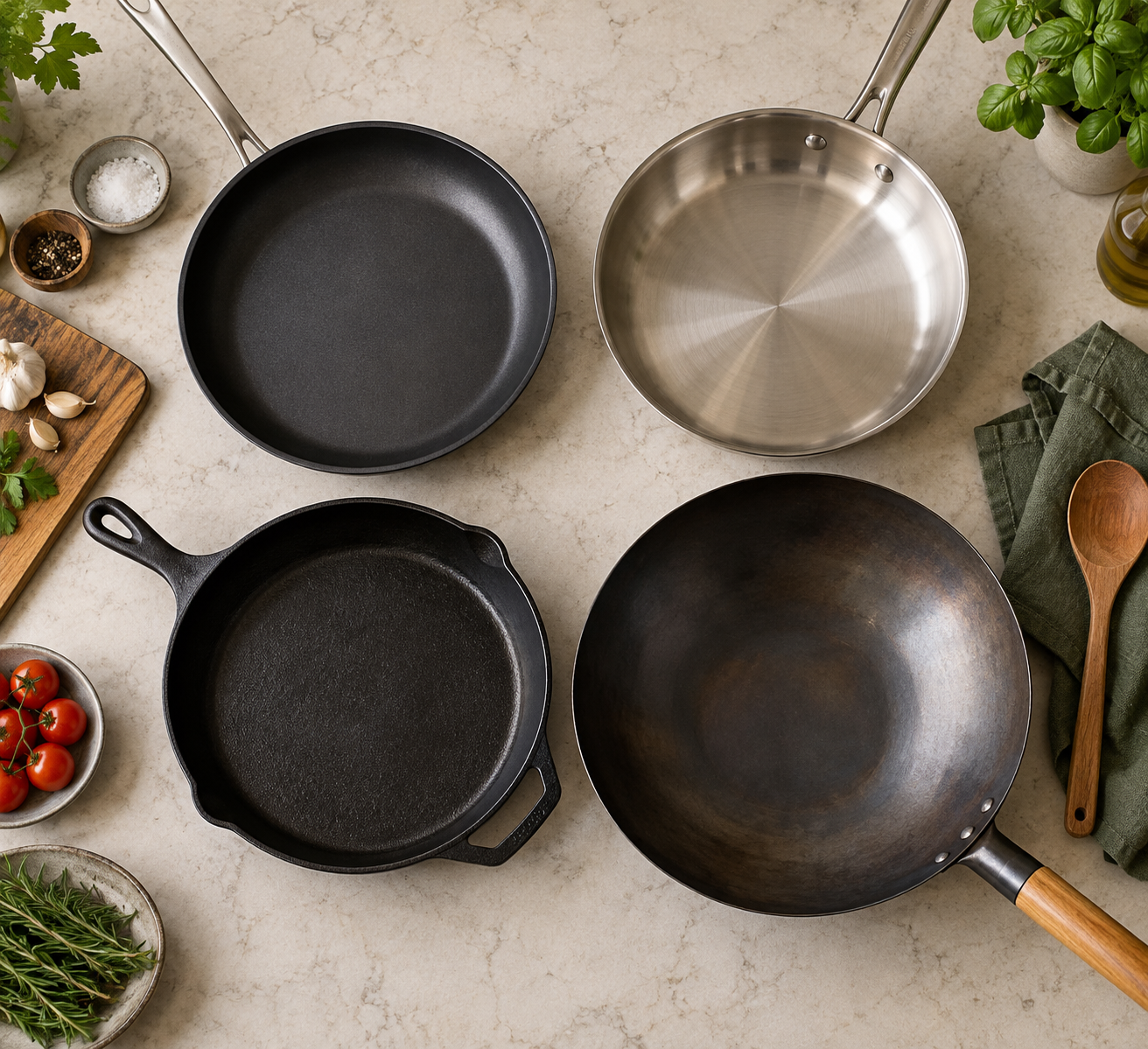
- Non-stick: helpful for delicate eggs and pancakes at low to medium heat. Use utensils and cleaning methods approved by the maker. Avoid metal spoons scraping a coated surface.
- Stainless steel: useful for browning and sauces. Food may initially stick, then release as a crust forms. It takes a little more heat control to learn.
- Cast iron: holds heat well but is heavy and slow to cool. Bare iron needs drying and care; enamelled iron has a different surface and care requirements.
- A wok: useful when its base fits your hob and you can work in small batches. A flat frying pan can be a more practical first choice on a small electric ring.
- A dark colour does not tell you the surface: bare seasoned iron, black enamel and a non-stick coating need different care. Ceramic non-stick is still a coating, not an ordinary oven dish. Identify the actual product rather than choosing cleaners, heat or seasoning by its colour.
Check a pan before cooking
- How to use hob heat without guessingIdentify the ring and observe a measured water practice before food.
- When to replace kitchen equipmentInspect an empty cold pan and isolate defects before cooking.
- Look at the base and manufacturer information for hob compatibility. Induction needs a suitable magnetic base; a label is more reliable than guessing by appearance.
- With the pan cool and empty, check for secure handle joins, an intact surface and a base that sits steadily on its intended ring. Isolate a rocking pan, peeling coating, loose handle or chipped glass lid. Do not run a hand over a sharp chip. Confirm separate oven limits for the body, handle and lid before any oven use; follow the lowest applicable limit.
- Before its first food use, remove labels and packaging, wash and dry food-contact parts as the manufacturer directs, and complete any specified preparation for that surface. Do not apply bare cast-iron seasoning instructions to every coated pan.
- Place it on a ring close to the base size. Keep handles away from the edge and neighbouring heat. A gas flame should stay under the base rather than climb the sides.
- Choose a spoon or turner whose material and temperature rating suit the pan. Maker-permitted wood or heat-safe silicone can protect coatings. Do not cut food in a non-stick pan or use a sharp blade or hand blender against its surface. Never assume a utensil is heat-safe because it is plastic.
- Use the heating sequence for the food and your identified pan. Do not leave an empty pan on a lit ring while preparing ingredients, or perform a water-droplet or smoke test to prove it is hot. Induction can heat quickly; a boil-water task is not permission to use boost for dry preheating. Heavy cookware remains hot after the dial is lowered. Stay beside cooking and have a suitable trivet ready for a controlled pause.
- After cooking, allow the pan to cool before washing. Pouring cold water into very hot cookware can damage it and create steam.
What to pay attention to when buying
Lift the pan in the shop if possible. Imagine it filled with food. Look for a comfortable secure handle, a base that sits flat, a lid you can lift safely and care instructions you can follow. A thick, even-heating base can be useful, but an expensive brand does not remove the need to learn your hob. Buy a specialist pan when a repeated task justifies it.
Find the product instructions before purchase if possible. Check the pan diameter fits the hob zone, the actual usable capacity fits the recipe with headroom, and its lid, grips and weight suit you. Hob-compatible, dishwasher-safe and oven-safe are different permissions. You can choose a pan for hob-only use; you do not need to buy high oven ratings for a first plain sauce.
Try the pans you already have
- How to use hob heat without guessingComplete the separate small water exercise.
- How to soften onions without burning themUse the measured onion practice.
- Make a simple tomato sauce from passataMake the complete plain sauce used for the flavour practice.
Start with the hob lesson's complete 300 ml water practice in one sound compatible saucepan holding at least 1 litre. Set up, measure, heat, reduce to gentle bubbling, switch off and let it cool fully before emptying and drying. This lets you learn the control without a hot-oil experiment. Do not repeat it in a doubtful pan to test its repair.
For a separate food attempt, follow the whole softened-onion lesson in its suitable frying pan or roomy saucepan: one prepared medium onion, 10 ml oil, and all the cutting, heat, clean tasting and supported bowl serving. It is not a direction to put a second batch into another vessel and leave the first cooking unattended. Later make the separate 250 g passata sauce with its own measured oil and water; it starts cold and does not silently reuse the onion pan or double the oil.
Record what you notice about each completed task: how quickly gentle bubbling began, whether the food stayed controllable, and whether lifting and cleaning were comfortable. Different foods and pan shapes are not a controlled experiment proving that a single material cooks faster. Change one practical choice on your next attempt, using that full method again.