
Sauces
Thicken a sauce with a cornflour slurry
Mix cornflour with cold liquid, add it gradually and give it time to thicken before deciding whether the sauce needs more.
Before you begin
- How to use hob heat without guessingHeat a small pan without losing control of the bubbling.
- Measuring accurately without stressUse level measuring spoons, not a heaped eating spoon.
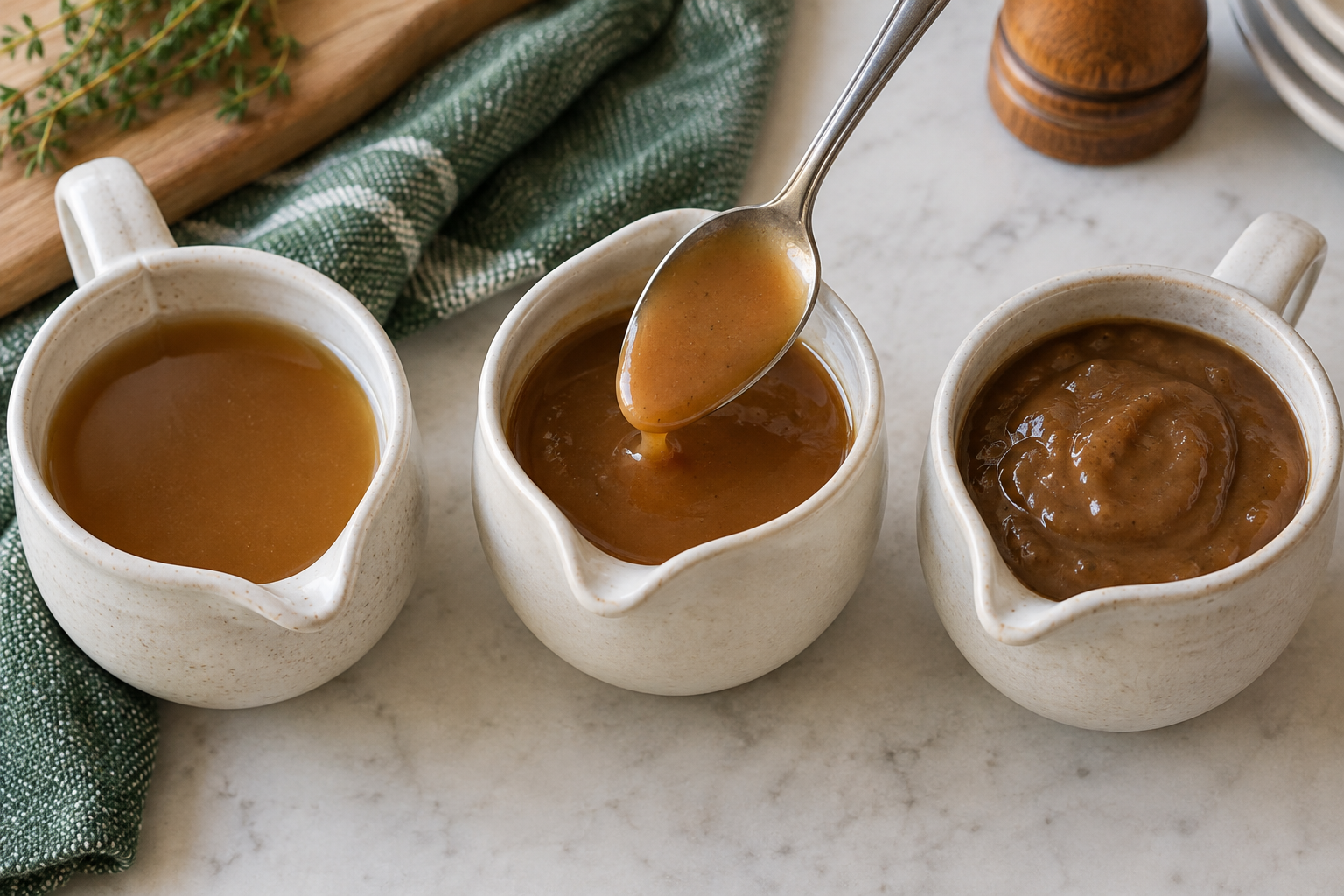
A slurry is simply a smooth cold mixture
UK cornflour is the fine white starch also called cornstarch. It is not yellow cornmeal or ordinary wheat flour. Starch thickens a watery sauce when heated. Mixing it with cold liquid first separates the particles; adding dry powder directly to a hot pan can trap dry centres in lumps.
This lesson is for a stock-based sauce or a watery cooked sauce that can safely simmer. It is not a repair for every sauce: a delicate egg emulsion, a curdled dairy sauce or an oily dressing needs its own method. Thickening changes texture, not whether meat or other raw ingredients have cooked safely.
Measure a small practice batch
- For the simplest first batch use 250 ml ready-to-use liquid vegetable stock from a suitable in-date pack, not a cube or concentrate needing dilution. Read its ingredients, opening/cooking/storage instructions and check allergens. Low-salt or unsalted stock lets you focus on texture. Open a pouring pack as directed, measure 250 ml into the jug and store the rest exactly as its label says. Concentrated stock needs the separate full dilution lesson before use; do not assume every carton is ready-strength.
- Start with 1 level teaspoon cornflour mixed with 2 teaspoons cold water. Have more cornflour and cold water available to repeat in small batches if needed. This deliberately cautious start avoids an immediately gluey result.
- A small cup, marked teaspoon and tablespoon measures, small compatible saucepan around 1 to 1.5 litres, coating-safe heat-safe spoon or whisk, jug, timer, dry oven gloves, trivet, clean testing teaspoon, plate and serving bowl. Have up to 60 ml additional drinking water in a small jug for measured thinning, not a free pour into a hot pan.
Mix cold, then add to the hot sauce
- Read food labels before you cookIdentify ready-to-use rather than concentrated stock and its ingredient limits.
- Stir, whisk, fold and turn: four different movementsLearn the supported spoon and whisk movements.
- Put the cornflour in the cup. Add the measured cold water and stir, pressing against the cup sides until no dry lumps remain. The mixture should pour, not sit as dry powder. Stir it again just before adding because starch settles.
- Put the prepared stock or sauce in the saucepan. Heat until gently bubbling, following any cooking requirement on the stock label. Keep the spoon moving across the base if using a sauce that can catch.
- Lower the heat so the liquid is not splashing. Stir the slurry again, then pour it in slowly while stirring the sauce continuously. Do not leave the slurry in one unmixed patch.
- Bring the sauce back to controlled bubbling and keep stirring for about 2 to 3 minutes, or the cooking period specified by the cornflour manufacturer. It should become thicker. Do not add another spoonful before this first addition has heated and developed its effect.
- Lift the spoon and watch how the sauce runs off. Put a little on a clean plate, let it cool and check the coating. A pouring sauce should flow; it need not stand up like a paste.
- If still too thin, make another teaspoon-sized cold slurry and repeat. Add in small stages, allowing the same heating and assessment each time. Different sauces and starch products need different amounts, so stop at the texture your dish needs. At the chosen endpoint, switch the ring off and land the pan safely on its trivet with dry handle protection if needed. Use the spoon to transfer into the supported serving bowl and leave cookware to cool safely before washing. Confirm the control is off.
Make the correction match the problem
- Make a white sauce, then a cheese sauceUse the supported spoon-through-sieve routine for persistent lumps.
For a sauce that has become too thick, take the pan off the heat and stir in 1 tablespoon water or suitable unsalted liquid. Warm through and reassess before adding another tablespoon. Use a liquid that suits the dish; more strong stock could make it too salty. Stir while warming until steaming through, then switch off and land the pan on its trivet before a cooled taste and serving. Do not keep adding water if the texture is already suitable.
For small lumps, switch off and whisk the supported pan first, holding a hot handle through dry protection. Stop adding powder. If persistent lumps prevent an acceptable result, follow the complete supported-sieving routine in the reviewed white-sauce lesson; this is a stock sauce, not an egg emulsion. Finish the cornflour maker's required cooking after returning to controlled heat, switch off and check a cooled sample. Do not serve merely because it looks glossy. Too much starch can become jelly-like, different from a creamy flour-and-butter sauce.
Serve with food that is already cooked
- Boil and steam vegetables without guessingCook the vegetables before coating them.
- Storage and reheating basicsCool and store the finished sauce.
Spoon the finished sauce over cooked vegetables or another appropriate cooked food. Taste the combination before adding more seasoning. A sauce tasted alone can seem stronger than the complete mouthful.
Make the slurry immediately before use and discard any unused small portion after cooking; this guide does not teach storing a homemade thickener bottle. For leftover finished sauce, follow the shortest storage limit of its ingredients and the storage lesson. Reheat only once until steaming hot throughout, stirring and loosening with a little suitable liquid if needed.