
Flavour
Make an oil and vinegar dressing
See what an emulsion means by shaking a simple dressing and learn how to adjust its balance without starting again.
Before you begin
- Read food labels before you cookCheck the oil, vinegar and any optional mustard.
- Measuring accurately without stressUse level marked 15 ml tablespoons and 5 ml teaspoons.
- Washing vegetables and keeping prep cleanPrepare clean dry salad leaves before dressing them.
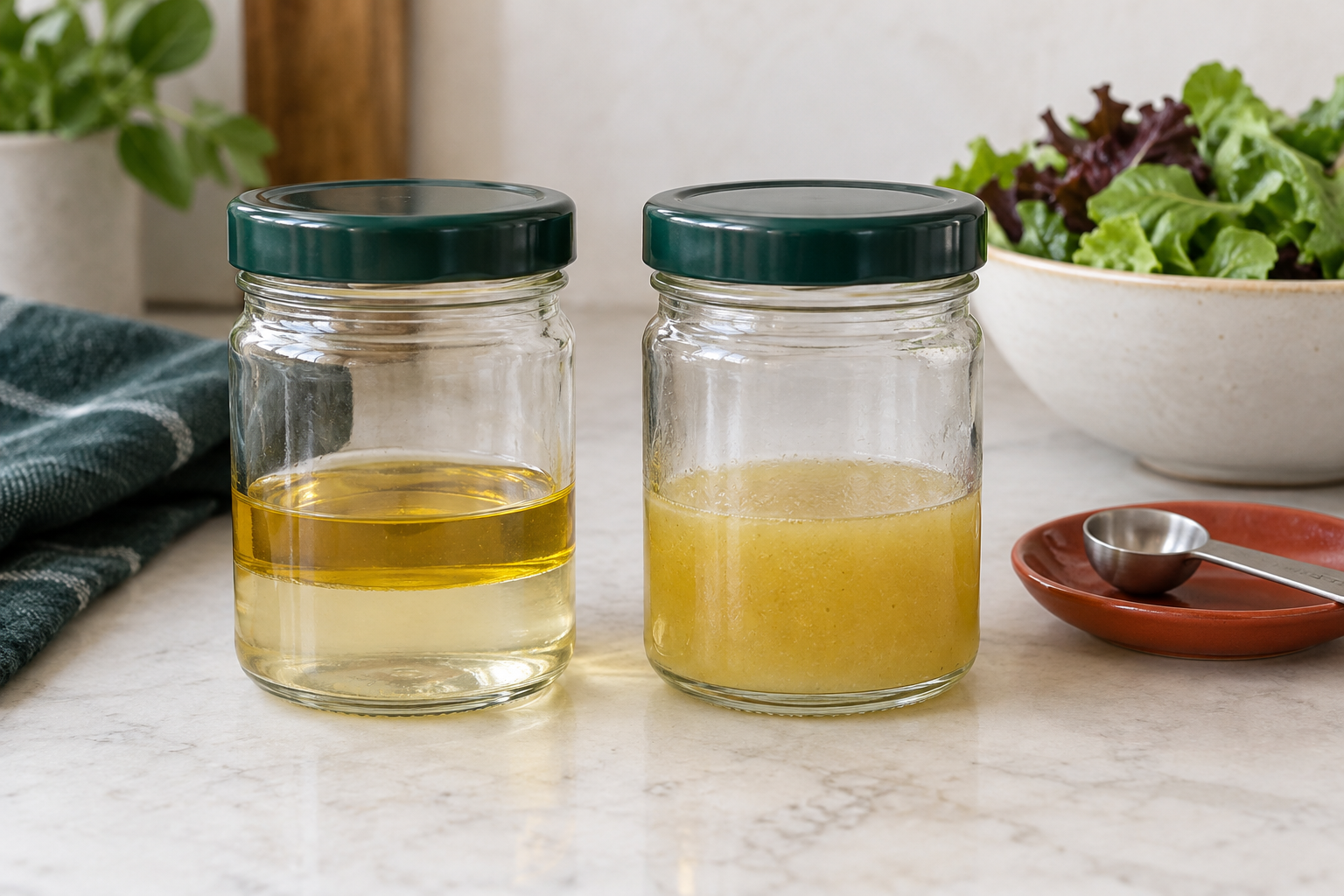
They can mix, but may separate again
Oil and watery vinegar form separate layers when left alone. Shaking or whisking breaks the oil into small droplets dispersed through the watery liquid. That mixture is called an emulsion. A simple dressing can separate again after standing; it is normal to mix it again just before using.
Mustard can help the mixture stay dispersed longer, but it changes flavour and is an allergen. It is optional for this first attempt. The ratio describes measured starting volumes, not the visible layer heights in every photograph or a guarantee that the mixture will stay together.
For a small first dressing
- Use 3 level 15 ml tablespoons mild olive or rapeseed oil, 45 ml, and 1 level tablespoon wine or cider food vinegar, 15 ml. This makes a 60 ml starting mix. Three parts oil to one part vinegar is a starting point, not a compulsory taste. Never substitute a household cleaning product.
- Optional: 1/2 level teaspoon suitable prepared mustard, a few grains of fine salt and a very small pinch of ready-ground black pepper. Check actual labels: mustard is an allergen, and some vinegars have sulphite labelling. Do not assume any replacement suits an allergy.
- Choose a clean undamaged food-safe jar of about 200 to 300 ml with its matching secure lid, suitable for holding and shaking cold food. Have ample headspace; do not use a chipped jar, loose lid or hot liquid. Set out a marked tablespoon, teaspoon and 1/2 teaspoon, clean mixing spoon, separate tasting spoons and a used-utensil plate.
- Have about 50 g salad leaves for a small serving, a serving bowl and two clean salad spoons. Wash and dry loose leaves using the produce lesson; follow ready-to-eat pack instructions. Set aside a few clean leaves for tasting. Most of this dressing may remain unused: do not pour it all onto one serving.
- For the bowl alternative, also prepare a stable mixing bowl, whisk and a clean damp cloth under the bowl on the cold worktop. Read its mixing steps before starting. Prepare a label and fridge space for untouched dressing.
Mix and taste
- Stir, whisk, fold and turn: four different movementsKeep the bowl stable and whisk in controlled movements.
- Read food labels before you cookRetain the earliest ingredient deadline when storing a mixture.
- Wash hands and set the jar on the clean cold worktop. Measure in the 15 ml vinegar. If using the optional mustard, salt or pepper, add the measured mustard and only the small seasoning amounts now. Stir gently with the mixing spoon, including the bottom so any salt can dissolve. Do not taste from that spoon.
- Measure in the 45 ml oil. Fit and firmly secure the matching lid, without forcing or cross-threading it. Check it is closed. Hold the jar body and lid securely with both hands, below face level and away from anyone nearby. Shake in short controlled movements for about 15 to 20 seconds; do not throw it or shake above your head. If it leaks, stop, stand it down and use the bowl alternative.
- For the bowl alternative, measure vinegar and any optional additions into the supported bowl and stir. Whisk the liquid in small controlled circles while adding the measured oil a teaspoon at a time, briefly setting the oil measure down and whisking between additions if coordinating both hands is awkward. Three tablespoons oil are nine 5 ml teaspoons total; do not accidentally add nine tablespoons. Continue until briefly cloudy and fairly uniform. If moving a leaked jar mix into the bowl, carefully pour that cold remaining mixture into the standing bowl and whisk it; do not add a second set of ingredients. Stand the jar down and wipe spills before continuing.
- For the jar option, stand it down before opening. For the bowl option, keep the bowl supported. With a fresh clean spoon, place a few drops on one reserved leaf and eat the leaf. Do not dip a bitten leaf or mouth-used spoon back into shared dressing. If too sharp for your taste, add 1 measured teaspoon oil, close and shake, or whisk the bowl, then try another clean leaf. If too heavy, use a clean teaspoon to add a few drops vinegar and remix. Change one thing at a time and stop when you enjoy the coated leaf.
- Put the remaining 50 g dry serving leaves in their bowl. Start with 1 measured teaspoon dressing, 5 ml. Use the two clean salad spoons to lift leaves from underneath and gently turn them until lightly coated, without throwing them. Add a little more only if wanted; a puddle below means more than the leaves needed.
- Eat the dressed salad promptly. Cover and refrigerate untouched dressing promptly at 0 to 5 C, with a label recording preparation time and any ingredient opening deadline. For this small home practice use within 48 hours, or sooner if an ingredient requires it. This is a conservative plan for this mix, not a claim that every commercial dressing has that life. Keep mouth-used utensils out of the stored portion.
When the layers return
Close the jar securely and shake again, or use the bowl and whisk method, just before serving. A temporary mixture does not have to stay cloudy all afternoon to be successful. Check flavour on food rather than adding more oil merely to chase a thicker appearance.
Refrigerated oil can thicken or look cloudy. Keep the small portion out only briefly during serving and stir or shake once it loosens enough; do not put the jar on the hob, microwave an unknown container or use a hot-water bath to force it. Return unused dressing promptly to the fridge and keep its original deadline. Separation alone does not prove either spoilage or safe storage.
Flavour variations after the first attempt
- Fresh herbs: storing them and using them upPrepare the measured herb addition.
- Softening butter and making a simple garlic butterFor a later garlic task, read its preparation and storage guidance first.
For a later herb version, wash, dry and finely chop parsley using its complete preparation lesson. Stir 1 level teaspoon into a newly made 60 ml dressing after mixing. Taste on a clean leaf. This is a small flavour addition, not an instruction to put a whole bunch in a jar.
For a lemon comparison, make a separate small fresh batch using 2 level teaspoons vinegar and 1 level teaspoon bottled lemon juice in place of the original 15 ml vinegar. Keep the original 45 ml oil and mixing method. Taste before changing more; lemon and different vinegars vary in strength and flavour.
Make fresh-ingredient dressings only for near-term use and follow the prompt refrigeration and earliest deadline above. Fresh herbs or garlic in oil are not room-temperature preserves. Do not infer safety from a sharp taste or copy a commercial jar's shelf life. Use the separate garlic preparation lesson before a later garlic version; it is not required here.
What the lesson transfers to
- Curdled dairy sauces: why they split and what to doFor a later dairy sauce, distinguish curdling from separate liquid layers.
This exercise teaches measured mixing, tasting on the actual food and recognising temporary separation. A dressing with two liquid layers can often simply be remixed. Protein lumps in a dairy sauce are a different texture problem; use the specific sauce-rescue lesson rather than assuming every split food is a jar dressing.
Record the vinegar, oil and quantities you preferred. For the next attempt change one ingredient or proportion, not everything together. The useful result is a salad you enjoy, not a jar that stays cloudy indefinitely.