
First Kitchen Skills
Stir, whisk, fold and turn: four different movements
Understand which utensil and movement a recipe needs, from scraping the base of a sauce to turning a fragile egg.
Before you begin
- Clean and set up your kitchen before cookingPrepare clean bowls and tools before practising.
- Measuring accurately without stressMeasure the small water and yoghurt quantities.
Match the movement to the job
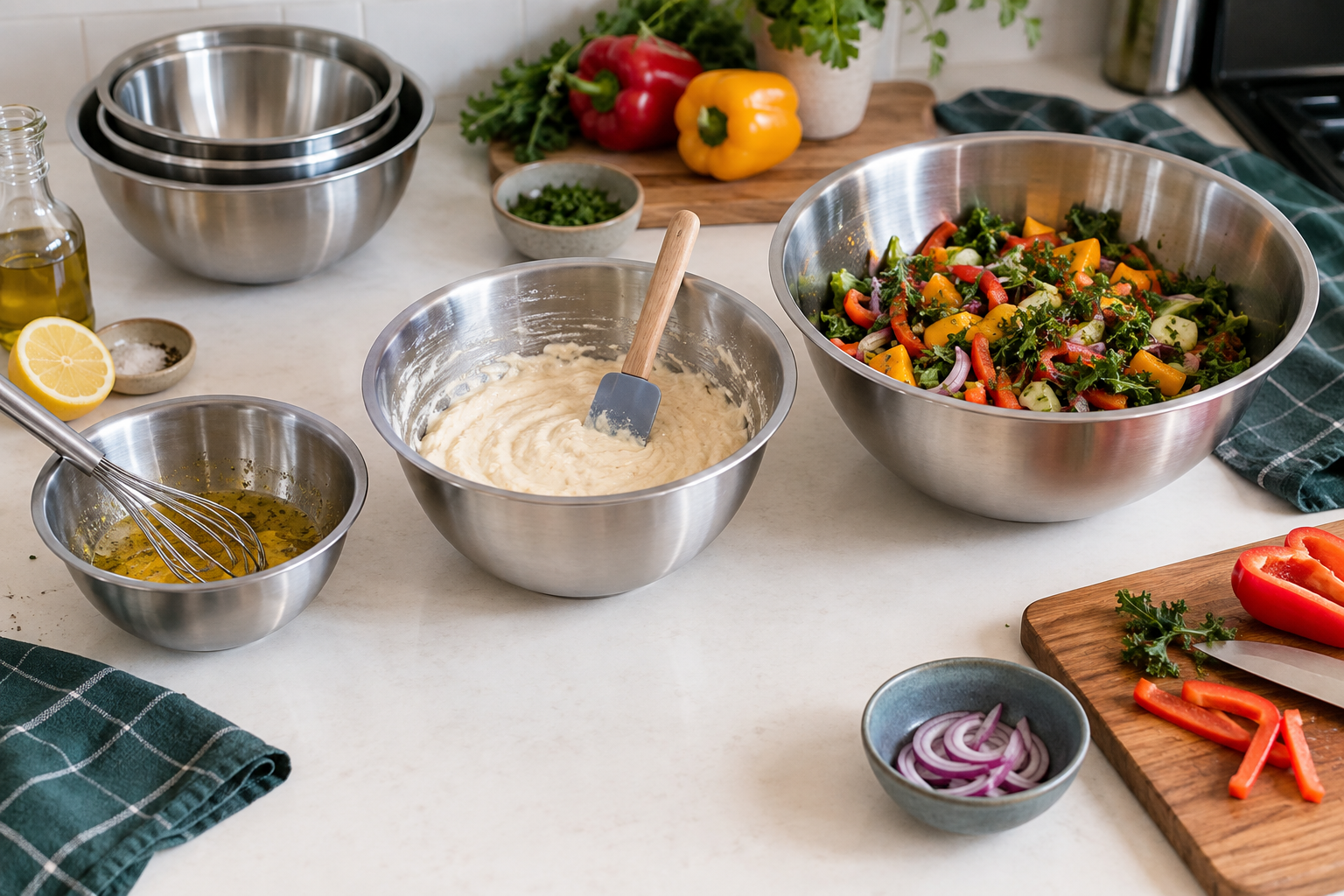
These verbs are not interchangeable. Stirring combines food and moves it across a pan. Whisking breaks up small lumps or adds air. Folding combines gently to protect an airy or fragile mixture. Turning changes which side touches the heat. A recipe chooses a movement because the food needs a particular kind of contact.
Choose a utensil safe for the bowl or pan. A heat-resistant silicone spoon or spatula suits many coated pans. Use a silicone-coated whisk if the pan manufacturer permits it; metal can damage some coatings. Do not leave a plastic tool against a hot pan unless it is rated for that heat.
Stir through the whole pan
- How to use hob heat without guessingLearn the controls before using these movements over heat.
- Hold the pan steady by a safe handle, using a dry oven glove if it is hot. Keep the handle away from the edge and other rings.
- Put the spoon into the mixture so it reaches the base. Move it across the bottom and around the inside edge, then draw food from the outside towards the centre.
- Use slow enough movements that liquid stays inside. A flat-edged spatula is useful for scraping a sauce from the base before it catches.
- When a recipe says stir occasionally, check frequently at first and stir whenever the bottom starts to sit undisturbed or edges cook faster. When it says stir continuously, keep moving the utensil for that stage rather than going to prepare something else.
- For browning, follow the recipe's pauses. Stirring constantly can prevent a mushroom or piece of meat staying against the hot surface long enough to colour.
Whisk a liquid smooth
- Put the bowl on a non-slip surface and choose one with plenty of space above the ingredients. For a small liquid, a fork can work; a balloon whisk has wire loops that mix a larger area.
- Keep the whisk head in the liquid and move it in brisk small side-to-side strokes or circles. Reach into the edges rather than working only in the centre.
- When adding liquid to a thick paste, begin with a small measured addition. Whisk until that portion is smooth before adding more. This is easier than chasing dry pockets in a full jug of liquid.
- Stop when the recipe's endpoint is reached. Smooth sauce, lightly beaten egg and whipped cream require different endpoints; "whisk" alone does not mean keep going until the mixture is stiff.
Fold without beating out all the air
- Use a broad spatula and a bowl large enough for both mixtures. Add the smaller mixture as the recipe directs, sometimes in portions.
- Cut the spatula down through the centre, slide it across the bottom, then lift a scoop up and over the top.
- Turn the bowl slightly and repeat. This brings mixture from underneath into the top rather than beating rapidly in circles.
- Stop when there are no obvious streaks or dry pockets, checking the bowl bottom. A few extra gentle folds are better than leaving unmixed flour underneath, but prolonged beating can lose the air you meant to keep.
Turn one piece in a pan
- Use a broad turner for a flat fragile item such as a pancake or fried egg. Use tongs for a solid piece the recipe permits you to grip.
- Let the underside set as described in its method. With a turner, ease the front edge under the food and slide far enough that most of the piece is supported.
- Lift only slightly above the pan, move your hand smoothly to roll the food onto its other side, and lower it gently. Do not throw it upwards or drop it from a height.
- If it sticks, stop pulling. Lower the heat if needed and work from an edge, or allow a little longer for the base to set if it is still wet. Avoid scraping a coated pan with metal.
Try the movements cold
- Set out a bowl holding at least 500 ml, a second small bowl, 100 ml room-temperature drinking water, 2 level tablespoons plain yoghurt and 1 teaspoon smooth jam. Have a spoon, balloon whisk or fork, broad spatula, ready-sliced bread, broad turner and a cold dry frying pan. Check milk, wheat and other ingredient allergens; choose suitable equivalents or use just the water and utensil rehearsals if those foods are unsuitable.
- Put the larger bowl on a non-slip mat or clean damp cloth on the worktop and add the water. Stir slowly around the inside edge, across the bottom and into the centre. Switch to the whisk and practise small side-to-side strokes with its head in the water. Stop when you can move through the bowl without splashing over the edge; this is a movement exercise, not an attempt to thicken water.
- In the other bowl, place the yoghurt and jam together. Use the spatula to cut down through the centre, sweep along the bottom and lift the mixture over itself. Rotate the bowl slightly and repeat gently until the streaks disappear. You are learning the path, not whipping air into yoghurt.
- Put the bread flat in the cold pan on the worktop. Slide the broad turner underneath until most of the slice is supported. Lift a little, roll it onto its other side and lower it gently. Repeat without tossing it into the air. The hob stays off throughout.
- Put away food that has stayed clean and suitable to eat; refrigerate the yoghurt promptly and keep its original after-opening limit. Empty the water, wash the tools and dry the pan. A later hot recipe will add its own heat and stopping checks to these movements.